Well-being and quality of life
The three previous articles described what the economy is embedded in, what its metabolism costs and where the planet's capacity to bear it ends. All three answer the question of the conditions under which economic activity is permitted. This article asks the other question, and the chapter closes with it: what is economic activity for in the first place?
The textbook's answer is that it has to serve people's well-being. That sentence sounds harmless and is not, because it calls for a yardstick. Until it is settled what separates well-being from a satisfied wish, nothing in an economy shows whether it is fulfilling its purpose.
The section therefore falls into two halves. The first sorts out six terms that run together in everyday speech, and shows from empirical findings why the sorting is not mere quibbling over words. The second builds a goal out of that sorting: a lower line no one should fall below, and an upper one no one may go beyond.
Without well-being, economic activity loses its justification
The textbook puts a question of purpose at the head of this section: what does the economy serve? And it gives an answer that is at the same time a condition. If it does not serve people, it loses its legitimacy (Legitimation).
Watch the direction of that sentence, because it is readily turned around. Growth does not justify economic activity, and neither does the level of production. Economic activity draws its justification from benefiting people; once that link falls away, no output figure replaces it.
It follows that a subjective quantity is expressly fit to serve as a goal here. Anyone objecting that well-being is too soft to be the target of economic policy is arguing against the founding figure of this whole section. The textbook insists on the contrary that this very question stands at the centre. That well-being is obtained from surveys it nowhere says outright, though; we infer it from the summary placing these quantities on the empirical level, and from the evidence it cites, the World Happiness Report and the Gallup data, being survey evidence.
Before the goal can be sharpened, though, terms are needed. Six everyday words stand in the way, and all six sound like the same thing.
Your turn1 of 19
An economic programme promises to raise industrial output by a fifth and already sees this as its justification. How should this be judged according to the textbook?
Needs are preconditions of existence, not wishes
A need is a precondition under which human life is possible at all. The textbook names four examples: nutrition, health, belonging and security. Because these preconditions can be established independently of the individual person, they count as objective.
Objective here does not mean measurable, it means independent of the person. Whether somebody needs food, health, belonging and security does not depend on what they happen to feel like. The question can be answered without asking them, and that is exactly what separates it from everything that follows.
Note as well how far the four examples reach. Two of them concern the body, two concern living together: belonging and security are needs just as nutrition is. Anyone who shortens the list to the bodily loses half of it.
From that independence follows the role needs play in what comes next. They mark what must be covered for a life to count as fit for a human being, and thereby become a minimum standard for justice. A minimum standard is not a wish list: it says where something is missing, not where something could be missing.
Two of these words you know from the first chapter, and there they stand wider. On page 5 the textbook counts among a household's needs food, a home, warmth and security, and alongside them sleep, personal care, education and mobility, and it appends an “etc.”; our article on economic activity and scarcity gives seven of them. Here, by contrast, stands a narrow definition with four examples. Whether the remaining items fall under it is nowhere said; the two passages are not reconciled with each other. Utility stands just as wide on page 18, namely as what somebody draws from a purchased good; in the article on market, price and competition you will meet it in that sense. Judge statements on this section by the narrow definitions that stand here.
Your turn2 of 19
A municipality surveys older people who live alone. Many say they miss nothing, although they speak to nobody for weeks. How should this be judged by the definition of needs?
Preferences evaluate, and their verdict can mislead
A preference is the evaluation somebody makes between possibilities: this rather than that. It comes out differently from person to person and is shaped by culture, and therefore counts as subjective. A preference can reflect needs, but it need not, because advertising, the pursuit of status and comparison with others all shift it.
Keep this assignment pointing the right way, because it is regularly swapped. Needs are the objective side, preferences the subjective one. Anyone who remembers it the other way round has the whole section against them, because everything that follows rests on this assignment.
An everyday example shows how both levels lie on top of each other in a single purchase. Somebody needs warm clothing for the winter and buys a jacket of a particular brand that is common among their acquaintances. The jacket has to keep them warm, which is the precondition; which jacket it turns out to be is the evaluation. The same need would have been covered by another model, and so neither the brand nor the price says anything about what the need consisted in.
From the shiftability of preferences follows the point at which this section gets sharpest. Preferences are no yardstick for sustainability. People can prefer things that damage the environment and destroy the social fabric, and that something is wanted is no proof that it can be borne. Preferences can perfectly well be collected: they can be asked about and put into figures. That does not make them objective, because objective in this chapter means independent of the person, not measurable.
One last case deserves attention, because it looks tempting. Sometimes a population's stated wishes coincide with its needs. Even then they remain two terms, because whether they coincide cannot be read off the wishes themselves. A policy that asks only about wishes never learns from it whether nutrition, health, belonging and security are in fact secured.
Your turn3 of 19
A government wants to build its policy on the population's stated wishes alone. Which statement of the textbook names what escapes it in doing so?
Utility explains decisions and does not measure welfare
Utility denotes the gain in satisfaction that the fulfilment of one single preference brings. It is short-term and tied to the moment of fulfilment. In the textbook's summary it stands at the same time as a theoretical model quantity by means of which decisions are explained, that is, as a computed quantity of a theory rather than something surveyed.
The order of the terms matters here: first comes the evaluation, then its fulfilment, then the utility. Preference and utility are therefore not one word for one thing but two links in a chain. Anyone equating them loses exactly the step that is at issue.
Only one link in this chain is observable, namely the decision. What somebody chooses can be seen; how much utility the choice brings them cannot be read off, but is assumed within the model in order to explain the choice. That is why it is called a model quantity and not a measured one, and why the summary puts it on a level of its own, the analytical one.
From this follows the limit of the term, and that limit is the reason it appears in this chapter at all. A model can predict a population's purchasing decisions accurately and still say nothing about whether those people are doing well. The accuracy concerns the level of decisions; how somebody judges their life as a whole is surveyed separately and not inferred from acts of purchase.
The term is value-neutral in the same sense. It records what individuals want and makes no statement about whether what is wanted is just or ecologically bearable. This neutrality is no defect of the theory but its division of labour; it becomes a defect only when someone takes utility for a measure of the good life.
The textbook fixes utility twice. On the first page of this section it is the short-term satisfaction from a fulfilled preference, that is, something experienced. In the summary a page later it is a theoretical model quantity that is meant to explain decisions and expressly does not describe well-being, and this chapter's exercises test both versions. They can be reconciled if the experienced thing is understood as what the model assumes: satisfaction is experienced, and a quantity that explains decisions is posited. The textbook never spells that bridge out. In economics outside this chapter, utility is usually the second quantity, a representation of preferences with no claim on experienced satisfaction.
Your turn4 of 19
A study observes that, at the same price, customers prefer organic milk to conventional milk, and assigns organic milk a higher utility in its model. What has it thereby recorded?
Well-being and life satisfaction judge a whole life
Both terms aim at the overall verdict somebody passes on their own life, not at the enjoyment of a moment. What is meant by that is the lasting quality of a human existence. Both are obtained empirically, which is why the textbook's summary puts them on the empirical level.
Subjective well-being, abbreviated SWB, covers two parts at once: the emotional life and the judgement. Anyone who admits only the first cuts the term in half, since it is precisely the second part that lifts it above the mood of a single day. In the summary it is therefore called an indicator of societal quality: it says something about the conditions the respondents live in, and not only about the respondents.
Life satisfaction is narrower and means the long-term assessment of one's own life. Because it sums up rather than reports, it does not react to every day's news, and that is exactly why the summary carries it as a measure of the success of policy and institutions.
Both differ from happiness by their span of time. Happiness stands in the summary for short-term positive emotions and therefore lies on the affective level; it is a component of well-being and not its result. A survey asking both about life as a whole and about today's mood is therefore collecting two different quantities, and a good day does not add up to a good year.
First together, then apart. On the first page the textbook sets subjective well-being and life satisfaction jointly against utility and treats them as one quantity. The summary a page later gives them two rows of their own with different descriptions and different roles. Both are meant: against utility they stand together, between themselves they differ.
Your turn5 of 19
A model predicts a population group's purchasing decisions very accurately. It is inferred from this that the model also describes how well those people are doing. Which statement of the textbook stands against this inference?
More utility and less well-being is no contradiction
Now the sentence can be said for the sake of which all this sorting was undertaken. A growing economic system can raise utility and lower well-being in the same movement. That happens when the growth widens social inequality, multiplies stress or destroys the environment.
Note what the real finding here is. The two quantities can run in different directions because they measure different levels: one the gain from single fulfilled preferences, the other the verdict on a whole life. Without the separation this case could not even be stated, and that is exactly why the textbook keeps the terms so carefully apart.
An expensive vehicle is the example on which the same thing shows up in miniature. In the first weeks it gives great pleasure, and a year later the verdict on one's own life comes out no better than before. The utility was there; the overall verdict it did not move.
Your turn6 of 19
Somebody buys an expensive vehicle that gives great pleasure in the first weeks. A year later that person judges their life as a whole no better than before. Which statement of the textbook makes this course of events understandable?
Six terms spread across five levels
The textbook gathers these distinctions in one summary, and because its assignments are themselves examined, it stands here as it stands there.
| Concept | What is described | Level | Meaning for sustainability |
|---|---|---|---|
| Bedürfnisse, needs | basic preconditions for a good life | objective | minimum standard for justice |
| Präferenzen, preferences | individual wishes and inclinations | subjective | socially formable, not always sustainable |
| Nutzen, utility | theoretical model quantity for explaining decisions | analytical | describes decision behaviour, not well-being |
| Subjektives Wohlbefinden (SWB), well-being | emotional and cognitive evaluation of life | empirical | indicator of societal quality |
| Lebenszufriedenheit, life satisfaction | long-term assessment of one's own life | empirical | measure of the success of policy and institutions |
| Glück, happiness | short-term positive emotions | affective | component of well-being |
The textbook's summary, p. 44, reproduced unchanged. The other two tables in this article are our own.
The third column carries the summary, because the summary is built by it. Five levels occur in it, in German objektiv, subjektiv, analytisch, empirisch and affektiv, and two terms share one: well-being and life satisfaction both stand on the empirical level. Anyone taking the six terms for six words for the same thing has overlooked the very column the summary was made for.
Follow two rows in particular, because they slip easily. Utility stands as an analytical quantity and not as an empirical one, although it is constantly computed in models; computed here is precisely not surveyed. And happiness stands on the affective level, although in everyday speech it often stands in for all the rest.
The fourth column answers what the sorting is for. It says of each term what it yields for sustainability: needs supply a minimum standard, preferences are unfit for that, utility describes decision behaviour, and the two empirical quantities report how things stand.
Your turn7 of 19
An institute asks people: "How satisfied are you with your life as a whole?" An economist assigns utility values in a model to explain which flats households rent. On which levels of the summary do the two quantities stand?
Kept apart the terms are usable, mixed together they are not
Why the separation is more than tidiness, the textbook says outright in one place, and that place is worth a look of its own. Each of the terms has a different ethical standing.
Needs are ethically binding: they name what must be covered for a life to count as fit for a human being. Preferences are not, since not every wish is morally or ecologically desirable. Utility abstains from evaluation entirely and records only what is wanted. Well-being and life satisfaction, finally, indicate whether societal systems really do contribute to a good life.
Only with these four roles side by side can an economics do three things at once: explain how people decide; say what they need; and establish how they are actually doing. From those three pieces of information it can then be derived how lasting well-being might be reached. Mix the terms up, and precisely this derivation falls away.
One practical consequence of that concerns policy. A government that surveys life satisfaction regularly gains a quantity it did not have before, and learns more about conditions from it than from an output figure. The question of needs is nevertheless not replaced by that survey: a satisfaction score can come out high while the minimum standard is missed, and the minimum standard does not depend on how it is judged.
Your turn8 of 19
A government surveys life satisfaction every year. In one region it turns out high, although some households have no secure food supply. Which conclusion is correct according to the textbook?
Income works on satisfaction only up to a threshold
Up to here the sorting stood on its own. Now come the findings that give it weight, and they come from a whole series of studies, among them work by Ferrer-i-Carbonell and co-authors and the World Happiness Report 2025.
The central finding is that income correlates with life satisfaction only up to a certain threshold. Below it, more income makes a noticeable difference; above it the correlation runs out, and further income barely moves satisfaction at all.
That explains a pattern which without this finding looks like a measurement error. If a country's incomes rise markedly over two decades while average life satisfaction stays almost unchanged, the result is to be expected. Anyone concluding from it that the survey was faulty has left the threshold out of account.
Two qualifications that are readily added are not made by the textbook. The finding does not hold for poor countries only, nor for populations with little education only; it is stated as a general claim about the relationship. And it does not assert that income is a matter of indifference, only that its effect runs out at a point.
A second mechanism supports the same finding from another side. How happy somebody is, they judge by comparison with others and not on their own. If all incomes rise at once, every position in the comparison stays where it was, and with it the judgement.
Your turn9 of 19
In one country incomes rise markedly over two decades while average life satisfaction stays almost unchanged. Which finding of the textbook makes this result expected?
Above the threshold what counts cannot be bought
If income stops working from a certain point, the question is what takes its place. The textbook names four findings, and together they make a coherent picture.
The first: four quantities weigh more than income, namely health, social relationships, trust and participation. They stand side by side and not in a ranking; none of them can be procured with money, and all four hang on conditions rather than on a bank account.
The second is the comparison with others already mentioned, which relativises any improvement in absolute terms if everyone attains it at once.
The third concerns work, and it is the finest of the four observations. Unemployment and insecurity push well-being down harder than a loss of income of the same size. So if two people lose the same amount of money in the same month, one through a cut and the other through losing their post, the second case weighs more. The amount alone does not say it; how the loss came about belongs to the reckoning.
The fourth concerns education, and it too runs along two paths. Education raises life satisfaction through self-efficacy, that is, through confidence in one's own action, and through the prospects of employment. The first of these paths runs past income; anyone tracing the effect of education entirely to the higher salary leaves it out.
Your turn10 of 19
Anna loses 400 euros a month through a pay cut. Ben loses his job, and after unemployment benefit he too is 400 euros a month short. What should be expected according to the findings in the textbook?
Well-being arises between people, not inside a person
The textbook makes this point twice, in two places and with different words, and both times it comes to the same thing: well-being is no private matter.
The first time it is about countries. Happiest of all, according to the World Happiness Report 2025, are those countries that stand high on three quantities at once: on social trust, on institutional quality and on environmental awareness. Scandinavia, the Netherlands and New Zealand are named.
The second time it is about society from within. Trust, cooperation and equality count as central factors of well-being. Societies with high social equality reach the highest happiness scores; where inequality or corruption is great, the scores come out markedly lower, and that holds even at a similar gross domestic product. As examples of the second group the textbook names Brazil and South Africa.
The addition about gross domestic product carries this whole section, so it is worth holding on to. Economic output precisely does not explain the differences between countries. Two countries can produce at the same level and lie far apart in life satisfaction, and what divides them is social equality, the quality of institutions and the extent of corruption. Nor is a just distribution alone enough to turn a higher gross domestic product into satisfaction: above the threshold additional income barely works anyway.
The social connection holds for the young as well. In countries with participatory education systems, that is, where young people can take part in shaping things, they report higher life satisfaction and at the same time less fear of the future. Participation works here not on learning outcomes but on well-being itself.
Your turn11 of 19
Two countries achieve a similar gross domestic product per head. In the first, inequality is low and trust in institutions high; in the second, inequality and corruption are widespread. What should be expected according to the findings in the textbook?
Young people tie happiness to meaning, not to consumption
For young people life satisfaction hangs particularly strongly on three quantities: on meaning, on security and on being socially embedded. All three answer the question of what something is for, and none answers the question of how much somebody has.
Against that background a finding from Europe that the textbook cites is to be read. According to Gallup surveys from 2023, nearly 60 percent of young adults between 18 and 29 voice worry about the future of the climate and of society. That is a majority, and it is a worry aimed at both at once.
Beside it stands a second observation, and only together do the two make sense. Awareness of sustainability is growing, and young people tie happiness more and more often to meaningfulness, to experiences in nature and to taking part in shaping things, rather than to material consumption. Worry and the search for meaning are therefore not opposed: they show that for this generation sustainability belongs to the good life and is not its price.
From this the textbook draws a conclusion that throws a bridge to the second half of this article. In the 21st century well-being can no longer be separated from sustainability. Whoever speaks of life satisfaction is speaking about the future of the foundations of life as well.
Your turn12 of 19
According to Gallup data from 2023, almost 60 percent of 18- to 29-year-olds in Europe worry about the future of the climate and of society. A commentary concludes that for this generation sustainability is a sacrifice that diminishes its happiness. What does the textbook set against this?
The doughnut stretches a base below and a ceiling above economic activity
With that the point is reached at which the terms turn into a goal. Kate Raworth found an image for it that consists of two circles and therefore bears the name doughnut.
The model brings two target quantities together. The social base (soziale Basis) is the inner ring: it stands for the basic needs of all people, and nobody should lie below it. The ecological ceiling (ökologische Decke) is the outer ring: it stands for the planet's limits of load, and nobody should go beyond it. The area between the two rings is called the safe and just space for action.
The image makes visible what two separate demands do not deliver. Anyone who sees only the lower line can reach it by bursting the upper one; anyone who sees only the upper one can keep to it by falling below the lower. Only the ring between them binds the two into a single goal.
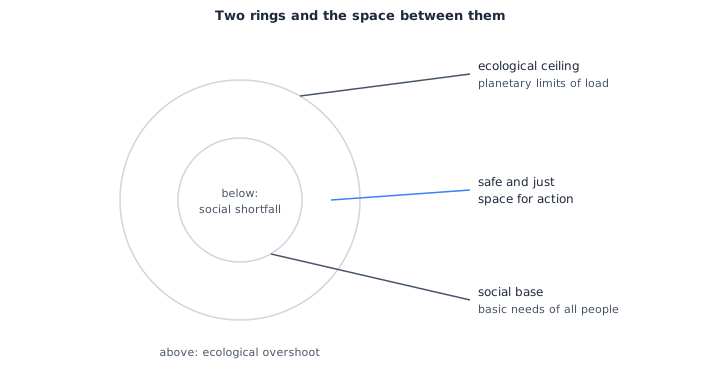
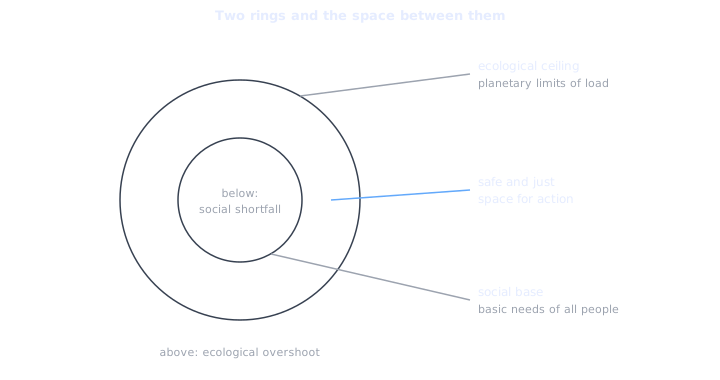
Both words in the name of this space contribute something, and neither is ornament. Safe means the ecological half: activity stays inside the limits of load. Just means the social half: basic needs are covered for everybody and not for some. Only the two together yield the goal: a good life for all, and that within the boundaries of the planet.
From this follows a rule for judging countries that looks unfair at first sight. Whoever misses one of the two lines stands outside the space, and it does not count which side. A country that crosses several limits of load while meeting all social minimum standards lies outside. A country that keeps within the limits and misses several minimum standards lies outside as well. The second position is not the better one; it is the other way of missing.
Nor does the model claim that the one line can be reached only at the cost of the other. That is exactly what it denies, by marking out a space between the rings. If the social base could be lifted only by bursting the ecological ceiling, this space would not exist and the model would have no subject.
The space for action is called something else here than in the previous article. The article on decoupling and earth-system boundaries introduces the safe space for action (sicherer Handlungsraum), the area within the nine quantified earth-system boundaries. Here a word is added: safe and just. The ecological ceiling is the same upper limit as there; what is added is the lower line. Which nine processes make up the ceiling, and which of them are already crossed, therefore stands in that article and not here.
Your turn13 of 19
A country wants to meet every social minimum standard and, to do so, raises its resource use so far that it exceeds two planetary boundaries. Where does it then stand in the doughnut model?
So far no country stands in this space
What the model demands is one thing; where the countries stand is another. The Doughnut Monitor 2025 reports on that, and its result is unambiguous: not a single country so far meets all social minimum standards while staying inside the ecological limits.
The deviation does not come out the same everywhere, though, and that is the instructive part of the finding. The rich countries go beyond the ecological limits. The poorer ones stay below the social foundation. Both groups stand outside the space, but on opposite sides, and each therefore faces a different task.
One misunderstanding is particularly close at hand here. That no country has reached the space so far does not make it unreachable. The finding describes a state of affairs and not a law of nature; the goal remains to secure a good life for everyone without leaving the planetary boundaries.
Your turn14 of 19
One country crosses several ecological limits of load while meeting all social minimum standards. A second stays inside the limits and misses several minimum standards. Which statement of the textbook decides where the two stand in the doughnut model?
A consumption corridor has two limits, not one
From the image of the two rings a short path leads to a tool that applies the same figure to consumption.
A consumption corridor is the area two lines enclose. Below lies a social minimum, namely what is necessary in order to live well. Above lies an ecological maximum, namely what the planet can bear in the long run. Consumption is meant to stay between the two.
The lower limit is often overlooked, and without it the concept would be a different one. A corridor naming only an upper limit would declare poverty the goal; a corridor naming only a lower one would be no ecological concept. Both lines belong to it, and each bounds it from its own side.
The textbook makes this clear with two examples from nutrition. Undernourishment lies below the minimum: whoever suffers it is not thrifty but underprovided. Excessive consumption of meat and energy lies above the maximum, because it lays claim to more than can be borne in the long run.
Where the two lines come from is the point at which the corridor is misunderstood most often. They come from needs and from the planet's capacity to bear, not from the behaviour of the majority. Whoever lies between the minimum and the maximum is therefore by no means consuming their society's average; about the average the corridor says nothing. And the idea is aimed at consumption in general: the example speaks of meat and energy, and the same reasoning carries for housing, mobility and everything else.
Your turn15 of 19
A study describes two groups: one is undernourished, the other consumes a great deal of meat and energy. Which statement of the textbook places both groups at once?
The production corridor asks about form and not only about quantity
A production corridor lays down two things: which goods and services should come into being at all, and in what form they should come into being. The yardstick for that is whether needs are covered without the ecological limits being crossed.
The addition about form is no aside but the core of this second corridor. A manufacturer weighing whether to build the same number of devices out of less material, or to build fewer devices that last longer and are used in common, is asking exactly the question this corridor asks. Both routes change the form of production, not merely its level.
Do not confuse the two corridors in their subject, then. An upper limit on how much a single household may consume belongs to the consumption corridor. The production corridor says nothing about single households; it says what should be manufactured and how.
| Question | Consumption corridor | Production corridor |
|---|---|---|
| What does it bear on? | on consumption | on what gets manufactured |
| What does it lay down? | an area between a minimum and a maximum | which goods should come into being, and in what form |
| Where do its limits come from? | from needs and from the capacity to bear | from the same two sources |
| What is it measured against? | needs covered, limits kept | needs covered, limits kept |
The last row is the same in both columns, and that is no oversight. The two corridors bear on two different places and are measured against one single yardstick: whether needs are covered without the ecological limits being crossed in the process.
Your turn16 of 19
Which of the following measures works through the production corridor rather than the consumption corridor?
Sufficiency means enough, not little
Sufficiency denotes a level of consumption that is enough and not too much. It is directed against the excess, not against the covering of needs. According to the studies the textbook relies on, it produces a more stable well-being in the long run than excessive consumption does.
With that the empirical finding from the beginning of this article returns, now in another place. Whoever already consumes a lot gains less and less from consuming further: the increments of satisfaction diminish. A corridor with an upper limit therefore takes away nothing that reliably makes people happy.
Exactly here lies the link between the corridors and subjective well-being, and the textbook makes it outright. The two corridors are therefore not an austerity programme prescribed out of ecological necessity, but an answer to an empirical finding about satisfaction itself.
Two mix-ups are worth warding off. Sufficiency is not the renunciation of covering needs: the corridor's lower limit stands and belongs to the same thought. And sufficiency is just as little maximisation: between the too little and the too much lies an area, and it is that area that is meant.
Your turn17 of 19
A manufacturer is weighing whether to build fewer devices that last longer and are used in common. In a discussion it is said that sufficiency means renouncing the covering of needs. Which statement of the textbook refutes this claim?
Environmental quality is at the same time a question of quality of life
The close of the chapter gathers what a society has to bring along for well-being to arise at all. The first block concerns the environment, and it is remarkable because the effect is measured here rather than merely supposed.
| What raises life satisfaction | What lowers it |
|---|---|
| clean air | noise |
| green spaces | air pollution |
| intact ecosystems | sealed ground |
A city that lays out parks, unseals ground and improves the air is therefore working on all three positions of the left column and on two of the right at once. That an accompanying study afterwards finds higher life satisfaction is the expected outcome and not the surprising one.
To this is added a finding about closeness to nature that reaches beyond mood. Connectedness with nature strengthens mental health and resilience, that is, the capacity to withstand strain. What is at issue here is consequently not only how somebody feels but also what they can take.
A second block concerns health and comes from a study by Prettner and co-authors from 2023, which uses an indicator of its own for it, the Healthy Lifetime Income. Their result: where life expectancy is higher and health care is better, a country reaches a level of well-being that lies markedly above, and it does so even where its material prosperity is only moderate. The direction is thus the expected one, and the addition about prosperity is the core of it: health replaces part of what is otherwise credited to income.
From this follows the sentence in which the textbook draws the two blocks together. Where health, environmental quality and social stability are strengthened, economic activity raises happiness over the long run more than it does by raising incomes alone. Environmental policy is thereby not only policy for the environment but policy for a good life.
Your turn18 of 19
A city removes the sealing from a car park, lays out a park there and diverts through traffic, so that noise and exhaust fumes decline. What should be expected according to the empirical findings in the textbook?
Economic stability is a means, and the goal has three dimensions
Before the chapter closes, the textbook settles a placing that it has prepared in several spots. Neither economic stability nor ecological sustainability is an end in itself. Both are means, and their purpose is people's freedom to lead a good life.
From this placing follows the closing figure of the chapter. A sustainable economy has to serve three dimensions at once, and none of them stands in for another.
The social dimension calls for covering everyone's needs and reducing inequalities. The ecological one calls for staying within the planetary boundaries. The third is the psychological one, and it is the one guessed wrong most often: it calls for making subjective well-being and meaning possible. A technological dimension is not on this list; technology figures in this chapter as a means and not as a goal of its own.
Test yourself on this threefold division by checking that you keep the first two dimensions apart. Reducing inequality belongs to the social dimension and not to the ecological one; bringing resource consumption down below the planetary boundaries belongs to the ecological one and not to the social one. Swapped over, both sentences sound plausible, and both are then wrong.
The chapter's last sentence gathers everything into one condition with three parts. Well-being arises where needs are met, where ecological stability is preserved and where social relationships are tended. All three count at once; if one of them drops out, the economy no longer contributes to a good life, however high its output may turn out to be.
Your turn19 of 19
A programme for a sustainable economy names three goals: reducing inequality, lowering resource use below the planetary boundaries and promoting technological innovation. What needs correcting here according to the textbook?
Was this article helpful?