Companies, Value Added and Sectors (Unternehmen, Wertschöpfung und Sektoren)
The circular flow listed companies as one of the participants: goods came from there, payments flowed towards them. What happens inside that box was left open.
This article opens the third chapter, and it opens the box. First comes the question of how one tells at all that an activity is a company. Then comes the contribution a company makes to a country's economic output. Last come three ways of sorting companies apart: by sector, by industry and by size.
A company operates under constraints similar to a household's
The chapter opens with a comparison, and at first it turns out surprisingly: in its basic features, less separates a company from a private household than you would expect.
Means are scarce on both sides. Neither a household nor a company has money in unlimited amounts, and means of production are no more unlimited for a company either. Managing your affairs therefore means the same thing on both sides: weighing up how scarce means are used and planning in advance what is needed and whether it can be paid for.
The financial goals coincide largely as well. A company wants to be able to pay at any time, wants something put aside for emergencies, wants to invest spare money and wants to finance itself as cheaply as possible. The same four sentences hold for a household. And operating sustainably serves both in the same way: whoever uses up their own foundations shortens their own survival.
Similar, however, is not the same, and the difference is not merely one of scale. Alongside everything a company shares with a household, its economic activity also has peculiarities of its own, and in most cases it is far more entangled besides. Anyone facing an exam statement that denies a company any distinctive features of its own has thereby already refuted it. A discipline of its own deals with that entanglement: business economics (Betriebswirtschaftslehre) asks about the tasks of a company, about the way it works and about the conditions of its success.
Your turn1 of 19
In a discussion someone says: 'A company is basically a large household. It operates with scarce means and pursues the same financial goals, so there is no need for a discipline of its own to study it.' What should be made of this?
A company creates what it creates for others
A company is an economically independent organisational unit. What arises in it does not arise for its own needs, but as a product or a service for others: for private households, for other companies or for the state.
Two words of this definition carry it. Independent means that the company acts on its own account and at its own risk; someone in employment does not bear that risk and therefore runs no company, however much they produce. For others means that the output leaves the company. Whoever covers only their own needs falls outside the term.
From that follows the task set for a company, and it is a double one. It has to find out what the state, other companies and households need, and it may also awaken a need that nobody had registered before. Both count: the WU text puts recognising and awakening side by side.
What gets bought, however, is only what is worth something to the customers. If they see neither value nor use in an offer, no interest in buying arises, and the output sits there. Producing the use first and then making it recognisable is therefore no side task of selling, but the reason a company sells anything at all.
Your turn2 of 19
Which of these four people runs a company in the sense of business economics?
Your turn3 of 19
A beekeeper keeps 40 bee colonies. Until now her family has used up the honey; from this year she sells it on her own account to organic shops and to a hotel. How is this to be judged in terms of business economics?
Four kinds of means go into every output
What a company builds its output from, the WU text lists in four items. The fourth is the one most often forgotten in the retelling.
- Betriebsmittel (operating resources): machines and business equipment, that is, everything that stays in use over a longer period and does not itself end up in the product.
- Werkstoffe (materials): the substances that do end up in the product, raw materials above all.
- Arbeitskräfte (labour): the work performed by the staff.
- Know-how und Information (know-how and information): the knowledge the work follows.
A brewery that installs a second fermentation tank, buys malt and hops, takes on two brewers and has a recipe for alcohol-free beer worked out for it from outside procures all four items in turn. The tank stays in use for years and is an operating resource. The malt and hops end up in the beer and are materials. The two brewers contribute their work. The recipe is knowledge and nothing else, and precisely for that reason the fourth item is easy to overlook: it comes with no invoice listing a piece of equipment.
From the third item follows an effect on the outside world that needs no further condition. Whoever employs staff creates jobs by doing so. A second effect, by contrast, depends on how strong the pressure from outside is. Above all in competition with others a company keeps developing its offer and brings out new things, and that is how innovations arise. New things without competition are not ruled out by this; under competitive pressure they are merely likelier. Do not confuse the two effects: jobs arise with employment, innovations above all under pressure.
Your turn4 of 19
A bakery buys a new deck oven, purchases flour and butter, takes on a pastry chef and has a consultant work out a hygiene concept for it. How is the hygiene concept to be classified?
Stakeholders expect something of a company, and it expects something of them
Stakeholders are the groups of people and the bodies a company acts upon and by which it is itself affected. Each of them directs expectations at the company, and the company for its part directs expectations at them.
Five of them are listed in the WU text, and for each it says what that group is after.
| Stakeholder | What they are after |
|---|---|
| Employees (Mitarbeiter:innen) | a job that is secure, that is interesting and that pays well |
| Suppliers (Lieferant:innen) | a durable business relationship and payment on time, in full |
| Customers (Kund:innen) | products and services that are worth having, and at a favourable price |
| Owners, shareholders, lenders (Geldgeber:innen) | a good development of the company; with the money they put in they pursue goals of their own |
| Municipality and province (Gemeinde und Land) | jobs and levies, and beyond that reliability, care towards the environment and social responsibility |
Two points about this list are readily overlooked.
The first concerns direction. The relation runs both ways: a company acts on its environment and is just as much affected by it. It expects reliable deliveries of its own, staff who know their trade, and conditions it can plan against. Whoever sees only one direction holds half the figure.
The second concerns the last row, which reaches beyond money. The municipality and the province expect not merely employment and levies, but also that the company meets its obligations, treats the environment with care and takes up its responsibility towards society.
A bank belongs in the fourth row here. Whoever grants a credit does not do it out of goodwill: with the money put in, goals of its own are pursued, and so the bank too stands opposite the company as a stakeholder.
Your turn5 of 19
A managing director declares: 'Stakeholders are people who want something from us. We ourselves expect nothing from them, we merely deliver.' Which statement of the WU material refutes him?
Your turn6 of 19
A company takes out a loan of 200,000 euro from its house bank. An employee thinks the bank is merely a service provider helping the company and does not count among the stakeholders. How is the bank to be classified?
The law recognises a company by three features
The state sets the legal frame for the economy, and for that it has to be settled whom this frame applies to. That is why the very first paragraph of the Austrian Commercial Code (Unternehmensgesetzbuch, UGB) says who an entrepreneur is and what a company is.
§1(1) UGB: 'Unternehmer ist, wer ein Unternehmen betreibt.' An entrepreneur is whoever runs a company.
§1(2) UGB: 'Ein Unternehmen ist jede auf Dauer angelegte Organisation selbständiger wirtschaftlicher Tätigkeit, mag sie auch nicht auf Gewinn gerichtet sein.' A company is any organisation of independent economic activity set up to last, even if it is not directed at profit.
Statutory text, quoted in the WU material on p. 49. The wording is the legislator's and therefore stands here verbatim; everything else in this article is our own presentation.
The first sentence points back: whether someone is an entrepreneur depends solely on whether what they run is a company. Legal form, size and profit intention play no part in it. The second sentence supplies the three features by which that can be tested.
Set up to last. The activity does not happen just once. A tailoring shop that has been taking in clothes for years meets this. Someone selling off their own household goods at a flea market one afternoon does not.
Independent economic activity. Products or services are created for third parties, independently and at one's own risk. This is the same feature that already carried the business-economics definition above.
Profit intention is not required. The closing clause of the paragraph quoted above says exactly this: without being aimed at profit, an organisation still remains a company. A charitable association that permanently runs a soup kitchen at cost price is therefore very much a company in the sense of the UGB.
Most exam statements hang on the third feature, and it is almost always turned the wrong way round. A missing profit intention does not exclude the term; it is expressly allowed. And a company that writes losses year after year loses nothing legally by it: it stays a company as long as the three features hold.
Two Austrian companies are named as examples in the WU text, and both meet all three features: woom GmbH, which builds bicycles, and Josef Manner & Comp. AG with its wafers and other confectionery. They do not produce for a couple of days only, they bear entrepreneurial risk, and they produce for third parties. Both do want to make a profit, but that is no condition of the term, only an addition.
Your turn7 of 19
An association has been running a soup kitchen at cost price for four years. A board member says it is not a company in the sense of the UGB, since it does not want to earn anything. Which statement from the WU material refutes this?
Business economics adds a condition the law does not impose
Business economics also regards the law's three features as characteristic. That a company renders its services to third parties it takes over expressly. To the third feature, however, it attaches something.
Legally a company need not strive for profit. In business terms it loses its basis of existence as soon as it stops at least covering its costs and staying able to pay. Both sentences hold at once, because they answer different questions: one says what a company is, the other how long it can remain one.
Keep the two conditions of the second sentence apart, because they do not coincide. Able to pay means that the invoices falling due can be settled. Covering costs means that the income carries the costs. In the short run each occurs without the other, and in both directions: a company can pay out of reserves without covering its costs, and it can cover its costs and still run into a cash gap because customers transfer late. In the long run it needs both.
Your turn8 of 19
A non-profit association has run a social department store for years. For three years it has not covered its costs and pays its bills out of an inheritance it received earlier. What is correct?
Profit means more income than expense
A profit is made by whoever's receipts over the period under review come out larger than their outgoings. In bookkeeping the two sides are called Erträge (income) and Aufwände (expenses), and profit is then the excess of income over expenses.
Why a company needs profits is answered in the WU text through what happens to them. If they stay in the company instead of being withdrawn, they can be invested again: in machines, in plant, in the company's own offer. A company that does this stays capable over the long run and keeps up in competition. That is exactly their use for the company, and it is why profit is not a matter for the owners alone.
A second reason works in bad years. Whoever leaves profits in the company thereby enlarges its equity (Eigenkapital), that is, the part of the assets that belongs to the company itself and is owed back to nobody. Loss-making years consume this equity, and whoever has built up a lot of it comes through a whole run of loss-making years before the debts grow out beyond the assets and over-indebtedness sets in. Two things follow, and exam statements twist both: a single year without profit does not remotely make a company over-indebted, and plenty of equity protects against over-indebtedness rather than inviting it.
Your turn9 of 19
An installation business has retained profits for years and built up equity of 600,000 euro. In the current year, income of 1,150,000 euro faces expenses of 1,230,000 euro. What follows?
Surpluses help even where nobody pays out a profit
Some organisations are from the outset aimed not at profit but at covering their costs. They are called non-profit organisations (NPO), and in law they are, as just shown, companies all the same.
An NPO nevertheless cannot do without income. The more of it there is, the better it pursues its goals and the better it tells its target group what it offers at all. Donations are named in the WU text as an example of such income, and revenue from sales is no more forbidden to an NPO: a social workshop that makes and sells furniture does nothing by that which would contradict its purpose.
Reinvesting works for it as for any other company as well. What stays in the house improves and extends the organisation's own offer. The difference from a profit-oriented company therefore lies not in whether surpluses may arise, but in where they flow: they are not distributed but fed back into the tasks of the organisation.
Your turn10 of 19
An animal welfare association covers its costs from donations and from a small shop selling accessories it sews itself. Last year, for the first time, money was left over, and the treasurer fears the association is therefore no longer a non-profit organisation. Which statement from the WU material removes her worry?
Value added is an increment, not a revenue
At this point the article changes the question. So far it was about what a company is; now it is about what it contributes.
In producing something and in rendering a service, something arises that is worth more than what went into it. That increment is what is meant, and it has a name of its own.
The value added by a company is the value of its finished output, reduced by the value of the Vorleistungen (intermediate inputs), that is, by everything it bought in from others for that output. It quantifies the value the company adds itself.
The WU text works it out on a child's bicycle. Finished, the bicycle is worth 500 euro. The components the company does not make itself but obtains from others are worth around 100 euro together. So it adds 400 euro, and those 400 euro are its value added on that bicycle.
Three confusions suggest themselves here, and the exam tasks pick up all three.
Value added is not the profit. Out of those 400 euro, rent, energy, levies, wages and all the further costs of the company still have to be paid. The remainder is the profit, and it comes out considerably smaller.
Value added is not the revenue. The 500 euro quantify the value of the finished output, not the contribution of the company. Whoever leaves the intermediate inputs standing credits somebody else's work to their own account.
A company's own wages are not an intermediate input. What was bought in from other companies counts as an intermediate input, goods and services alike. The work of a company's own staff is precisely what creates the increment in the first place.
Services are not exempt from this, even though nothing tangible arises. A tax consultancy that renders 240,000 euro of services in a year and buys in software, professional literature and outside services for 40,000 euro arrives at 200,000 euro of value added. The arithmetic is exactly the same as with the bicycle.
Your turn11 of 19
A furniture joinery sells 800,000 euro of furniture in a year and buys in wood, fittings and outside services for 300,000 euro. Its employees receive 250,000 euro in wages altogether. An intern calculates 800,000 minus 300,000 minus 250,000 and arrives at 250,000 euro of value added. Which statement from the WU material shows his mistake?
Gross domestic product sums value added, not turnover
Why this difference is taken at all only becomes visible at the level of a whole country. Value added represents the production side of gross domestic product (Bruttoinlandsprodukt, BIP). The basis of the calculation is the total value of all goods produced within a country's borders, and from it the value of the intermediate inputs is subtracted. What BIP is beyond that, how it differs from BNP and where it fails as a measure of prosperity stands in the article on the circular flow; here only one thing counts, namely how a single company's contribution gets into it.
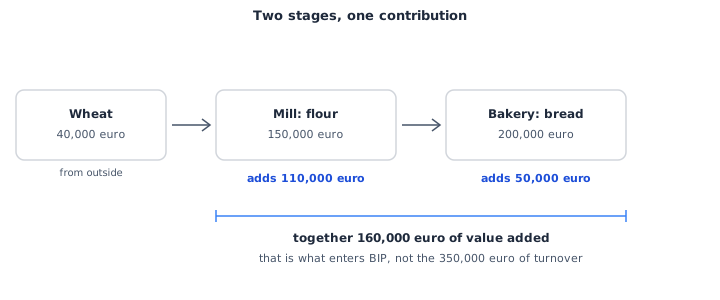
Why subtracting is necessary is best seen on a chain of two companies. A mill buys wheat for 40,000 euro and sells flour made from it for 150,000 euro. A bakery buys this flour and sells bread made from it for 200,000 euro.
| Company | Sales value | Intermediate inputs | Value added |
|---|---|---|---|
| Mill | 150,000 euro | 40,000 euro | 110,000 euro |
| Bakery | 200,000 euro | 150,000 euro | 50,000 euro |
| together | 160,000 euro |
Add the two sales values instead and you arrive at 350,000 euro. The flour sits in that figure twice, once as the mill's ware and a second time inside the price of the bread, and the wheat that was bought in sits in it as well, although neither of the two companies grew it.
The 160,000 euro, by contrast, are at the same time the value of the bread reduced by the wheat: reduced, that is, by what came into the chain from outside the two companies. That both routes lead to the same result is no accident. Every intermediate stage is counted once at its own stage and subtracted once at the next.
One conclusion is readily drawn wrongly here. The higher selling price says nothing about the contribution. The bakery turns over more than the mill here and still adds less, because a larger part of its price had already been bought in.
Your turn12 of 19
A mill buys wheat for 40,000 euro and sells flour for 150,000 euro. A bakery buys this flour and sells bread for 200,000 euro. A newspaper adds the two turnovers and reports a contribution of 350,000 euro to BIP. Which statement from the WU material refutes the newspaper?
Three sectors divide the economy by what a company does
What a company deals in, its Unternehmensgegenstand (business object), settles which Wirtschaftssektor (economic sector) it is active in. What is meant is a division by kind of activity, not by ownership: an economic sector is not the same thing as the public sector. In essence three economic sectors are distinguished.
| Sector | What happens there | Who belongs there |
|---|---|---|
| Primary sector | raw materials are extracted | mining, fishing, and agriculture and forestry |
| Secondary sector | products are made from raw materials | industry and crafts, plus the energy sector |
| Tertiary sector | services of every kind | trade and tourism, banks and insurance, legal and tax advice, education, care and support, coaching and training |
Follow a substance along the chain and the three sort themselves out. Getting ore out of the ground is extraction and therefore primary. Making metal out of that ore is production and therefore secondary, and the same holds for the filling made from cocoa and hazelnuts for a wafer. Selling on the finished metal or the finished wafer is a service and therefore tertiary.
The assignment goes wrong most often at trade. A bicycle dealer makes no bicycle; he brings it to the customers, and that is a service. The company that assembles those same bicycles sits in the secondary sector instead. Every ware is sold in the end, and so selling says nothing whatever about the sector; what counts is what the company does itself.
A company can moreover stand in several sectors at once. A farm that grows fruit, presses it into juice and lets guest rooms to holidaymakers is active in all three, because its business object covers all three activities.
Your turn13 of 19
One company assembles bicycles from bought-in parts, a second sells those same bicycles in its shop. A colleague puts both in the tertiary sector, since both sell their bicycles. Which statement from the WU material refutes her?
Your turn14 of 19
A fruit farm grows apples, presses them into juice and lets guest rooms to holidaymakers in summer. A consultant assigns the farm to the primary sector alone, because it practises agriculture. Which statement of the Skriptum refutes him?
In Austria around 70% of economic output falls to the tertiary sector
How a country's economic output spreads across the three sectors depends on its level of development. As a rule the tertiary sector's share grows with economic development, because more and more services are then demanded.
Austria stands correspondingly high. Around 70% of total economic output falls there to the tertiary sector, which makes it the largest part. Only a little over 1% falls to the primary sector.
This one percentage regularly leads to a false conclusion, which the WU text heads off separately. What this share measures is the contribution to economic output, and that alone. For supplying food and for maintaining and tending nature the primary sector plays an essential role, and that role stays the same however small its share of economic output turns out to be.
Your turn15 of 19
A commentator reads in the statistics that merely a little over 1% of Austria's economic output falls to the primary sector, and concludes that agriculture and forestry can safely be neglected. What should be made of this?
An industry is cut finer than a sector
An industry gathers companies that make very similar products or render very similar services. Which industry a company is assigned to is settled by its field of activity. The word Wirtschaftszweig means the same thing and is used alongside it.
Keep sector and industry apart. The sector is the coarse three-way split into extraction, production and services. The industry lies below it and cuts finer. Named as examples in the WU text are construction with the erection of buildings, the crafts with joineries, plumbers, electricians and locksmiths, trade both wholesale and retail, plus tourism and hospitality, transport and logistics, telecommunications, media, and the pharmaceutical and health industry.
As with the sector, a company can belong to several industries as well, once its field of activity covers several.
What the classification is good for shows in the interest associations. Companies of the same industry face similar challenges and therefore pursue similar interests, and those associations are structured along exactly that line. The commonality is founded on the activity and not on the neighbourhood. A bakery in Vorarlberg and a bakery in Vienna share their industry across half the country; a bakery and the pharmacy next door share nothing but the address.
Your turn16 of 19
In a Viennese commercial building a bakery and a pharmacy lie door to door. Another bakery is located in Bregenz. Which statement about industry and sector is correct?
The size class settles obligations and eligibility for support
Sorting companies by size is no exercise in statistics. Tax provisions, accounting obligations and the possibility of receiving public support are all tied to size. Whether a company counts as small or as large therefore has immediate consequences for it.
KMU covers three categories: Kleinstunternehmen (micro enterprises), small enterprises and medium-sized enterprises. In English they are called SME, and MSME once the micro enterprises are counted in. The thresholds were set by a recommendation of the European Union, and that is why the same limits apply everywhere in the single market. In the EU around 99% of all companies belong to this category.
Micro enterprises are meant to be included. Whoever reads KMU as small and medium-sized enterprises and counts the smallest separately has thrown the largest of the three groups out of the category.
| Category | Employees | Turnover per year, EUR million | or balance sheet total, EUR million |
|---|---|---|---|
| Micro enterprises | up to 9 | up to 2 | up to 2 |
| Small enterprises | up to 49 | up to 10 | up to 10 |
| Medium enterprises | up to 249 | up to 50 | up to 43 |
| Large enterprises | from 250 | over 50 | over 43 |
Values after the table in the WU material, p. 52. An 'or' stands there between the two monetary figures.
Read the table in the right order and the usual traps fall away. The number of employees first: it separates most sharply and in the exam tasks decides almost always on its own. A company with 80 employees lies above 49 and below 250 and is therefore a medium enterprise, however small its turnover may turn out to be.
Three further traps are worth naming one by one.
At 250 employees, and on no account earlier, the large enterprises begin. Whoever supposes the threshold at 100 or 150 shifts three categories at once.
A balance sheet total below 43 million euro does not yet make a company small, since medium enterprises stay below that limit as well. Small means: at most 49 employees, and at most 10 million euro besides.
And large enterprises do not count among the KMU. The category ends with the medium ones, and here too the headcount decides: whoever employs 250 people or more is no longer one. A high turnover on its own is not enough for that, and that is exactly what the 'or' in the table header is doing. The EU recommendation the thresholds rest on requires the headcount limit and, on top of it, only one of the two monetary limits; a company with 100 employees, 60 million euro of turnover and a 20 million euro balance sheet total therefore stays a KMU. This linkage is not spelled out in the WU material, where the single word in the header carries it alone.
Your turn17 of 19
A company employs 200 people, turns over 8 million euro a year and shows a balance sheet total of 9 million euro. The managing director thinks it is a small enterprise, since both monetary figures are low. Which statement from the WU material refutes him?
Your turn18 of 19
A company employs 180 people, turns over 70 million euro a year and shows a balance sheet total of 30 million euro. An analyst counts it among the large enterprises because its turnover lies above 50 million euro. Which statement of the Skriptum refutes her?
Around 99% of Austrian companies are KMU
How the sizes are actually distributed is given for Austria in a series of figures. They come from the WKO and from Statistik Austria.
- Around 99% of all companies in the country belong to the KMU category, just as in the EU as a whole.
- The largest part of them are micro enterprises with fewer than ten employees: around 90% of all companies.
- Below an annual turnover of one million euro lie roughly 85% of companies.
- Around two thirds of all people in employment work in KMU.
- Of the revenues of Austria's commercial economy, just under two thirds come from KMU.
- Of those same revenues, a good third falls to the around 1,900 large enterprises.
Among the country's largest companies by turnover are OMV, Red Bull, voestalpine, ÖBB and Porsche Holding.
Together these figures refute a widespread notion: that a handful of corporations carry the country economically. The around 1,900 large enterprises are the visible ones, and a good third of the revenues does indeed come from them. The country's employers are nevertheless the others: two out of three people in employment work in a KMU, and almost nine out of ten companies do not even have ten employees.
Your turn19 of 19
A talk show claims that without the big corporations Austria would grind to an economic halt. Which statement from the WU material sets something against that?
Was this article helpful?