Market, Price Formation and Competition (Markt, Preisbildung, Wettbewerb)
In the circular flow goods run one way and payments the other. What stays open is how much gets paid and what quantity changes hands at all. Both are settled where buyers and sellers meet, and this article is about that meeting point.
A market is a mechanism, not a place
The first thing the word Markt suggests is a square with stalls. What is meant, though, includes shops, exchanges and purely virtual places such as electronic trading platforms. What they have in common is not the location but what happens there.
A market is a mechanism through which buyers enter into a relation with sellers in order to determine the price and the quantity of a good. A physical place is no part of the definition.
Which market is meant depends on the good: the consumer goods market, the labour market, the property market, the capital market, the commodities market, the market for emission certificates. Add a geographical qualifier and a particular section is meant, such as the Austrian labour market, the European capital market or the world market for crude oil.
The essential task of a market is price formation. The price expresses in money units how much has to be paid for a good, and at the same time it indicates the scarcity of that good and the extent of that scarcity. A high price reports that there is little of something many people want.
Your turn1 of 13
On an electronic trading platform second-hand textbooks change hands for money without anyone meeting in person. What makes it a market?
Supply and demand are aggregate quantities
Neither term means what a single firm sells or a single person buys, but the sum across all participants.
The Angebot of a good is the entire quantity of that good offered for sale. The Nachfrage is the entire quantity that participants in the economy want to buy and are able to buy.
Two conditions stand side by side in the definition of demand, and the exam grabs precisely there. Someone who would like a car but cannot afford it is not part of demand. Demand is the wish to buy and the purchasing power together, not the wish on its own.
Your turn2 of 13
In one town 300 people would each like to buy a flat. 200 of them can also pay the price, 100 cannot. How large is the demand for flats in this town in the sense of the WU text?
Why supply rises with the price
The higher the achievable price, the higher the quantity supplied usually is. Two considerations lie behind that, and you know the first one already.
Whoever does not sell forgoes the price they could have obtained. Those are exactly opportunity costs, and they grow with the price: the more there is to be had on the market, the more expensive it becomes to leave the goods in the warehouse. That is why more suppliers are willing to sell at a high price.
The second consideration concerns production. Making more costs money, because additional quantities need additional plant and additional staff.
Marginal cost is the cost of producing one additional unit of a good. For many firms it rises as the quantity produced rises.
From that follows the rule by which a firm decides on an expansion: the achievable price has to be at least as high as marginal cost. If it lies below, every additional unit costs more than it brings in, and expanding production would mean making a loss. As the price rises, expansion becomes worthwhile for more and more suppliers.
Your turn3 of 13
A carpenter makes tables at an average of 200 euros each. One more table would cost him 300 euros because of overtime, and he can sell it for 250 euros. He thinks the table pays because 250 euros lies above his average of 200 euros. Which statement from the textbook refutes him?
Your turn4 of 13
The market price of flower pots rises from 3.50 to 5 euros. A nursery for which one more pot costs 4 euros now makes one more pot; one for which it costs 6 euros does not. What does the example show about supply in the market as a whole?
Why demand falls with the price
In the other direction the reasoning is shorter. The higher the price, the fewer people can afford it. Whoever cannot or will not pay it tries to get a similar good more cheaply or does without altogether. The quantity demanded falls accordingly, and conversely it rises when the price falls.
Whether someone is willing to pay a given price further depends on the Nutzen the good gives them, meaning the degree to which it satisfies a need. If the expected benefit is high and no comparable good is available more cheaply, the price is more likely to be paid.
Your turn5 of 13
The price of cinema tickets rises markedly, and part of the audience can no longer pay it. What do these people do?
Ceteris paribus: a curve shows one relation only
Both statements hold under a condition that is easy to read past. It is called ceteris paribus, meaning all else being equal: every other influence is held fixed, and only the price is allowed to move.
The condition is no formality. A supply or demand curve describes how the quantity changes if the price changes and nothing else does. Should something else change, the curve no longer holds; you get a new one instead. That very distinction becomes the most important section of this article below.
Your turn6 of 13
In summer the price and the quantity sold of bicycles rise at the same time. Why does that not refute the falling demand curve?
The equilibrium price clears the market and coordinates it
Take the regional market for apples. The listing below shows how many tonnes per week suppliers want and are able to sell at each price, and how many buyers want and are able to buy.
| Price per kg | Quantity supplied | Quantity demanded | Result on the market |
|---|---|---|---|
| 1.00 euros | 10 t | 70 t | shortage |
| 2.00 euros | 30 t | 50 t | shortage |
| 2.50 euros | 40 t | 40 t | market cleared |
| 3.00 euros | 50 t | 30 t | excess supply |
| 4.00 euros | 70 t | 10 t | excess supply |
At the equilibrium price the quantity suppliers want and are able to sell matches exactly the quantity buyers want and are able to buy. Because nothing is left over at that price and nobody goes away empty-handed, it is also called the Markträumungspreis, the market-clearing price.
On the drawing that is where the two lines cross. Follow the dashed lines: they meet the axes at the quantity and the price at which both sides want the same thing.
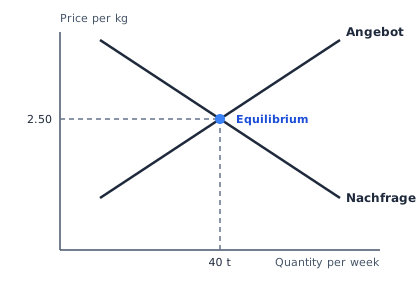
What happens at a different price? If it lies below, say at two euros, buyers want more than suppliers hand over: a shortage arises, because the good is scarce at that price. If it lies above, say at three euros, goods are left unsold: excess supply arises. In both cases the market is not cleared, and in both cases the price moves back towards the equilibrium.
That return movement is why the price is credited with a function of its own, the coordinating function. Nobody orders how much is produced and bought; the price coordinates the decisions of both sides by giving both a signal at once.
A high price stimulates supply and dampens demand, so that the price tends to fall again. A low price stimulates demand and dampens supply, so that it tends to rise again. One and the same figure tells one side "more of this" and the other "less of this", and the two reactions together lead back to the market-clearing price.
Your turn7 of 13
On the apple market from the table the price stands at three euros per kilogram. What follows?
Your turn8 of 13
At a weekly market the farmers offer 200 kilograms of strawberries at 3 euros per kilogram; at this price the customers want and are able to buy 320 kilograms. What follows from that?
Movement along the curve or shift of the curve
This is where wrong answers cluster, and the difference is nevertheless easy to test: ask what has changed.
If the price has changed, you are moving along the curve. The curve itself stays where it is, you are simply standing at a different point on it. If something else has changed, that is one of the influences held fixed by ceteris paribus, then the whole curve shifts. At every price a different quantity now holds.
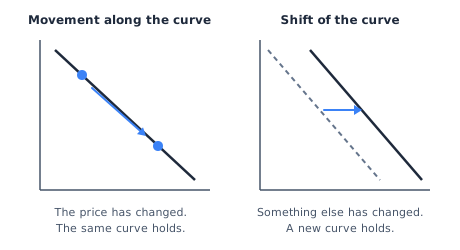
Two ways of putting the same thing. In the section on equilibrium the WU text says, in substance, that a lower price makes demand rise and supply fall at the same time. Taken literally that is the language the standard economics textbook reserves for a shift of the curve; what is meant at that point is the quantity demanded and the quantity supplied, that is, a movement along the curve. The WU text itself speaks of a shift only in connection with the other influencing factors. So decide an exam statement not by the wording but by the cause: the price changed means a movement along the curve, something else changed means a shift of the curve.
Your turn9 of 13
The price of apples rises from 2.50 euros to 3 euros per kilogram, and the growers offer 50 instead of 40 tonnes. How do you classify the extra 10 tonnes?
What shifts the curves
On the demand side there are four groups of influences.
- Income. If it rises, buyers can afford more at every price level, and the demand curve shifts to the right. If it falls, the curve shifts to the left.
- Preferences. If a trend towards a product appears, demand for it rises. During the coronavirus pandemic demand for bicycles rose so far that production could not keep up.
- Complementary goods. If a useful add-on product appears, demand for the original good can rise overall.
- Comparable goods. If a good exists that is more innovative or cheaper, buyers switch to it, and demand for the original good falls.
On the supply side there are three.
- The entry of further suppliers. If more firms judge the market profitable, the quantity supplied rises and the supply curve shifts to the right.
- Price expectations. If suppliers expect rising prices, they stay in the market and increase their supply. If they expect falling prices, they do the opposite.
- Technical progress and cheaper resources. Both lower costs and draw additional suppliers into the market.
When reading a statement about expectations, watch which side is meant. Expected price increases raise supply, because a supplier then wants to stay in the market; on the demand side expected price increases raise today's demand, because purchases that would cost more later are brought forward. What is meant is an expectation about the price that can be obtained over time. If a supplier merely expects the price to rise soon, he may hold goods back today to sell them later at the higher price; then today's supply falls.
This list is hard to keep in your head and easy to check on the market itself. The tool below runs the same apple market as the table above: the first tab changes the price only, the second lets an event happen, and the third asks you to sort the case out.
The same apple market as in the table. Move the price and read off what each side then wants.
- Quantity supplied
- 30 t
- Quantity demanded
- 50 t
- Result on the market
- Fehlmenge (shortage): 20 t
Buyers want more than suppliers hand over. Whoever misses out is willing to pay more, and that is why the price climbs back towards equilibrium.
The slider changes the price of the good itself and nothing else. Both curves stay exactly where they are and you travel along them. This is a movement along the curve, not a shift.
Your turn10 of 13
Buyers' income has risen while the price of the good has stayed the same. What happens to the demand curve?
Market forms: how many stand on which side
Which competitive situation prevails on a market depends first on the number of suppliers and on whether comparable goods exist that the good can be replaced by. The names differ according to which side is thinly occupied.
| Market form | Suppliers | Buyers |
|---|---|---|
| Monopol | one | many |
| Monopson | many | one |
| Oligopol | few | many |
| Oligopson | many | few |
| Polypol | very many | many |
A monopoly is rare in market economies but possible; in some countries there is only one supplier of rail transport. Usually the state has a hand in it, because there is a general economic interest in the service being offered at affordable prices, for instance on routes into thinly populated areas.
A monopoly-like position can also arise without anyone being the only supplier at all. During the interval of an opera performance the buffet inside the house is the only supplier of refreshments, and on a hiking route the mountain hut can be the only place to eat. Since there is no alternative there, higher prices can be obtained.
In an oligopoly the few suppliers hold considerable market power, and competition between them is nevertheless often hard, because each has to defend its market share. How hard depends on the good: on the mobile telephony market a price cut can be implemented quickly and cheaply, whereas on the market for passenger aircraft it can hardly be done, because production cannot be expanded at short notice and undercutting therefore gains little.
In a polypoly a very large number of suppliers faces a large number of buyers. Perfect competition, vollkommener Wettbewerb, is the sharpened case of it and is present when there are so many participants on both sides that in theory nobody is able to influence the price. Three further assumptions come with it: perfect transparency, meaning access by everyone at any time to all information; no restrictions on market entry; no personal preferences. On most markets those assumptions are not met. Closest to them come standardisable goods whose features are comparable across suppliers, such as agricultural products or capital markets.
Your turn11 of 13
In one region a single firm buys up the harvest of every fruit grower. What is this market form called?
Your turn12 of 13
A great many farmers deliver milk, and it is bought by only three dairies. What is this market form called?
Cartels and the permitted exceptions
Few suppliers might hit on the idea of agreeing offers and prices among themselves in order to be rid of competitive pressure. Such agreements are called a Kartell, and they are against the law. The legal position is set up in principle to enable competition rather than to restrict it, because as a rule competition benefits customers.
Two exceptions, on the other hand, are expressly permitted, and they are no loophole but serve a purpose of their own. A patent gives a firm a monopoly on its invention for a limited time and thereby creates an incentive to invent in the first place. Gebietsschutz, territorial protection, assigns certain professions a fixed area, in Austria for instance pharmacies and chimney sweeps, so that coverage stays comprehensive.
Your turn13 of 13
Thanks to a patent, a pharmaceutical company is the only seller of a medicine for a few years. A commentary calls this a prohibited cartel. Which statement of the Skriptum refutes it?
Was this article helpful?