Inflation and the Value of Money (Inflation und Geldwert)
The article on money left one question open. As a store of value, money holds savings across time, but whether the amount you set aside still buys the same quantity of goods a year later is not decided by the figure in your account.
All three functions of money depend on an amount doing roughly the same job over time. Money loses value precisely when 100 euros today cover fewer goods and services than the same 100 euros a year ago, because prices have risen in the meantime. This article shows what that loss of value is called, where it comes from, how it is measured, and why a little of it is even desirable.
Inflation is a rise in the general price level
Inflation is the process in which a great many goods and services become more expensive at the same time, so that the price level of the economy as a whole rises and the same amount of money achieves less than before. What a fixed amount still buys at the end of a year falls short of what it would have bought at the start. The quantity of goods behind an amount is called purchasing power (Kaufkraft), and that is exactly what falls.
Two parts of this definition are examined, and both concern the word "general". What is meant is many goods and services at once, not a single one: if the price of one single good rises, that is not yet inflation. Conversely, the price level can stay almost unchanged while rents and food become more expensive and electronics and air travel become cheaper, because the individual movements cancel each other out.
The second part is the period. One point in time is compared with an earlier one, usually with the year before. For there to be inflation, the price level need not have risen for several years in a row; one year is enough.
Note what actually shrinks here. The amount of money stays what it is: 100 euros remain 100 euros. What gets smaller is the quantity of goods that this amount buys, and that quantity is precisely purchasing power.
Your turn1 of 16
In one year rents and food become more expensive, electronics and air travel become cheaper, and the general price level stays almost unchanged. A colleague still speaks of inflation, because rents and food have risen. Which statement of the WU text refutes her?
Internal and external value measure different things
The internal value of a currency says what its money achieves at home: it is the purchasing power, that is, the volume of goods a given amount covers domestically. The external value says what the same currency yields against foreign money: it measures how much foreign currency one unit of your own currency buys, US dollars or Swiss francs for instance.
Inflation lowers the internal value of money. You already know the external value from the article on money, currency and interest, where it was defined strictly: as the rate against a whole basket of foreign currencies and not against a single one. Here the WU text describes it more loosely, using a single foreign currency as the example, and what is asked in both places is the same, namely what your own money yields abroad. Internal value and external value look alike and nevertheless answer two different questions.
| Question | Internal value (Binnenwert) | External value (Außenwert) |
|---|---|---|
| What it refers to | the domestic economy | the world abroad |
| What an amount buys with it | goods and services | units of a foreign currency |
| Where it can be read off | the general price level | the exchange rate |
| When it falls | when domestic prices rise across the board | when one euro buys less foreign currency |
Because two different quantities are being measured, they need not move together. If domestic prices rise while the country's own currency gains value against its main trading partners, then the internal value falls and the external value rises at the same time. For imported goods the rising external value works in the opposite direction to domestic inflation: fewer euros are due for a given amount in foreign currency, so imports become cheaper.
Your turn2 of 16
In the euro area the general price level rises by 4 percent in one year, and in the same year the rate moves from 1 euro = 1.08 to 1 euro = 1.14 US dollars. What has happened to the value of the euro?
Three explanatory approaches that condition one another
Where inflation comes from cannot be traced back to a single mechanism. The WU text names several explanatory approaches and states explicitly that they are not entirely independent of one another but can condition each other. Three are essential: an increase in the money supply in circulation, rising demand for goods, and rising costs.
The drawing sorts the three approaches by where the impulse begins. First follow the three arrows from left to right, and only then read the return arrow at the bottom.
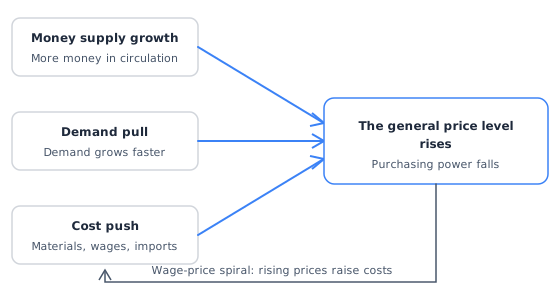
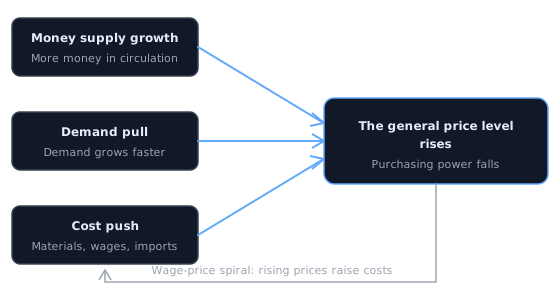
An exam task rarely names the cause; you recognise it by where the impulse begins. If households spend considerably more without firms being able to produce any faster, the impulse lies on the demand side. If purchase prices for intermediate goods rise first, it lies on the cost side.
Two conclusions follow. The approaches do not exclude one another, they occur side by side and reinforce each other. And the size of the inflation rate alone does not reveal which cause is at work: the same three percent can come from demand or from costs.
Your turn3 of 16
In a country energy and intermediate products get dearer first, and firms raise their prices. The following year households spend markedly more after a tax cut, without firms being able to produce any faster. Which statement about the inflation is true?
Money supply growth: too much money for too few goods
The first approach sets the money in circulation against what is actually offered in goods and services. If the money clearly exceeds that supply, inflation is encouraged. There are two ways the money supply can grow that far: the national central banks can obtain permission from the European Central Bank to print additional money, and the banks can expand their lending, which sharply increases deposit money (Buchgeld). For this increase in deposit money through credit there is the term deposit money creation (Buchgeldschöpfung).
A single loan shows how this works. The bank credits the loan amount to the borrower's account, and this balance is deposit money that can be used for payments straight away. The bank does not have to have taken in the same amount in cash beforehand. When the loan is later repaid, the deposit money created in this way disappears again. Growth in the money supply therefore does not presuppose that the central bank prints notes.
By itself, a growing money supply does not yet drive prices. It takes effect when the growth happens quickly and the additional money reaches households and firms rather than staying with the banks: only once it is spent on consumption and investment does it meet a supply of goods that cannot keep pace.
The same route runs in the opposite direction. If banks grant fewer loans and loans become more expensive, the money supply is usually reduced again. How a central bank sets this off is covered in the last section of this article.
Your turn4 of 16
The banks of a country grant considerably more loans than in the previous year, and the central bank prints no additional notes. A reader concludes that the money supply therefore cannot have grown. Which statement of the WU text refutes him?
Demand pull: demand draws prices upwards
If households and firms have more money at their disposal and therefore demand more goods and services, while supply does not grow to the same extent, prices rise across the board. Because it is the excess demand that draws them upwards, this case is called demand pull (Nachfragesog).
The mechanism is the same one you saw in price formation on a single market: for a given supply, a larger quantity demanded goes with a higher price. The only new thing is that here it works across the board and therefore moves the general price level.
The impulse lies on the demand side and specifically does not presuppose that production costs rose first. Costs may be affected in the end all the same: prices driven upwards by strong demand are higher costs for those firms that buy these goods themselves. This is how demand pull passes into the next explanatory approach.
Your turn5 of 16
After years of restraint, households and firms suddenly spend markedly more on travel, furniture, cars and machinery. Supply hardly grows with it, and the firms' production costs are unchanged for now. What is true?
Cost push: costs shove prices upwards
The third approach starts at the firms. If producing becomes more expensive, they have little choice but to raise their prices. More expensive raw materials, higher wage costs and dearer imports raise production costs, and raised production costs show up sooner or later as higher prices on the market.
With imports there are two triggers for this. Either what is produced in the country of origin has itself become more expensive there. Or the exchange rate shifts, so that an unchanged price in a foreign currency takes more euros. If the impulse comes in from abroad by either of these routes and works on through imported goods at home, this is called imported inflation (importierte Inflation).
The reach of it matters. If energy becomes more expensive, it is not only the prices of goods that themselves use a lot of energy that rise: everything else becomes more expensive too, as soon as transporting it costs more. An impulse in a single cost category can spread across the entire supply of goods along this route and lift the price level as a whole.
Your turn6 of 16
The price of imported natural gas rises sharply, and energy-intensive firms raise their prices in response. A commentator calls this demand pull, as in the end many things become more expensive. Which statement of the WU text refutes him?
The wage-price spiral connects both sides
The wage-price spiral describes a circle in which several causes of inflation drive one another. If prices rise, employees demand higher wages and salaries in order to keep their purchasing power. If those demands are met, the cost side of firms grows, and the firms in turn add the increase to their prices. The prices that have risen lead to the next demand, and the circle starts over.
That does not make the spiral a separate, fourth cause. It describes how two of the causes named above keep each other going, and it is the clearest case of the mutual conditioning discussed above.
It is set off by the parties themselves and not by the state fixing wages. A wage increase works on both sides at once: it raises the money households can spend, and it raises the costs firms calculate with. Anyone who looks at only one side misses the feedback that explains the spiral's name.
Your turn7 of 16
After a year with 7 percent inflation the unions win a 7 percent pay rise, and many firms then raise their prices. How is this process to be classified?
Inflation is measured with the consumer price index
The inflation rate (Inflationsrate) is the figure with which the level of inflation is stated; it is calculated on the basis of the consumer price index (Verbraucherpreisindex, VPI). For this index the prices of a fixed selection of goods and services are collected month after month and held against the previous month or the previous year. That selection, everything that goes into the survey, makes up the contents of the basket of goods (Warenkorb).
Around 800 products and services lie in this basket, selected according to what an average household needs to live on. Food belongs there, as do housing and energy, and cultural and leisure offerings are represented as well. Every 5 years this selection is adjusted to how the population actually consumes by then.
Keep the two time spans apart, because they are readily swapped. Prices are collected monthly; the contents of the basket are adjusted every 5 years. The adjustment is necessary because consumption habits change permanently: a basket left standing would soon measure past reality.
Within the basket, not every good moves the index equally. A good enters with the share it has in an average household's spending, and that is why the same percentage price change for housing moves the index far more than one for cut flowers.
Alongside the VPI, further indices are calculated, each for a different question.
| Index | What it depicts |
|---|---|
| Consumer price index (VPI) | the entire basket of an average household |
| Harmonised consumer price index (HVPI) | inflation comparably across Europe and monetary stability in the euro area |
| Index of daily needs (Mikrowarenkorb) | the inflation of a daily shop |
| Index of weekly needs (Miniwarenkorb) | the inflation of a weekly big shop |
The two small baskets exist because not all items in the large one are bought daily or weekly. Prices in the Mikrowarenkorb fluctuated on average more strongly than those from which the VPI is calculated, and for that reason alone the impression you get while shopping need not match the published rate.
On top of that, price developments for the individual items can turn out highly differently. For each individual person a great deal therefore depends on what they usually buy: a household that drives a lot and often buys fresh food is affected differently by the same published rate than a household that does neither. A personally perceived inflation that departs from the statistics is therefore not an arithmetic error.
Your turn8 of 16
A simplified basket: housing takes 25 percent of a household's spending, cut flowers 1 percent. In one year housing costs rise by 4 percent and the prices of cut flowers by 20 percent, all other prices stay the same. By how much does the index rise?
The index protects agreed amounts and wages
The VPI does not only supply the inflation rate. It also serves to protect agreed sums of money against the loss of value, above all rents and maintenance payments. A level of the index is recorded in the contract; if the index later stands above it, the payment is adjusted accordingly. Wage and salary negotiations also draw on the VPI when it comes to the size of the increase.
Why this is necessary is shown by a small calculation. If wages in an industry rise by 3 percent while prices in the same year rise by 4 percent, then the wage has risen in euros and fallen in purchasing power: the higher salary buys fewer goods than the lower one did a year earlier. A wage can therefore only be judged with the price development standing next to it.
Your turn9 of 16
An employee's salary rises by 2.5 percent from 2,400 to 2,460 euros, and inflation in the same year is 4 percent. What holds for her salary?
Your turn10 of 16
A tenancy agreement sets a rent of 800 euros and ties it to the VPI; the contract records an index level of 120. Today the index stands at 126. What is the rent after the adjustment?
A falling rate does not mean falling prices
If the inflation rate falls from 8 percent last year to 3 percent this year, prices continue to rise, only more slowly than before. Last year's price increase remains contained in the price level and is not reversed.
Prices actually fall only once the rate lies below zero. And what is measured is always the change against the comparison period, usually against the previous year, not the distance to some year far in the past. Many households' impression that everything has stayed expensive and a clearly fallen rate therefore do not contradict each other.
Your turn11 of 16
The published inflation rate falls from 8 percent last year to 3 percent this year. A neighbour concludes that prices are now falling. Which statement of the WU text refutes him?
Unexpected inflation relieves debtors and hits savers
If prices rise more strongly than expected over several years, the two sides of a money transaction are not affected equally. For a debtor on a fixed interest rate and a saver on a fixed interest rate the same development runs in opposite directions.
| Who | What the unexpected inflation does |
|---|---|
| Debtor on a fixed interest rate | She repays with money that is worth less than when the contract was concluded. |
| Saver on a fixed interest rate | Her balance loses purchasing power: the same sum buys fewer goods later. |
| Creditor before concluding | He demands compensation for this risk in advance, the Geldwertrisiko. |
The third row is the term from the previous article: the Geldwertrisiko stood there as one of the three reasons why interest is charged at all. Read from the saver's side it means this: if the agreed interest rate lies below the inflation rate, nothing of the return is left in purchasing power, even though the account statement shows a gain.
The word "real" stands in this section for "after the price increase has been taken out", the way the WU text uses it for real GDP. A separate term "Realzinssatz" is not introduced by the WU text: against the nominal rate it sets the effective rate (Effektivverzinsung), and the difference between those two is additional costs and contract conditions, not inflation. Test a statement about nominal and effective against the costs of the transaction, therefore, and read "real" as a statement about purchasing power.
Your turn12 of 16
A saver deposits 10,000 euros for one year at a fixed 2 percent p.a., there are no fees, and tax is left aside. Unexpectedly, prices rise by 5 percent that year. At the end the account statement shows 10,200 euros. What is true?
Very high inflation destroys the store of value
Under very high inflation over years, money loses its suitability for preserving value across time. Whoever holds money loses purchasing power continuously, and that is why many people spend their money immediately or exchange it into a foreign currency.
Both reactions show that the trust on which the use of money rests is fading. Switching into a foreign currency is precisely not a sign of trust in one's own money, but the opposite. And spending immediately does not dampen the price increase: it raises demand further and thus works in the same direction as demand pull.
Planning is affected as well. Anyone who does not know what an amount will still buy in six months can calculate neither spending nor investment reliably. High inflation therefore does not make planning easier, it makes it harder.
Your turn13 of 16
In a country prices have been rising by more than 50 percent a year for years. Many employees spend their pay on payday itself or change it into US dollars at once. What is true according to the section?
Price stability lies at two percent, not at zero
The European Central Bank (ECB) regards an inflation rate of 2 percent per year as the best measure for preserving price stability. If the rate comes out higher, the general price level climbs too strongly, and economic participants clearly notice the upward push. Price stability is therefore regarded as conducive to a stable development of the economy, by which low inflation is meant and not absent inflation.
Price stability therefore does not mean that no individual price changes any more. Individual prices always move, and all that is meant is that the general price level rises only slowly.
Nor is zero the goal. If the inflation rate stays clearly below 2 percent, some economic participants will presumably expect falling prices, and whoever expects that waits before making purchases and acquisitions. This restraint would have a dampening effect on the economy. The 2 percent therefore keep a distance from the range in which such an expectation arises.
Your turn14 of 16
A student asks why the ECB aims at an inflation rate of 2 percent and not 0 percent, when every rise in prices costs purchasing power. Which statement of the WU text answers her question?
Deflation: falling prices are not an advantage
Deflation is the reverse case: the general price level goes down. Because the same sum then covers more goods and services, money gains value, and purchasing power rises.
The reference to the general price level stands here for the same reason as in the definition of inflation: a decline in individual prices is not yet deflation. And the fact that money gains value sounds at first like an advantage for households.
For an economy it is none, and the reason is already in the previous section. Anyone expecting falling prices waits, because the same acquisition will cost less later. Households postpone purchases, firms postpone investments, and demand falls.
The rest follows from that. Falling demand can prompt firms to cut back production and employment, which leaves households short of income again. And for debtors the picture from the section on savers and debtors turns around: what has to be repaid is an amount that gains value from year to year, so that repayment weighs more heavily in purchasing power than when the contract was concluded.
Your turn15 of 16
In a country the general price level falls two years in a row. An acquaintance thinks that everyone has nothing but advantages from this, as money gains value. Which statement of the WU text refutes him?
Higher interest rates slow lending and with it inflation
Against inflation, central banks therefore often reach for the interest level and raise it. It reaches customers by way of the banks: if the banks' own refinancing becomes more expensive, they pass the higher costs on in the form of higher lending rates. What a bank's interest rate is made up of in detail was covered in the previous article; here only the direction matters.
From the more expensive loans, the circle closes back to the first explanatory approach. Every new loan costs more, demand for loans declines, and because fewer loans are granted, deposit money also grows more slowly: the money supply is usually reduced again. At the same time saving becomes more rewarding, which reduces immediate spending and thereby dampens demand pull as well.
There is one thing an interest rate increase does not deliver, namely an immediate effect. Loans keep running, contracts keep holding, and decisions about purchases and investments take time. That is why the interest level is changed over longer periods and not from month to month.
Your turn16 of 16
The ECB raises the level of interest rates to slow an inflation rate of 6 percent. Which chain of effects does the section describe?
Was this article helpful?