The Economy Inside Society and Environment (Wirtschaft in Gesellschaft und Umwelt)
The economic cycle showed how goods, services and money circulate between households, firms and the state. Two questions stay open in that picture: where does what enters the cycle come from, and where does what drops out of it go.
The second chapter of the WU text therefore puts a frame around the cycle. How people fare, how well the economy does and how stable the earth system stays are closely connected, and this article shows how. It starts with the arrangement of the three areas, follows the flows between the economy and nature, adds up what destroyed nature costs, and ends with the question of whom the consequences hit.
The Economy Lies Inside Society, and Society Lies Inside Nature
Embedded means that economic activities take place inside a social environment (gesellschaftliches Umfeld) and that this environment lies inside the biophysical sphere (biophysische Sphäre), that is, inside nature. The economy is therefore not a self-sufficient system standing on its own: economic activity always takes place at once in a fabric of social structures and inside the limits ecology sets.
The drawing arranges the three areas one inside the other. Read it from the outside inwards first, and follow the two arrows afterwards.
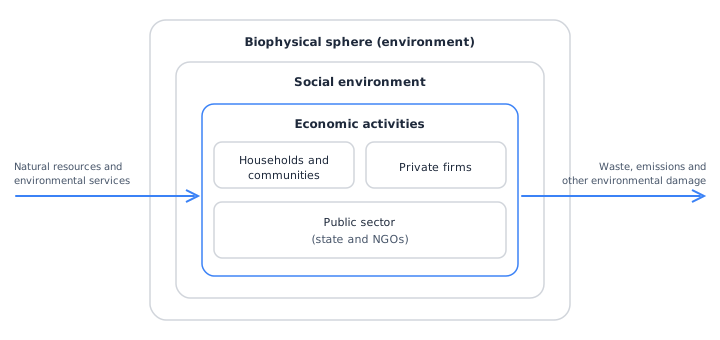
The order of the rings is the actual content of the picture, and it is often turned around. Economic activities lie in the middle, the social environment surrounds them, and the biophysical sphere surrounds both. Anyone who places the social environment inside the economy has read the nesting the wrong way round.
The rest of the chapter follows from that arrangement. Because no ring can leave the one around it, there is no economic decision taken outside social rules, and no production that manages without water, soil, energy and biodiversity.
Your turn1 of 21
How do economic activities, the social environment and the biophysical sphere lie inside one another in the picture?
Your turn2 of 21
A commentary calls the economy a self-sufficient system: rules and education from society are an extra, it says, and nature is one supplier among many. Which statement from the WU text refutes it?
Three Groups Carry Out the Economic Activities
Three groups of carriers stand side by side in the inner ring: the firms in private hands, the public sector, and the households together with their communities. None of them comes before the others, and economic activity is not the same as the business of a firm: a household doing the laundry is engaged in economic activity just as much as a ministry having a road built.
| Carrier | Who belongs to it | An example |
|---|---|---|
| Private firms | privately owned businesses, from sole trader to group | a dairy processing milk |
| Public sector | the state and NGOs | a municipality supplying drinking water |
| Households and communities | private households and their associations | a household that cooks and repairs |
That the NGOs stand with the public sector here is surprising, since they belong to no state, and outside this text they are usually treated as a private sector of their own without profit intent. Why they stand there the WU text does not say. The likeliest explanation is that the task counts here rather than the legal form of the carrier, namely providing services for the general public without profit intent; nowhere, however, is that written down. What the exam tests is the classification itself and not its justification.
The same NGOs turn up a second time further down, there as part of civil society. This is a contradiction only at first sight, because the two places answer two different questions: here, who carries out economic activities, there, who shapes the rules of economic life.
Your turn3 of 21
A family grows vegetables in its garden for its own table, and an environmental NGO runs a free advice centre. How does the classification in the WU text place the two?
Every Economy Takes From the Earth System and Gives Back to It
An input is everything that enters the economy from the earth system: natural resources such as water, soil and energy, plus environmental services (Umweltdienstleistungen), that is, services nature itself performs, such as the pollination of food crops. An output is what goes back from the economy to the earth system: waste, emissions such as climate gases, and other environmental damage.
Both directions belong to the picture; an economy that gives nothing back to nature does not appear in it. Even a firm that extracts nothing and grows nothing depends on that withdrawal: whoever buys barley from the farms nearby buys a harvest that would not exist without pollination. Through the supplies it buys in, the chain runs on into the earth system.
Whether something is an input or an output is decided by the direction of the flow alone. The price does not decide it: water from a firm's own well is an input even though nobody invoices it. Nor does the condition of the substance decide it: treated wastewater flows out of the plant into the river and therefore remains an output, because treatment reduces the burden but does not reverse the direction. Waste heat escaping unused through the roof stands on the same side.
Your turn4 of 21
A brewery discharges treated wastewater into the river and gives off waste heat through the roof. How are the two flows classified?
Your turn5 of 21
A fruit grower pays nothing for wild bees pollinating his trees. How is the pollination to be classified?
Greenhouse Gases Hold Back the Heat the Earth's Surface Gives Off
Greenhouse gases are gases of the atmosphere that together form a kind of insulating layer there: of the heat radiated by the earth's surface they hold part back instead of letting it escape. Five of them play the largest part: water vapour, carbon dioxide (CO₂), methane (CH₄), nitrous oxide (N₂O), which is colloquially called laughing gas, and ozone (O₃).
Pay attention to where the layer takes effect. It does not strengthen the incoming radiation from the sun; it obstructs the way back of the heat from the earth's surface to the outside. A statement that places the effect on the incoming path of sunlight therefore describes a different process from the one at issue here.
The greenhouse effect is decided by the physical property of the gas and not by its origin: water vapour heads the list although it arises naturally. And the layer is carried by several gases acting together; a single one of them does not carry it.
That the concentrations of these gases are rising goes back to what people do: to the burning of fossil fuels, to the clearing of forests and to the intensification of agriculture. The path there does not necessarily run through a chimney. At the end of it stands a higher global average temperature, and climate change gains pace.
Your turn6 of 21
Where does the effect of greenhouse gases set in?
All Act on Nature, While Only Some Depend on It Particularly Strongly
The services of nature are indispensable for the production of goods and equally so for services. Food and laptops stand on the same footing as tourism and insurance in the WU text, and neither side manages without the natural foundations.
The dependence is particularly close in fisheries, in agriculture and forestry, and in tourism. These areas live directly off what nature holds ready: off resources that are available and off ecosystems that work. Whether they still exist in the long run and how much they then achieve is decided by whether those foundations are preserved and used with care.
Keep apart two questions that are easily confused. All economic activities have effects on nature, and a data centre that needs electricity and cooling water is no exception. Directly and particularly strongly dependent, by contrast, are only some areas. A firm can therefore act on nature without itself depending on it to any particular degree.
All the same, nobody works without preconditions drawn from nature. Water, soil, energy and biodiversity are needed by the insurance branch office too, which is heated and lit. The particular dependence is thus a question of degree and not a question of whether.
Your turn7 of 21
A data centre processes no raw materials. What follows from that for its relation to nature?
Your turn8 of 21
A ski resort and an insurance company are compared. Which statement about their relationship to nature is correct?
Society Is Not Merely the Setting but a Resource of the Economy
The middle ring first supplies the economy with its rules. Laws, property rights, and labour and social standards take part of the uncertainty out of economic life and give it a footing, because they make the conduct of others predictable. Whoever knows that a contract is enforceable and property protected can plan and invest.
Secondly, it supplies the qualification of the workforce. That arises through education, training and research, and hence largely outside the individual firm: whatever skills employees bring with them when they join, society has supplied in advance.
Thirdly, it supplies cohesion. Social cohesion and trust are what keep markets and organisations working at all, because where nobody trusts anyone, every arrangement has to be separately secured and thereby becomes expensive.
Society and the state are therefore more than a setting for the economy: from them comes what makes cooperation, predictability and the capacity to innovate possible in the first place. Anyone treating them merely as a frame within which business is done overlooks the contributions that no firm can produce for itself.
Your turn9 of 21
A mechanical engineering firm hires a technician trained at a technical college (HTL) and relies on its contract with a supplier being enforceable. What does the case show about the role of society?
Even in Day-to-Day Business a Firm Is a Social Actor
Firms act in the other direction, and they do so not only as producers. They hire people and thereby create employment, they set the conditions under which the work is done, they take on social responsibility and they drive innovation, all of it in day-to-day operations. The social role therefore does not begin only where a firm donates something beyond its production.
Creating employment heads that list, and not as a side effect of producing: whoever hands out work decides about other people's income and security. A firm that trains apprentices, negotiates working hours with its staff and files a patent fills this role in three respects at once.
Your turn10 of 21
A joinery donates nothing and sponsors no clubs. It does, however, train two apprentices and agree flexible working hours with its staff. How should its social role be judged?
The Rules of Economic Life Are Negotiated, Not Found
The social environment is shaped by several actors, and each of them has means of its own. Who holds which means is the core of this section, because exam statements like to swap the means around.
Civil society comprises NGOs and associations, together with academia and the media. In the interplay of actors it appears as a critical authority: it questions economic conduct, brings grievances into the open and formulates what society expects of sustainable and ethical economic activity.
| Actor | How it acts on economic life |
|---|---|
| The state | passes laws, enforces regulation, shapes conditions through tax policy and environmental requirements |
| Firms | act within the framework conditions and influence them through lobbying, self-regulation and CSR |
| Civil society | questions, brings grievances into the open and formulates expectations, but passes no laws |
| Consumers and employees | shape structures and norms through purchasing decisions, labour mobility and protest |
The third row is where exam statements fail most often. Civil society does not enforce its expectations of sustainable economic conduct by passing laws, because it cannot make them legally binding. Conversely, an operators' association lobbying members of parliament for longer transition periods does not step out of its role: lobbying is expressly among the means of firms.
The sentence this section leads up to follows from the interplay: what happens in an economy stands at the end of processes of negotiation, social as much as political. What is produced and under which conditions has been negotiated and is not technically given.
Your turn11 of 21
An environmental organisation publishes a report on a paper mill's wastewater, the operating company lobbies members of parliament for milder limits, and parliament passes stricter ones. Which assignment of the means is correct?
Environmental Destruction Comes Back as Costs Along Two Paths
This interaction also runs the other way: damage in society and nature burdens the economy with considerable costs. These costs fall into two groups, and for each individual item it is checked which group it belongs to.
Direct consequences arise through the immediate effect of the event: infrastructure destroyed by extreme weather events, production stoppages, and rising insurance claims. Indirect effects run through changed conditions of production and of life: crop failures, increased health costs, and losses of productivity.
| Question | Direct consequences | Indirect effects |
|---|---|---|
| How the damage arises | through the immediate effect of the event | through changed conditions of production and of life |
| What the WU text lists | destroyed infrastructure, production stoppages, rising insurance claims | crop failures, increased health costs, losses of productivity |
| An example | a railway bridge destroyed by the storm | a harvest reduced by the drought of the following summer |
The classification is decided by the path and not by the moment. A warehouse left undamaged by the heavy rain whose operation nevertheless stands still for three weeks bears a direct loss, because the event halted production immediately. If several weeks later workers are missing because they have fallen ill, the damage runs through changed conditions and counts among the indirect effects.
The classification itself comes with a warning. Outside this text, production stoppages and insurance claims are usually counted among consequential losses, because no physical asset is destroyed in them; the WU text lists both under the direct consequences, and for the exam its list is what counts. The loss does not disappear, incidentally, just because an insurer bears it at first, because recurring claims make insurance cover more expensive for everyone.
Your turn12 of 21
A drought reduces the harvest in the following summer, and the number of heat-related hospital treatments rises. How do these two items count?
Your turn13 of 21
A flood submerges the access road to a plant; the hall stays dry, but production stands still for two weeks. In the same two weeks workers are missing too, because many employees have fallen ill after the flood. How do the two items count?
In the Long Run Items Are Added That Nobody Sees on the Day of the Event
A third time horizon stands beside the two groups. In the long run four developments are added: the degradation of ecosystems, climate-driven migration, rising investment risks and disruptions to global supply chains. Each of them sharpens what the economy has to cope with anyway.
Why investment risks appear on that list can be read off the capital. Whoever cannot estimate whether a plant will still be usable in twenty years demands more security or more return for their capital, and investment becomes more expensive as a result. Climate-driven migration is not a purely social phenomenon on this list, because where people lose their livelihood and regions empty out, labour markets, demand and public duties shift.
On top of this comes an item that is not a consequence of damage but an advance outlay. Whoever wants to adapt to the climate consequences has to invest considerably to do so: in infrastructure that withstands more, in renewable energies and in sustainable economic models. Without these outlays economic stability cannot be held, and these outlays come on top of the losses already incurred instead of replacing them: whoever counts only the losses underestimates the burden by exactly this item.
Your turn14 of 21
A report puts a region's climate costs at the sum of destroyed roads, production losses and crop failures over the last five years. Which assessment of this calculation is correct?
Intact Ecosystems Save Costs That Nobody Invoices
Intact ecosystems act like a natural buffer against natural disasters, and their value shows most clearly where that buffer is missing. A forest takes up rainwater and lets it out again later in measured amounts; a flood thereby fails to happen or turns out weaker. What the forest takes up reaches the river with a delay instead of all at once, and the peak of the flood wave sinks.
In high alpine locations the same stand of trees puts itself in the way of descending masses of snow and catches avalanches, and thereby protects settlements, transport routes and installations from damage. Wetlands soak up arriving floodwater like a sponge and hold on to it. The direct damage to infrastructure and property thus turns out smaller, and after a disaster the area recovers faster.
Read economically, this means: the benefit of a forest reaches beyond the timber that can be won from it. If a municipality clears a floodplain forest for commercial land, the value of that land stands against the loss of the retention effect, and this loss shows up at the next flood as direct damage to infrastructure and property. A calculation containing only the return on the new land is therefore incomplete.
Your turn15 of 21
A municipality clears a floodplain forest to sell the land as a commercial zone, and counts only the sale proceeds and the timber. Which assessment of this calculation is correct?
Species Diversity Makes Ecosystems Resilient
The more species live in an ecosystem, the more resilient it is. Diversity lets the system adjust to changes, and after a disturbance it finds its way back to its initial state more quickly. The quicker recovery is not a second advantage next to resilience but the sign by which it is recognised.
Protected biological diversity keeps natural systems stable, and the people whose income and supply hang on the ecosystems concerned live off that stability. A farm switching from a single variety to several varieties and crop rotations makes itself less sensitive to disturbances for the same reason.
The economic value of diversity is not exhausted by what can be harvested directly. From nature come many valuable compounds and genetic resources, and out of them arise products and technologies that did not exist before, in pharmacy, in biotechnology and in agriculture. The loss of species therefore also destroys development potential that nobody has yet lifted, and a missing price is not a missing value.
Your turn16 of 21
An expert report values a species-rich bog solely by what can be sold from it today, and therefore sets its value low. Which statement about the bog's value is correct according to the WU text?
An Intact Environment Acts Directly on Health
Whoever breathes clean air, drinks unpolluted water and has natural spaces within reach is healthier in body as in mind. The connection runs without an intermediate step: these environmental goods act on the body and on the well-being of those who live among them, and not only by the detour of economic magnitudes. The WU text sets no condition under which green spaces would take effect only from a certain size onwards.
A healthy population copes better with health crises and can meet an outbreak of disease earlier. That closes the circle back to the cost side: increased health costs stand among the indirect effects of environmental destruction, and what supports health today helps decide how expensive a crisis tomorrow will be.
Your turn17 of 21
In a city the air gets worse, residents fall ill with respiratory diseases more often, and spending on their treatment rises. How do these higher health costs count?
The Picture Orders, It Does Not Measure
The picture makes three statements and claims no more: the economic activities are carried out by households, firms and the state; they fetch inputs from nature and give outputs back to it; and they stand inside social institutions, societal norms and political rules.
About quantities it says nothing. How large the individual flows between economy and earth system are, which prices apply and which shares fall to whom cannot be taken from it. It is deliberately simplified and clarifies the central connections without putting figures on them.
One group is also missing from it. Consumers and employees do not appear as a box of their own, although they help shape economic structures and norms: that they do stands in the text and not in the picture.
What the picture does carry is a conclusion about the economy itself. It does not run autonomously: it reflects how a society has decided about the use of resources, about distribution and about justice. Who withdraws, who pollutes and who bears the consequences has been decided and is not simply found.
Your turn18 of 21
A presentation relies solely on the picture of the three nested areas. Which statement can be supported with this picture?
Climate Risks and Responsibility Are Distributed in Opposite Directions
Neither the risks of climate change nor the responsibility for it are spread evenly across the world. Named among them are heavy precipitation, floods, droughts and avalanches, and they do not strike everywhere with equal frequency or equal force. Their worldwide occurrence therefore does not imply an equal distribution.
To the output of CO₂ the countries of the Global South have contributed only a small part over the course of history; the consequences of global warming nevertheless hit them today with particular force. The two inequalities thus run against each other, and precisely that makes the subject a question of distribution: emissions act globally, their consequences strike locally.
| World region | Share of historical emissions |
|---|---|
| USA | 40% |
| EU-28 | 29% |
| rest of Europe | 13% |
| rest of the Global North | 10% |
| Global South | 8% |
Read the table as what it is, namely a summation over time. What counts for warming is the cumulative quantity and not the emissions of a single year. Whoever measures responsibility by a single year therefore arrives at a different picture and assigns a larger share to today's growing economies; the two views fall clearly apart.
Your turn19 of 21
According to the WU text, 8% of historical emissions come from the global South. Which conclusion is consistent with this and with the rest of the section?
Within Countries Emissions Diverge More Widely Than Between Them
The distance between emitters is by now greater within a single country than the distance between countries. A small, wealthy part of the population arrives, through its consumption and through its investments, at a share of greenhouse gas emissions far above its share of the population. The dividing line thus runs less along state borders than along incomes.
Two figures show the distance. The richest one percent of the world's population racks up twice as much carbon dioxide as the poorest 50 percent combined. For the top 10 percent of emitters, the average per-head output in 2021 stood at 22 tonnes of CO₂, more than two hundred times the average for the bottom 10 percent.
Note that this calculation does not rest on consumption alone. Where a fortune flows affects emissions too, and not only what is consumed directly.
Your turn20 of 21
Two countries have the same average CO₂ emissions per head. A commentary concludes that within both countries people contribute roughly equally to emissions. What speaks against this according to the WU text?
Consuming Little Makes Nobody Either Safe or a Model
On socially disadvantaged groups, by contrast, several burdens lie at once: a low income, insecure employment, missing education. Climate risks therefore hit them harder, and the way to adjust to changed conditions is less open to them. Low consumption therefore confers no capacity to adapt, and exposure and responsibility come apart.
Climate policy measures too can hit them disproportionately. A levy on CO₂, called CO₂-Steuer in the WU text, weighs more heavily on a small budget, since energy and the bare necessities tie up a larger share of the income there. Climate protection can therefore work out socially unequal as long as it is not compensated.
The ecological footprint of poorer parts of the population is mostly smaller, yet that does not make poverty an ideal of sustainability. Where little is consumed because the income is missing, behind it stand a restricted quality of life and a limited share in the life of society, and neither is the good life being aimed at. Consumption below the average is thus not yet a standard for sustainable economic life.
Your turn21 of 21
In a debate it is proposed to make the resource use of low-income households the standard for sustainable living. What speaks against it?
Now practise it
The Economy Inside Society and Environment (Wirtschaft in Gesellschaft und Umwelt)
PractiseWas this article helpful?