Money, Currency and Interest (Geld, Währung und Zinsen)
In the circular flow goods run one way and payments the other. What actually flows on the payment side is something the circular flow left open: all it says there is Geld, as though the word settled the matter.
This article opens the word up. It shows which tasks money takes on inside the circular flow, which forms it comes in, how two currencies stand to each other, and what it costs to leave money with somebody else for a while.
Without money an exchange fails on the double coincidence of wants
In early societies wares could only be exchanged directly for wares, meat for clothing say. Such an exchange demands two conditions at once: the butcher must need clothing, and the customer must need meat.
Drop either condition and the deal does not happen, although both sides wanted to trade. Nor is it enough that the butcher will need clothing at some point: she has to need it at the very moment the customer wants to acquire the meat. This double coincidence of wants is the bottleneck of every pure exchange of goods.
As soon as there is a good that everybody accepts as a means of payment, the exchange falls into two halves that no longer have to match. The butcher sells for money, and later and elsewhere she buys with it what she actually needs. Only then do the many exchange relations the circular flow is made of become possible.
Your turn1 of 19
A beekeeper wants to trade honey for a haircut. The barber likes honey, but still has three jars at home and will not need more for another two months. Both would be willing to trade. Does the trade come about without money?
Why a printed piece of paper is worth something
As paper a banknote is worth almost nothing, and a figure in an account is less tangible still. Both are accepted all the same, because everyone can count on paying with them again later, and at a value that will hold until then.
That also settles what the value of money hangs on: the certainty of getting wares and services for it at any time. That trust in the exchange value is the precondition for all the functions in the next section. Once people lose it, no print on the note helps: a means of payment is accepted only as long as everyone counts on the next person accepting it too.
Your turn2 of 19
In a country the expectation spreads that traders will soon stop accepting the domestic notes. A commentator reassures people: the printed amount stays the same, after all. What is right according to the section?
Three functions that do not exclude one another
Money does three jobs side by side. As a means of exchange (Tauschmittel, also Zahlungsmittel) everyone accepts it for purchases. As a measure of value (Wertmesser) it gives every good a figure against which goods can be compared with one another. As a store of value (Wertaufbewahrungsmittel) it carries an amount from today into a later time.
The measure of value is the function most easily overlooked. In a shop the price of bread, of an hour of tutoring and of a bicycle stand side by side, and only expressing them in money units makes such different things directly comparable. Without money you would have to weigh up how many hours of tutoring a bicycle is worth.
The third function follows from the second: what you set aside is expressed in money, and in money it stays put until you need it. All three functions run alongside each other, and the same amounts perform them one after another.
| What somebody does | Which function is at work |
|---|---|
| Transferring the rent from an account | Means of payment |
| Comparing the prices of two brands while shopping | Measure of value |
| Setting part of the salary aside for later | Store of value |
A qualification hangs on the third row, and this article leaves it open. Whether what was set aside still buys the same quantity of goods a year later is settled not by the amount but by how prices moved. That is the subject of the article on inflation and the value of money.
Your turn3 of 19
A student compares two laptops online at 899 and 1,049 euros, buys neither for now and leaves the money in his savings account until autumn. Which function of money is at work in the comparison, and which in leaving the money there?
Bargeld and Buchgeld are the same money in two forms
Notes and coins, Bargeld, everyone has held in their hand. The second form is more abstract and is nevertheless the larger one in circulation.
Buchgeld, also called Giralgeld, has no physical shape: it stands as an amount in an account and nowhere else. It is moved by instructing the bank to transfer a certain sum from that account to another.
| Feature | Bargeld | Buchgeld |
|---|---|---|
| Appearance | Banknotes and coins | An amount in an account |
| How it is used | Handed over | Transfer, bank card and credit card |
| Interest | none | balances usually earn interest, often only little |
| Share of the money in circulation | the smaller part | by far the larger part |
Between the two forms there is a road in both directions. Whatever goes onto an account and comes off it moves mostly cashlessly, by transfer, and whoever withdraws at a machine turns a balance back into notes. A firm that transfers wages needs no cash for that; for the till it holds notes and coins all the same.
The two forms are worth the same anyway. A euro in an account is a euro, and an invoice is effectively paid by a transfer in which no note changes hands anywhere. And both stand and fall with the same trust: as long as nobody doubts that wares and services are to be had for them, both stay in use.
Your turn4 of 19
A colleague thinks that most of the money circulating in the euro area consists of notes and coins. Which statement of the Skriptum refutes her?
A currency holds in a currency area, not across the whole EU
A Währung is the money to which a state grants validity as a means of payment on its territory. For Austria that is the euro; money in any other currency counts, seen from Austria, as a foreign currency (Fremdwährung), such as Swedish crowns, Swiss francs, Japanese yen or US dollars.
Austria's currency is the euro because Austria belongs to the euro area. Some EU states, Austria among them, switched to a common currency in several stages; what they expected from it was a sturdier economy and a firmer union. The euro area came into being in 1999 with 11 member countries at first, cash followed as the last stage in 2002, and the latest to join was Croatia in 2023.
Taking May 2024 as the reference date, the euro area counts 20 countries, around 341 million people reach for the euro daily, and worldwide only one single currency is used more than it is.
Note the word "some" two paragraphs above. Membership of the European Union does not bring the euro with it automatically. Someone shopping in Vienna and in Lisbon pays with the same notes, someone shopping in Prague exchanges money first. Inside the same currency area the exchanging falls away, and with it any risk from a fluctuating rate.
Your turn5 of 19
A Viennese firm buys goods in Bratislava and in Budapest and pays each time in the local currency. Slovakia belongs to the euro area, Hungary is an EU member and has the forint. For which purchase must the firm reckon with a fluctuating rate?
The exchange rate is the price of a currency
A Wechselkurs puts a figure on what one currency costs in another currency. If a day's rate reads 1 euro = 1.2 US dollars, then on that day one euro is paid for with 1.2 US dollars.
Hold on to whose price is being named here. An exchange rate is the price of a currency and not the price of a good in a foreign currency. And being a price, it is subject to the same fluctuations as other prices.
Your turn6 of 19
One day the newspaper reads: 1 euro = 160 Japanese yen. What does this figure state?
Mengennotierung, Preisnotierung and the external value
The same rate can be written down in two ways. The Mengennotierung names the quantity of foreign currency falling on one unit of your own, for instance 1 euro = 0.95 Swiss francs. The Preisnotierung turns that around and names the sum in your own currency that one unit of the foreign currency costs. At the WU it stays the Mengennotierung throughout, if only to spare anyone converting between the two.
The two notations are reciprocals of each other and say the same thing economically. The Mengennotierung has one advantage all the same, and it concerns reading: when the figure rises you get more foreign currency for one euro, so the euro has become stronger. In the Preisnotierung the same movement shows up as a falling figure.
Besides the rate against a single currency there is a measure for the strength of a currency as a whole. The Außenwert measures a currency not against a second one but against a whole basket: all the rates to the individual foreign currencies are worked into one single multilateral figure, in which each foreign currency counts mostly by its weight in trade with the home currency area. The script itself, though, does not always take the word that narrowly. On page 25 it means this weighted basket, on page 28 simply how many units of a foreign currency one unit of your own currency buys, that is a single rate. What is being asked is the same both times, namely what your own money brings in abroad; so reckon with both phrasings and read off from the context which one is meant.
Your turn7 of 19
In the Mengennotierung the rate changes from 1 euro = 0.95 Swiss francs to 1 euro = 0.92 Swiss francs. What is true?
What a stronger or weaker euro means for you
When the euro gains on the dollar, the dollar equivalent of one euro comes out higher, and where payment is in dollars your money goes further. Seen from the other end it runs the same way: when the franc gets dearer against the euro, the same sum in francs now costs you more euros, and Swiss prices move up for you as a traveller from the euro area.
The drawing shows both directions side by side. Follow only the figure in the Mengennotierung first, and read what stands in the column below it afterwards.
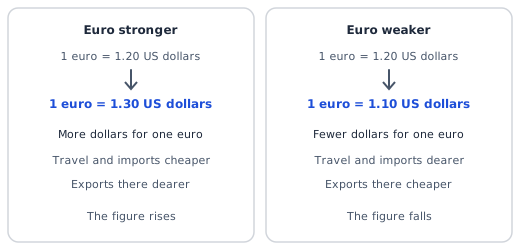
The same movement hits firms, and it hits the two directions of foreign trade in opposite ways. If the euro loses value against the dollar, components from the USA become dearer counted in euros, because a given dollar amount now takes more euros. For customers in the USA, Austrian machines become cheaper counted in dollars at the very same moment.
It also hits whoever never touches a foreign currency personally. A firm that has an invoice in dollars to settle in a few months does not know today how many euros that will cost it, and this uncertainty is why firms hedge against movements in the rate.
Your turn8 of 19
A hotel in Tyrol has many guests from Great Britain. The British pound gains value against the euro. What does that mean for these guests?
Your turn9 of 19
The rate rises from 1 euro = 1.10 US dollars to 1 euro = 1.20 US dollars. What does this mean for an Austrian firm that pays for components in dollars?
Two rates stand side by side at the bank counter
Which rate applies to a transaction depends first of all on the form of the money. Cash business runs on the Valutenkurse, everything cashless on the Devisenkurse. Someone withdrawing francs in cash therefore settles at a different rate than someone transferring the same amount.
Second, the bank works with two different rates: one at which it buys foreign currency, the Ankaufskurs, and another at which it sells it, the Verkaufskurs. The two rates come apart, and always in the bank's favour; the spread between them is what it earns on the business. Whoever buys foreign currency and immediately exchanges it back therefore gets less back than they handed over, even if the rate has not moved in the meantime.
Your turn10 of 19
Before her holiday a traveller exchanges 500 euros into British pounds in cash at the counter, cancels the trip the same day and exchanges the pounds back. The rate has not moved. What holds for the exchange back?
Interest is the price of money left with somebody
Zinsen are the price for somebody leaving money with another person for a set time. Whoever leaves it there is paid that price and is called the creditor (Gläubiger); whoever takes it up and repays it later pays the price and is called the debtor (Schuldner).
These two roles hang on the individual relation and not on the person, and a bank shows that most clearly. Taking in savings deposits, it is the debtor towards the saver; granting a loan out of that money, it is the creditor towards the borrower. Both hold at once.
Money transactions of this kind are settled outside banks as well, for instance when you buy in instalments in an online shop. And whoever grants a customer a payment term of 30 days leaves her money for that time: towards her he is the creditor and for that time he carries the risk that she does not pay.
Your turn11 of 19
A student takes 5,000 euros to the bank and places them there for a fixed two years. Her boyfriend thinks the bank is the creditor here, because it keeps the money and pays the interest. Which statement of the Skriptum refutes him?
Your turn12 of 19
A tenant lodges a deposit of 3,000 euros when she moves in, which the landlord pays back to her when she moves out. Her brother thinks that towards the landlord she is always the debtor, since she pays him rent every month. What role does she have with the deposit?
Three reasons why interest exists
That a creditor asks for a return at all has three reasons, and each of them carries a name of its own.
- Dubiosenrisiko. The creditor may never see his money again, because the debtor cannot pay. For that risk he wants to be paid up front.
- Konsumverzicht and Opportunitätskosten. While the money is gone it is not at the creditor's disposal: no investment, no consumption, no other use.
- Geldwertrisiko. If prices rise before repayment, the same sum buys less at the end than at the start. Interest is to make up for that too.
The second reason is the concept from the first chapter under a different name. Whoever lends money is deciding about a scarce resource and thereby turning down every other use of it; the returns forgone on those turned-down uses are opportunity costs.
Your turn13 of 19
A grandmother lends her grandson 4,000 euros for five years and asks for 2 percent interest p.a. Her reason: had she kept the money, she would have invested it profitably herself. Which reason for interest does she give?
What a bank's interest rate is made of
Because interest is a price, supply and demand act on its level as they do on other prices. Cheap loans pull demand in: when money costs little, more people take some up. If demand rises very sharply, the price of loans gradually climbs until it stops growing; if it later falls short of what the banks want to lend out, lower rates can stimulate it again.
When a bank grants a loan, the rate depends on three things.
- Refinanzierungskosten. What the bank itself pays to get hold of the money.
- Risikokosten. How likely it is that this particular loan defaults.
- Other costs and profit. What the rest of running the bank costs and what it wants to earn on the business.
It follows why a young firm pays more for the same amount than a long-standing customer with a secure income. The higher rate is not a disadvantage without reason but the possible default priced in.
Through the refinancing costs the central bank reaches every single loan. To fight inflation, the ECB has markedly raised the level of interest rates over roughly the past 3.5 years. Once refinancing becomes more expensive for the banks, they pass these higher costs on to their customers through the loan rates, and at present (2025) the interest level stands markedly above that of previous years, when rates were so low that people spoke of zero interest rates.
Your turn14 of 19
The ECB raises the level of interest rates. A bank then charges long-standing customers a higher rate on new loans, although their risk of default is unchanged. Through which component of the loan rate does the ECB's decision work?
Fixed and variable interest rates
Interest is stated as a percentage, and that percentage is called the Zinssatz; it almost always refers to a year (p.a.). It is agreed either fixed or variable: a fixed rate is nailed down with the contract and does not budge until the term ends, a variable one follows the general level of rates and travels up and down with it.
For the debtor that means two things. With a fixed rate the burden stays plannable over the whole term. With a variable rate it rises when the level of rates rises and falls when that level falls, which is why only the end of the term shows which of the two agreements was cheaper. That is exactly why the interest payments of debtors who had agreed a variable rate went up after the ECB's increases.
Both forms occur on both sides. Not only loans but balances too can carry a variable rate, and a savings rate then moves with the level of rates just as a loan rate does.
Your turn15 of 19
In the same month two neighbours each take out a housing loan of 200,000 euros over 20 years, Mr Aigner at a fixed rate, Ms Berger at a variable one. Shortly afterwards the ECB raises the level of interest rates. What follows?
Nominalverzinsung and Effektivverzinsung
A rate written into a contract does not yet say what a money transaction actually costs or brings in. As soon as fees or particular conditions come on top, total costs and return shift, and what comes out at the end no longer matches the figure on the page.
The Nominalzinssatz is the figure standing in the contract. The Effektivverzinsung adds in everything that makes the transaction dearer or less profitable on top of that, meaning fees and other conditions, and thereby puts a figure on what the transaction really yields in the end.
A loan carries 5 percent p.a. as its nominal rate, and on top of it come a handling fee and further costs. It therefore costs the borrower more than those 5 percent a year, and by how much more only the effective rate shows. A second offer at 5.4 percent with no further costs may therefore be the cheaper one. You compare different offers meaningfully only through the effective rate.
The same holds on the credit side of an account. A savings offer with a higher stated rate but an annual account maintenance fee can bring in less than one with a slightly lower rate and no fee; a fixed fee weighs more heavily on a small invested amount than on a large one.
Nominal versus effective, not nominal versus real. In the economics literature "nominal" is usually set against the "real" rate, that is the rate adjusted for the rise in prices. The WU script uses the pair differently: it sets the effective rate against the nominal rate, and what separates the two is costs and contractual terms, not inflation. The script introduces no real rate at this point; compensation for generally rising prices appears in it as the Geldwertrisiko among the reasons interest exists. Measure an exam statement about the effective rate against the costs of the transaction, then.
Your turn16 of 19
Two loan offers over the same amount and the same term: 5 percent p.a. plus a handling fee, or 5.4 percent p.a. with no further costs. Which statement of the Skriptum tells you how to decide between them?
Your turn17 of 19
You invest 2,000 euros for one year; leave tax aside here. Offer A pays 2.0 percent p.a. and charges an account fee of 15 euros a year, offer B pays 1.8 percent p.a. with no fee. Which offer brings in more after one year?
Interest on interest
Every statement of interest belongs to a period of time, and that period is usually a year. If a money transaction lasts longer and the interest stays with the capital instead of being paid out, then from the next period on the interest amount itself carries interest.
Zinseszinsen arise as soon as interest is not paid out but added to the capital: from the following period on it earns interest itself.
Work it through on 1,000 euros at 3 percent p.a. over three years.
| Year | Balance at the start of the year | Interest for the year | Balance at the end of the year |
|---|---|---|---|
| 1 | 1,000.00 euros | 30.00 euros | 1,030.00 euros |
| 2 | 1,030.00 euros | 30.90 euros | 1,060.90 euros |
| 3 | 1,060.90 euros | 31.83 euros | 1,092.73 euros |
The rate is the same in all three years, and the interest amount grows from year to year all the same, because the balance being paid interest on grows. Had the interest been paid out every year, it would have stayed three times 30.00 euros and 1,090.00 euros at the end; that is simple interest. The difference of 2.73 euros looks like little, but it grows with every further period, and over long terms it makes up the larger part of the return.
For the calculation itself there is a short notation. With the initial capital , the rate as a decimal and the accumulation factor , after periods you have
and in the example above therefore . With simple interest there would stand , and comparing those two expressions is exactly the comparison of the two final amounts in the table. The calculating with them is done in the Finanzmathematik topic; what counts here is where the difference comes from.
The same holds on the debtor's side. If the interest on a loan is added to the debt, the remaining debt grows by a larger amount every year than it did the year before: the same mechanism, only at the expense of the one who pays.
Your turn18 of 19
1,000 euros sit in an account for three years at 3 percent p.a., and the interest is added to the balance every year. Why is the interest amount higher in the second year than in the first?
Capital gains tax reduces what goes on earning interest
Whoever receives interest on a balance in Austria hands part of it to the state: the capital gains tax (Kapitalertragsteuer, KESt) strikes returns that come from assets, and interest is exactly that. It is deducted by the bank, at the close of the accounting period, that is at the end of a quarter or of a year; the bank passes it on to the tax office without the account holder having to do anything for it.
What lands in the account is therefore not the full interest earning but only what is left after the tax, and only that remainder earns interest in the next period. The actual return thus lies below the stated rate. The tax is levied on the interest, not on the amount invested.
Your turn19 of 19
On a savings account the interest is added to the balance at the end of the year, and the bank deducts the KESt as it does so. Which amount earns interest in the following year?
Was this article helpful?