Scarcity and Opportunity Cost (Knappheit, Opportunitätskosten)
Economic activity (Wirtschaften) starts with a sober observation rather than with money: everything a household or a company can put to use is limited. A resource spent on one thing can no longer be spent on another. That single fact produces the concept the exam material keeps returning to: opportunity cost (Opportunitätskosten).
Needs, goods and companies
Everyone belongs to a private household (privater Haushalt), whether they live alone, in a family or in a shared flat. And every household has needs (Bedürfnisse) every day: food, housing, warmth, security, personal care, education, mobility. Some of them are met only when somebody produces something or performs a service.
Products and services together are called goods (Güter). A bicycle is a product, repairing it is a service. Goods are produced and offered on one side, and demanded and bought on the other.
In theory a household could produce the goods it needs itself, in practice almost never. The skills are missing, so are the means of production and above all the time. Somebody who can bake their own bread still cannot build a bicycle, heat a flat or treat a tooth.
Companies (Unternehmen) take these tasks on. A company recognises a need of households or of other companies and produces what is needed there. That is how it creates value for its customers, and its success depends on exactly that: a product that meets no need stays on the shelf, however carefully it was made.
Your turn1 of 12
A shared flat bakes its own bread but buys its bicycles in a shop. According to the WU text, what explains why it does not make the bicycles itself as well?
Division of labour (Arbeitsteilung) on three levels
No good is made by one person from start to finish. The tasks are divided, and on three levels at once:
- Inside an organisation. In a household one person cooks and another cleans. A company has purchasing, production, sales, marketing and accounting, and each department can concentrate on its own part.
- Between companies. A farm supplies fruit to a maker of frozen food and to a maker of fruit preparations, and both buy their packaging from a third company. What one produces is the precondition for what the next one produces.
- Between countries. Countries develop the areas they have favourable conditions for: climate, natural resources, workforce, know-how. That is why the frame, the gears and the tyres of a single bicycle often come from three different countries.
Your turn2 of 12
A bicycle maker gets the frame from one country, the gears from a second and the tyres from a third. According to the WU text, what explains why the parts come from different countries?
Why specialisation (Spezialisierung) lowers the cost per unit (Stückkosten)
Whoever sticks to a few production steps gets better at them and can make larger quantities. The second advantage is arithmetical, and it matters more for the exam: not all costs grow along with output.
A workshop pays 900 euros of rent per month, whether 100 or 300 bicycles are assembled in it. At 100 bicycles each one carries 9 euros of rent, at 300 bicycles only 3 euros. The rent has stayed the same, its share per unit has fallen. Once the cost per unit falls, so can the price a unit is sold at.
Your turn3 of 12
A workshop pays 900 euros rent a month and will assemble 300 bicycles a month from now on, up from 100. The master thinks that this also raises the share of the rent each single bicycle has to carry. Which statement of the WU text refutes him?
Your turn4 of 12
A gym pays 6,000 euros rent a month. Since it has had 600 members instead of 400, it charges a lower monthly fee. According to the WU text, what explains why it can afford this?
What specialisation costs
Whoever relies on suppliers becomes dependent on them: on the quality of the delivery on one side, and on whether the quantity needed arrives at the right time on the other. If a delivery arrives late or in poor quality, production stops. Orders are lost and reputation suffers. The dependency becomes particularly serious for goods that are needed urgently, medicines for instance. A whole country becomes dependent too when it specialises in a few export goods, namely on the markets for those goods: if their price falls there, a large part of its exports is hit at once.
Long supply chains also carry an ecological price. Moving parts thousands of kilometres by truck, container ship or plane burdens the environment, and that burden appears on no invoice. It is the first example of a cost that arises without anybody transferring money for it.
Your turn5 of 12
A bicycle maker gets all of its gears from one single supplier. A delivery arrives three weeks late. According to the WU text, what follows from this for the bicycle maker?
Scarcity and the basic economic questions
Exchanging goods for money would be simple if there were an unlimited amount of both. There is not: no company can produce any amount it likes, and no household has any amount of money it likes. Raw materials, machines, labour, time and financial means are scarce.
Scarcity (Knappheit) does not mean rarity here, and it does not mean expensive either. It means that there is less of the resource than all its possible uses together would require. That is why its use has to be planned, and this planning is what the word economic activity refers to. From it follow the basic questions of economic activity (Grundfragen des Wirtschaftens):
- What should be produced, and how, for whom, in what quantity and in what quality?
- What should be bought or exchanged?
A family answers these questions through its budget: how much for housing, how much for mobility, how much for the daily shopping, how much to save. A company answers the same questions through its means of production: what can be made with the machines and staff it has, how much money it can invest, and how much has to stay available for current payments.
Your turn6 of 12
You have 16 free hours at the weekend. Studying, sport and your friends would need 25 hours together. What makes your time scarce in the sense of the WU text?
Your turn7 of 12
A village's only well delivers 50,000 litres of water a day. For drinking, cooking and watering, the villagers together use 30,000 litres a day. Which fact shows that the water there is not scarce in the sense of the WU text?
Opportunity cost
Every decision in favour of one use rules out all the others at the same time. Somebody who spends Saturday studying does not spend it working a side job. Somebody who plants a vegetable bed in the garden gets no flower meadow in the same spot. Somebody who puts their savings into founding a company buys no securities with them and pays for no training.
Opportunity cost is the return forgone or the benefit not realised from the course of action (Handlungsalternative) that was given up in favour of another. It arises with every decision about a scarce resource, including decisions where no money moves at all.
The name is easy to misread. What is meant is not money flowing out, but a return that never arises. None of it shows up on a bank statement, and it still belongs to the decision.
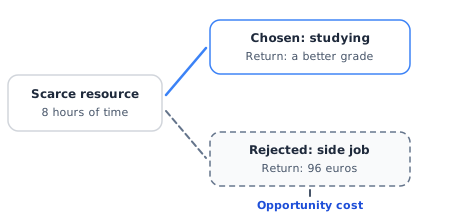
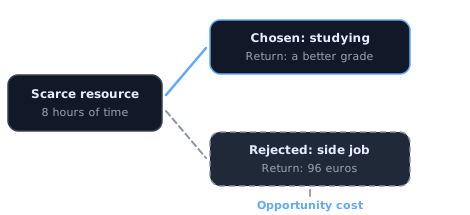
Two calculations. Somebody who spends 600 euros on a bicycle, and would otherwise have invested that money for a year at 2.5 percent, gives up 15 euros of interest. Those 15 euros are the opportunity cost; the 600 euros are not, because they are the price. And somebody who studies for eight hours instead of working a side job gives up earnings of 96 euros at an hourly rate of 12 euros, even though they spent nothing at all during those eight hours.
Not every forgone benefit can be expressed in euros. The founders of a company give up free time and rest, and both have a value, however hard it is to put a figure on.
More than one option is usually rejected as well. What to do with those several options is phrased differently by the WU textbook and by the standard economics definition, and the difference matters for the exam.
Two phrasings, and the exam follows the textbook. The textbook defines opportunity cost through the course of action that was given up in favour of another; the word 'best' does not appear in it, and in the company-founding example it even names all the options given up together. The standard economics definition, by contrast, explicitly counts only the best rejected option, because you could only ever have chosen one. Both say the same thing in principle: they name what a decision makes you go without. Exam statements are measured against the textbook, so do not read a statement about 'the forgone alternative' as false merely because the word 'best' is missing from it.
The sketch shows how any such decision is built. Follow the lower path: what it carries is not what you pay, but what you do not get.
The concept comes back twice in this exam material. It explains why a seller sells at all, since stock sitting in a warehouse produces no return. And it is one of the reasons interest exists: whoever lends money gives up every other use of it for the whole term.
Your turn8 of 12
A student spends her free Saturday helping a friend move house instead of going hiking with acquaintances as planned. No money changes hands for either. Her flatmate thinks that without money there can be no opportunity costs here. Which statement of the WU text refutes him?
Your turn9 of 12
A business uses a storeroom it owns for production. It could let it for 300 euros a month. The owner thinks the room costs him nothing, because it belongs to him and nobody sends a bill for it. Which statement of the WU text refutes him?
Three misconceptions about opportunity cost
- 'It cost nothing, because no money moved.' Time, space and attention are scarce resources just as money is. A Saturday can be given away exactly once.
- 'A right decision has no opportunity cost.' It arises with every decision about a scarce resource, the best one included. A decision is good precisely when its return is higher than the return of the option it rules out.
- 'The opportunity cost is the price.' The price is what you pay. The opportunity cost is what you would have achieved with the same money.
Your turn10 of 12
You bought a ticket for a sold-out concert for 60 euros. On the day of the concert someone offers you 150 euros for it. How high is the opportunity cost if you go yourself?
Your turn11 of 12
A firm buys a machine for 20,000 euros that brings it 5,000 euros of extra return. With the same money it would otherwise have paid for training that would have brought 3,000 euros of extra return. The manager says that because the machine was the better choice, the decision has no opportunity cost. How high is it?
Sustainability (Nachhaltigkeit): costs other people carry
Some consequences of a decision are carried by somebody other than the person taking it. Air, water and soil are scarce resources too, and whoever burdens them narrows the options of other people and of later generations. A decision that is cheap today becomes expensive later along that route.
Sustainable economic activity (nachhaltiges Wirtschaften) builds these effects into the decision and connects three dimensions: ecology, economy and society. None of them replaces the other two, because ecological measures are only supported when economic and social goals are met as well. How the three dimensions work together is set out in the second chapter of the WU textbook, 'Wirtschaft als Teil der Gesellschaft und Umwelt'.
Your turn12 of 12
To improve the air, a city closes its centre to all delivery vans at once, although many shops there live on deliveries. Shopkeepers and their staff protest fiercely. According to the WU text, what explains the resistance?
Was this article helpful?