Sustainability and the Circular Economy (Nachhaltigkeit und Kreislaufwirtschaft)
The previous article showed that the economy sits embedded in society and nature: it draws inputs from the earth system and hands outputs back to it. From that picture follows the question this section asks. Under what conditions will the arrangement still hold tomorrow?
The script calls its answer sustainability (Nachhaltigkeit), and it comes in two halves. The first says how a sustainable economic system can be recognised and why today's carries none of those marks: it pushes part of its costs outside, and it moves material towards waste rather than back around. The second says what should take its place: an economy that keeps material in circulation, and growth that does not eat up the future.
One note in advance, because it makes the whole section easier. The word sustainability appears on these pages at two levels. Once as a short statement of what sustainable means, and once as a disputed question in which two schools face each other. Both levels are examined, and this article ends with the second.
Sustainable means still able to deliver in future
Sustainability means that the economy and the environment, taken as one shared system, stay able to cover people's needs in future as well. What gets judged is therefore not today's yield but the capacity to produce it once more tomorrow.
The reference to time is the core of this statement, and without it no claim about the concept can be judged. What is judged is not today's condition but the system's power to deliver later as well. A system that uses itself up in the process may show glowing figures today and is still not sustainable by this statement.
Notice, too, what is being spoken of: one shared system of economy and environment, not the environment on its own. In this statement the economy does not stand opposite nature, it is part of what has to stay in working order.
From that follows a distinction that is examined regularly: sustainability does not demand that today's state of the environment be preserved unchanged. The yardstick is the system's capacity, not its momentary picture. Change is therefore allowed, exhaustion is not.
Your turn1 of 18
In a valley, farming has changed the look of the landscape a great deal over thirty years. Yields are stable and the soils still bear. A critic calls the valley unsustainable on the strength of the changed look alone. Which statement of the Skriptum refutes her?
Sustainability carries two conditions, and neither replaces the other
The short statement says what it all comes down to. Alongside it the script spells out how a sustainable system can be recognised, in two conditions that must hold at the same time.
The ecological condition: economic activity stays within the biophysical limits of the planet (biophysische Grenzen) and does not destroy the natural foundations of life. This is not a target you meet more or less well, it is a condition. Whoever crosses it takes away the ground the economy stands on.
The social condition: sustainable economic structures cover the needs of all people and at the same time foster social inclusion and social cohesion. The claim is expressly made for everyone and not for a part, and it does not stop at provision but takes in cohesion as well.
Hold both conditions side by side, because that is exactly what the most common false claims aim at. In the script sustainability is not a purely ecological goal with social questions ranked below it; whoever brackets out the social half cuts the concept short. Just as little is an economic system sustainable simply because it grows: growth and sustainability are two different claims, and a system that crosses its ecological load limits endangers precisely its own stability, growing all the while.
Both conditions stand in the script as a task, not as a description of a state. Determined action is required, it says there, to arrange economy and society so that they hold up within biophysical limits and secure social justice. Neither condition arrives on its own.
Your turn2 of 18
A region demonstrably operates within the biophysical limits, and its economy is growing. Yet a third of the population cannot meet its basic needs. Is the region sustainable according to the Skriptum?
What decides is the path of the resources, not the quantity taken alone
What the two conditions mean in practice, the script pins to a single thing: the path the resources take. How are they taken out, how are they used, and do they then return to a cycle? So it is not quantity alone that decides but this path. What comes back need not be taken a second time, and only that way do the ecological load limits stay untouched.
Whoever passes over these principles, the script says, puts at stake not the environment alone but equally the stability of their own system and the prosperity of society. That is a claim about the economy and not only about nature: a system that eats up its own foundations undermines the conditions of its future production, and the people who live off it lose along with it.
Three names for one thing, and a fourth word that means more. On these pages the ecological upper limit is called, by turns, the biophysical limits of the planet, ecological load limits and planetary boundaries. Between those three there is no difference of substance; each time the point is that nature bears only a certain amount of strain. A fourth word falls alongside them, ecological tipping points (ökologische Kipppunkte), and here it is used loosely: at this place it stands for one more limit that should not be crossed. In section 2.3, by contrast, the tipping idea takes on a meaning of its own, namely components of the earth system that change irreversibly under sustained warming; there they are called Kippelemente and they are something other than the earth system boundaries. Both the nine processes and the Kippelemente the script unfolds only there, and the article on decoupling follows both up. On these pages, hold on to the substance: what is at issue here is the upper limit, not yet the individual Kippelemente.
Your turn3 of 18
Two furniture makers each process 500 tonnes of wood a year. Firm A takes back old furniture and processes its wood again, firm B burns its leftovers. What follows for the comparison according to the Skriptum?
External costs appear on nobody's bill and still do not disappear
If the conditions are that clear, why does almost nobody act on them? The script's answer starts from a concept that carries the whole section.
External costs are costs of economic activity that arise neither at the firm nor at the consumers (Konsument:innen). They are borne by society or show up as ecological damage, often falling on uninvolved third parties and often only on future generations. As examples the script names the destruction of nature and social exploitation, ranked equally.
What decides in this statement is a single question: who bears the costs? Not how large they are, not whether anyone can put a figure on them, and not what kind of damage it is. Three false conclusions hang on this, and all three turn up in claims you are asked to judge.
First, external does not mean abroad. Outside here means outside the bill of whoever causes the costs, not outside the country. A factory piping untreated wastewater into the river next door produces external costs in its own municipality.
Second, the concept does not hang on measurability. Whether damage can be costed to the euro changes nothing about who bears it. Costs that are hard to measure are costs all the same.
Third, no breach of law is needed. External costs arise from the shifting itself, not from a rule that was broken. Entirely lawful conduct can leave follow-on costs with others too, and that is where students stumble most often on this concept.
The kind of damage decides just as little. Destruction of nature and social exploitation stand side by side in the script as equally ranked examples; a supplier where people work far below local standards produces external costs as surely as a spoil heap whose securing falls due only decades later.
What the script does not treat at this point. In economics the concept sits in a larger setting: alongside external costs it knows external benefits, and it deals at length with the means by which such effects are pulled back into the bill of whoever caused them. At this point the script names only the costs and not one instrument against them. So do not expect a question about environmental taxes, levies or permits: what is asked is who bears the costs.
Your turn4 of 18
Which of the following cases describes external costs in the sense of the Skriptum?
The advantage stays with the causer, the costs travel
From the statement it follows at once why the behaviour persists. A single actor often gains by making the short-run profit as large as possible and economising on production costs, while leaving the external costs to others or to future generations. The advantage therefore stays where it arose, and the costs go away.
As long as that holds, the behaviour is sensible for the individual firm and harmful for the system as a whole. Precisely this tension is the reason the question of external costs has to be raised at all: what explains it is not ill will but a bill in which the consequences do not appear.
Two points follow, and claims about the concept like to turn them around. The first: costs do not disappear by changing who carries them. If a waterworks downstream pays more for treatment and a fishery loses its yield, those are costs to the national economy, even though they show up in no balance sheet of the factory. The second: whoever settles every one of their invoices has not thereby borne every cost of their production. What is settled is what appears on the bill; what arises beside it as environmental damage and social consequences is precisely what does not appear there.
That is also why good will in the individual case is not enough. As long as the bill looks the way it looks, it works against the responsible firm. So the script does not call for better intentions but for other models of doing business; which three components it assigns them stands further below.
Your turn5 of 18
A textile factory cuts its costs by discharging leftover dye untreated into a river. Downstream a waterworks pays more for treatment and a fishery loses its catch. All of it is legal, and the factory denies that any external costs arise. Which statement refutes it?
The linear system ends at waste, not at the beginning
Seen ecologically the problem has a second root, and it lies in the direction material travels through the economy.
Linear is the name for an economic system in which material takes a path with an end to it: raw materials are taken out, products are made from them, the products are consumed and afterwards disposed of. The script sums this path up in the three steps Take-Make-Waste. The ecological follow-on costs of resource extraction, emissions and waste are not adequately taken into account along the way.
The script writes the three steps with dashes, as Take, Make and Waste; what is meant is always the same sequence of extraction, manufacture and disposal. The spelling does not matter, the direction does: the flow ends at waste instead of returning to the beginning.
Proper disposal changes nothing about that. It settles how the flow ends, not whether it ends. A firm that separates and hands over its waste in exemplary fashion still stands at the end of the linear path; a way of doing business becomes circular only when the material goes back into the cycle instead of leaving it.
Just as little do the ecological follow-on costs arise only at the waste stage. The script names three places, and they are spread over the whole chain: resource extraction at the start, emissions in the middle, waste at the end. Whoever looks only at the end sees a fraction.
That leaves the question why circular use, meaning the reuse, repair or recovery of materials, is passed over so often. Not because the technology is missing: all three routes are available options, and the article comes back to them shortly. They are passed over because the ecological follow-on costs do not appear in the individual's bill. The linear flow and the external costs are therefore not two problems but two sides of one.
Your turn6 of 18
A business separates its waste carefully and hands it over properly. The management calls this circular business. Which statement of the Skriptum refutes them?
A linear flow makes burden and consumption grow together
A linear resource flow drags three consequences behind it, and they arrive together: the environmental burden grows, resource consumption rises, and the pressure on the planetary boundaries increases.
That the first two rise together is no duplication, it is the mechanism itself. Where nothing returns, every new cycle has to extract afresh. A claim that a linear flow burdens the environment but leaves resource consumption unchanged therefore misses: it is precisely the absence of the return path that drives both at once.
Nor does the pressure fall on the climate alone. The script names four central biophysical systems side by side which this way of doing business destabilises: climate, biodiversity, land and water. As consequences it lists the climate crisis, the loss of biodiversity and the overuse of natural resources, and it records that these consequences do not stop at the environment but strike economic stability and human wellbeing along with it.
From this the script draws the conclusion that leads to the second part of this article. A sustainable economy is to stay within the ecological limits and at the same time see to the wellbeing of all, and for that other models are needed. Three components it names in doing so: circular economy, regenerative resource flows, social justice. The first of them is spelled out below.
Your turn7 of 18
A country with a linear resource flow increases its production. A report expects the environmental burden to grow as a result, but raw material consumption to stay the same. Which assessment matches the Skriptum?
The circular economy keeps the value of the material in circulation
In the circular economy two goals are pursued at once: as little waste as possible should arise, and resources should stay in the economic cycle (Wirtschaftskreislauf) as long as possible. The route there runs through three ways of handling products, materials and raw materials, namely reusing them, repairing them or recycling them. What should be preserved along the way is the value of the resource, and for as long as that can be managed.
Two goals, not one: avoiding waste is the one, keeping resources in circulation is the other, and the script names both in a single breath. Whoever retains only the first loses sight of the decisive part, since a material's value is not saved by its not ending up in landfill.
Just as expressly double is the purpose. The circular economy is to lower the environmental burden and create economic advantages; the one does not stand against the other. Preserving value is itself an economic argument, since whoever uses a material a second time need not buy it a second time.
The drawing puts both paths side by side. Watch for the single difference that matters here: in the upper picture the path stops, in the lower one it leads back.
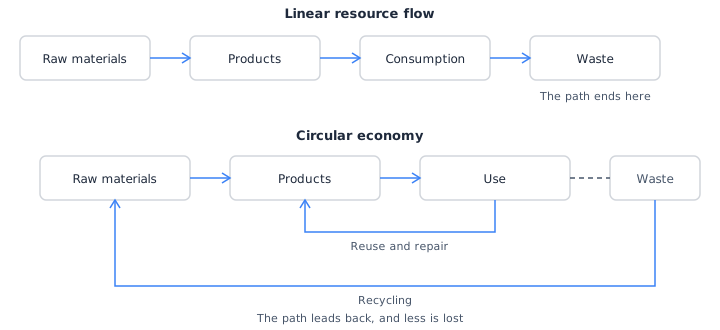
Wirtschaftskreislauf means something different here from chapter 1. The script says resources should be held im Wirtschaftskreislauf for as long as possible, and in doing so takes a word you already know: in chapter 1 the Wirtschaftskreislauf is the model of the flows of goods, services and payments between households, firms and the state. What is meant here is not that model but the circulation of the material itself. The two senses share nothing but the word.
Your turn8 of 18
A city burns all its residual waste and reports that practically nothing ends up in landfill any more. It therefore calls itself a pioneer of the circular economy. What does the Skriptum hold against this?
Reuse, repair and recycling are three routes and not one
The script names the three return routes side by side, and their order is not a ranking by value but a list. Even so it pays to keep them apart, because they take hold at different points.
In reuse the product stays what it is and gets used once more. In repair it is put back into a usable condition and likewise stays the same product. In recycling the material is recovered and the product dissolves in the process: what is left is raw material and no longer a device.
From this follows the commonest false assumption about this section, namely that resources could be held in the cycle by recycling alone. All three routes lengthen the time a material does some good, and that is exactly the declared purpose. For that purpose each of the three counts, and none of them is the principal one.
No such ranking stands in the script. That reuse and repair preserve more of the original value than melting down does, because the product stays a product, is our reading of the declared aim of preserving the resource's value for as long as possible; it stands that way in our task solutions too. The script does not state the comparison out loud. Memorise the three routes as three routes; their order does not matter.
Your turn9 of 18
A district funds a second-hand shop for children's clothing, a repair café for electrical appliances and a plant that shreds old window frames into aluminium granulate. A district councillor wants to count only the plant as a contribution to the circular economy. What is correct?
Four related concepts take hold at four points of a product's life
For the circular economy the script names four related concepts. They do not stand against one another, nor against the circular economy, but pursue the same goal at different points of a product's life.
| Concept | Where it takes hold | What it does |
|---|---|---|
| Circular Design | before manufacture, at the plan | the product can later be taken apart, repaired and recovered |
| langlebige Produkte, durable goods | during use | the bound value keeps longer, because the product serves longer |
| Reparaturbonus, a repair subsidy | at the household's decision | repair becomes cheaper than buying new, the device stays in use |
| Urban Mining | after use | material from existing stocks replaces newly extracted raw material |
Two of these rows get turned around readily. Durable goods are sometimes taken to contradict the cycle, because the material returns later; the opposite holds, since the longer a product serves its purpose, the longer the value bound up in it keeps. And urban mining, meaning the winning of metals from old cabling or discarded devices, works not only because less lands in the tip but because the material won replaces newly extracted raw material.
Circular design meanwhile answers a question that often gets answered wrongly: what makes a product fit for the cycle? Not the raw material. An object of natural material can be glued and pressed together so that nothing separates any more, and a device of plastic and metal can be built so that every component can be swapped out singly. What decides it is the way it is built. The script does not say so in these words; it follows from what circular design is meant to achieve.
Your turn10 of 18
A manufacturer designs devices so that parts can be swapped one by one, a city subsidises repairs, and a business recovers metals from old cables. A council group wants to fund only the third approach as circular economy. Which statement of the Skriptum refutes it?
Growth is both the means against poverty and the cause of the burden
With the rebuilding of the economy, the script says, one of the problems that press hardest is to be tackled at the same time: widespread poverty. The order of magnitude belongs to understanding the dilemma that follows.
Almost 700 million people live in extreme poverty today, which is 8.5 percent of the world's population. Reckoning by the higher threshold used for the better-off among the middle-income countries, 44 percent of the world's population count as poor. In Austria in 2023 around 14.9 percent of the population counted as at risk of poverty.
| Group | Size | Threshold |
|---|---|---|
| in extreme poverty | almost 700 million, 8.5% of the world's population | less than 2.15 US dollars a day |
| counted as poor | around 3.5 billion, 44% of the world's population | 6.85 US dollars a day |
| Africa south of the Sahara | 16% of the world's population, 67% of the extremely poor | the extreme-poverty threshold |
| Austria, 2023 | 14.9% of the population, around 1,314,000 people | income below 1,572 euros a month, single-person household |
The sources for these figures, the script says, are the World Bank and Statistik Austria. What stands out about them above all is that the number of the poor has barely changed since the 1990s, because population growth has largely offset the progress made.
Growth is often taken to be the solution, that is, an increase in economic activity. From that a fundamental dilemma arises, and it comes in two halves, both of which hold.
The one half: given the way the world does business today, several planetary boundaries have already been crossed, and with that it becomes questionable over the long run whether people's needs can be met at all. The other half: without additional economic activity the means are lacking with which poverty is reduced and social development carried, and that is why growth counts as necessary.
Note why this contradiction does not resolve itself through speed. It is resource-intensive growth that produces it; growing faster sharpens the ecological half instead of settling it. What lowers poverty today can, through its effects on the environment, produce new risks tomorrow, economic and social alike, and especially where it rests on resource-intensive growth.
Just as little does it resolve itself through a ranking. What the script calls for is a route on which the economy can develop within the biophysical limits, on which social justice moves forward, and on which the ecological tipping points stay untouched. Both stand side by side: the fight against poverty is not postponed until the ecological limits are respected, and the ecological condition is not ranked above the social one. And development within the biophysical limits is precisely not ruled out, it is what the script demands.
Your turn11 of 18
A government wants to halve poverty within ten years and relies solely on letting the economy grow faster in the existing way. Which statement of the Skriptum speaks against this plan?
For the Brundtland report, squaring the circle is doable
This dilemma is not new, and the most influential answer to it is almost forty years old. It stands in a report titled “Our Common Future”. It was published in 1987 by the World Commission on Environment and Development (WCED); it is also known as the Brundtland report (Brundtland-Bericht), named after Gro Harlem Brundtland, who chaired that commission. The script counts it among the most important publications of the late twentieth century.
The first thing to remember about it is its design: it describes the extent of poverty and the threats to sustainability together, not one after the other and not in separate chapters. Only out of that joint view does the question arise at all of how fighting poverty and protecting the environment can be reconciled.
The second is its answer, and it comes out more confident than many expect. Squaring the circle is possible, the report says. No renunciation of growth is demanded in it; what is demanded is a condition on the kind of growth. The growth that is needed against poverty must not, through its effects on the environment, produce economic problems in the future.
Watch the direction of this condition, because it gets turned around readily. The report does not say the environmental consequences of the needed growth are to be accepted. It says the opposite: precisely those consequences must not occur, and that is why another kind of growth is needed.
The third is a claim about feasibility. The report holds a new kind of economic growth to be not only necessary but also doable. Without that second half, all that would remain of it is a demand with no prospect.
Your turn12 of 18
A commentary sums up the Brundtland report like this: fighting poverty needs growth, and its environmental consequences simply have to be accepted for that. How does this relate to the report?
Sustainable development is a kind of growth, not a rejection of growth
For this new kind of growth the report coined the name sustainable development. Because the exact wording is itself examined here, it stands unchanged as the script gives it: “Sie ist eine Form des Wirtschaftswachstums, die die Bedürfnisse und Wünsche der Gegenwart befriedigt, ohne die Fähigkeit des Wirtschafts- und Umweltsystems zu gefährden, diese Bedürfnisse und Wünsche in der Zukunft zu erfüllen.” That is: it is a form of economic growth that satisfies the needs and wants of the present without endangering the capacity of the economic and environmental system to meet those needs and wants in the future.
Break the sentence into its two halves and it checks out easily. The first half says what is delivered: the needs and wants of the present are satisfied. The second names the condition on it: the capacity of the economic and environmental system to deliver the same in future must not be endangered in the process.
Two things are therefore precisely not in it. First, no rejection of growth: in the script sustainable development is a form of economic growth and not its opposite. Second, no ceiling on today's consumption: the condition addresses the system's capacity and not a quantity.
You will recognise in it the short statement from the start of this article, and that is no accident. Both say the same thing: sustainable is whatever preserves the capacity to deliver later as well. The Brundtland report merely sets that capacity in relation to growth.
Growth or development. In the report's customary wording, sustainable development is a form of development, not a form of economic growth. The script renders it as a form of economic growth and thereby shifts the emphasis. What is examined is the script's version, and this chapter's claims are aimed at that one.
Your turn13 of 18
In a seminar the report "Our Common Future" is presented as a call to give up economic growth. Which statement of the Skriptum refutes this?
Sharing, durable designs and remanufacturing are routes to that growth
What such a kind of growth might look like, the script answers with three examples: sharing models (Sharing-Modelle), durable designs (langlebige Designs) and remanufacturing, that is, the reconditioning of used parts. All three save raw materials, cut emissions and at the same time open up new economic opportunities.
The last point is the one most often overlooked. The three routes are no substitute for growth and no alternative to it, they are routes to a different kind of growth. The ecological and the economic reason coincide here: whoever puts in less raw material saves costs and emissions in one.
Keep remanufacturing apart from recycling, because the two get equated readily. In recycling the material is recovered and the product dissolved in the process. In remanufacturing the part is kept, put back in order and used on; the manufacturing effort already inside it is kept along with it. A gearbox that has been taken apart, checked and put back together is still a gearbox afterwards.
With sharing models the gain arises from one device serving several users instead of standing with each of them separately. The script sets no condition that the shared device must be new: a jointly used older trailer replaces just as many separately bought trailers as a new one does.
Your turn14 of 18
A manufacturer takes back used gearboxes, dismantles and tests them, replaces worn parts and sells them again. How can this business be classified according to the Skriptum?
In the European Green Deal the claim has turned into a duty
Up to here sustainability was a claim made on individual firms. With the European Green Deal (EGD) it has become, for European economic policy, a key concept, and thereby a frame for the common market. The script names two tools for this.
The first is sustainability reporting (Nachhaltigkeitsberichterstattung). It is compulsory for large firms: in the EU since the 2017 financial year under the Non-Financial Reporting Directive (NFRD), at first for large listed companies and other public-interest entities, and since the 2024 financial year, step by step, under the Corporate Sustainability Reporting Directive (CSRD), which widens the circle of firms that must report. The script gives 2022 as the starting year; if an exam statement names that year, the script's figure is meant. Two parts of this duty are asked about: that it is a duty, and that it is addressed to large firms and not to firms of every size. Two things at this point come from us and not from the script: that voluntariness preceded this duty, and the reasoning behind the size line, namely that a report costs work a small firm could hardly carry and that the line therefore trades informativeness off against effort. The script names the line without justifying it.
The second is the EU taxonomy (EU-Taxonomie). It is meant to promote ecological business, and the script names as an example a better standing on the capital market. The whole route of the effect is contained in that: the taxonomy sorts economic activities by whether they count as ecologically sustainable, and whoever is sorted in there gets capital more easily and more cheaply.
Remember what this tool works through; the script only hints at the route with the capital market, and everything further unpacks that half-sentence. A classification forbids nothing and prescribes no technology. It changes the conditions of financing, and through those conditions it changes the decisions of firms.
Your turn15 of 18
A wind farm operator learns that his activity is classified as environmentally sustainable under the EU taxonomy. Where does the advantage for him lie according to the Skriptum?
The term comes from the forest
Up to here you have worked with a term as though its meaning were unambiguous. The script contradicts that itself: sustainability is used often, it says, yet its meaning often stays unclear. Frequent use has therefore not made the term sharper but blurrier, and that is exactly why a distinction between two schools follows at the end of the chapter.
The origin lies in forestry (Forstwirtschaft). Sustainable there meant not taking more trees from the forest than grow back in it, since only that way does the stand of trees remain and yield timber lastingly. That was an economic consideration from the outset and no programme against use: the stand was preserved precisely because people wanted to use it.
Out of this basic idea a wider concept has grown, one that takes in long-run ecological, social and economic developments together. The core stayed put in the process, namely not to take out faster than things renew themselves; what is new is the breadth of the fields the rule is applied to. It holds for water, for soils and for fish stocks just as for trees, and the fact that it could be carried over is what made the term what it is today.
Your turn16 of 18
A fish stock of 50,000 tonnes grows back by 4,000 tonnes every year without fishing. Which annual catch matches the forestry idea of sustainability?
Weak sustainability nets losses against gains
Weak sustainability rests on the three-pillar model (Drei-Säulen-Modell). It knows three pillars, ecology, society and the economy, and treats them as equal in worth. From that follows its central assumption: what is lost in one of the three pillars can be made good by a gain in another. Natural resources are on this view replaceable in principle, whether by human knowledge or by capital, as long as the total sum of all kinds of capital stays constant or grows.
The reckoning at issue needs entries, and the script names three kinds of capital. Natural capital (Naturkapital) is forests, mineral deposits and biodiversity. Human capital (Humankapital) is the education and qualification of the workforce. Physical capital (Sachkapital) is production plant in factories. Only this division makes the sum reckoning statable at all, and what gets asked about is which items belong to it.
The yardstick of this school is therefore the sum and not the individual entry. A corporation that clears an old stand of forest and puts up a training centre and a new factory in its place is arguing in exactly this logic: natural capital falls, human and physical capital rise, the sum stays.
One misunderstanding is worth pinning down here. Weak sustainability does not overlook losses of natural capital. It does take note of them and merely demands that the total sum not fall in the process; the loss is netted, not passed over. That is a difference which claims about the two schools like to blur.
In the script, the three-pillar model and weak sustainability are the same thing. Outside the script the three-pillar model is the common frame for sustainability in general, and there are versions of it that expressly deny any substitutability of the pillars. The script ties the model to the weak school and derives substitutability from the equal worth of the pillars. What you learn is the script's assignment.
Your turn17 of 18
A corporation clears an old stand of forest and builds a training centre and a new factory in its place. The board calls this sustainable. Which statement of the Skriptum shows which school of thought it relies on?
Strong sustainability does not let you net
Strong sustainability stresses how fundamental the ecological systems and processes are that the economy and society rest on. Particular ecological functions, a stable climate for instance, count for it as indispensable, because no amount of economic or human capital replaces them. It therefore rejects treating natural resources as equivalent to other forms of capital and demands instead that natural ecosystems be preserved and protected as far as that is possible.
On this school the assessment of the corporation from the previous section comes out differently. A training centre and a factory do not make up for the cleared stand of forest, because the two cannot be netted against each other in the first place. A stable climate is the example the script names for this: no amount of growth in human or physical capital brings it back.
The difference between the two schools therefore lies in a single assumption, namely the one about substitutability. It does not lie in their goals: both want a sustainable economy. Everything else follows from the assumption, above all the question whether a loss here can be made good by a gain there.
| Question | weak sustainability | strong sustainability |
|---|---|---|
| Basic figure | three pillars of equal worth: ecology, society, economy | ecological systems carry the economy and society |
| Are natural resources replaceable? | in principle yes, by knowledge or capital | no, particular functions by nothing |
| Yardstick | the total sum of all kinds of capital does not fall | every indispensable ecological function is preserved |
| A loss of natural capital | counts as made good if other kinds rise correspondingly | stays a loss |
| The script's assessment | the less demanding reading | markedly more demanding, but necessary |
The last row is a judgement, and the script makes it expressly. Markedly more demanding is strong sustainability, it says there, and at the same time necessary if a sustainable economy is to come about. More demanding it is because it forbids netting: whoever may not net has to preserve every single ecological function instead of crediting a loss in one place against another. Whoever takes the strong school for the milder one has swapped the two.
The last row is a position and not a finding. Whether strong sustainability is necessary is disputed in the scholarly debate, and the script settles the question instead of leaving it open. What you learn is the script's ruling; but keep it apart, as the script's assessment, from what the script describes.
What all of this hangs on shows up best in an appraisal. Two experts assess the same project, one nets losses against gains, the other holds one of the affected stands to be irreplaceable. The two are not arguing about figures. They are arguing about whether netting is allowed, and which of the two schools underlies an assessment decides how it comes out.
Your turn18 of 18
A bog that stores large amounts of carbon and thus contributes to a stable climate is to be drained for a new factory. In return the corporation offers a training centre whose value exceeds that of the bog. How does an expert who follows strong sustainability judge this?
Now practise it
Sustainability and the Circular Economy (Nachhaltigkeit und Kreislaufwirtschaft)
PractiseWas this article helpful?