Legal Forms of Companies (Rechtsformen von Unternehmen)
The article on companies and value creation asks what a company is and what it contributes. One question stayed open, and it faces everyone who goes into business with a company: whom are you actually dealing with? Who may sign, who decides, and who pays when there is nothing left inside the company?
The legal form answers that. This article goes through the main forms, but not as a list to memorise. They differ along a few axes, and whoever knows those axes can derive the individual form almost every time.
The legal form says who may speak and who has to answer
Whoever does business with a company takes on a risk and wants to be able to judge it. Five things have to be known for that: who runs the company, who conducts its day-to-day business, who may sign contracts for it, where its capital came from, and who answers for its debts if it comes to that. Negotiating this afresh at every deal would be five questions too many, and so the legislator has answered them once and for all for a set of forms.
The legal form is the statutory frame within which a company is run. It sets out who runs the company and represents it towards the outside, who provides its capital, and how far liability for its debts reaches. These answers come as a package: choosing the form chooses them too, and they cannot be assembled one by one.
Part of this information is open to inspection, namely in the commercial register (Firmenbuch). That holds only for companies entered there, however, and which ones those are depends on the legal form in turn. A section of its own further down comes back to it.
One statement gets turned around here regularly, and it stands in the definition already: the legal form does say who may sign for a company. That is exactly what it is there for.
Your turn1 of 21
A printing firm is to deliver a large machine to a KG that is a new customer. Its sales manager says the customer's legal form tells you nothing about who may sign a contract there; that has to be asked separately for every customer. What is correct?
Four questions decide which form suits a company
There is no best legal form. Which one suits depends on four questions:
- Who founds the company?
- Who wants to run it, or is meant to?
- How is the necessary capital to be raised?
- Who is liable, and up to what amount?
Keep these four in view, because the exam tasks take them up as a whole. The number of employees at any rate does not decide on its own which form is any good for a company, and neither does the industry or the turnover taken by itself.
How far the answers can diverge is shown by comparing two foundings. A person starting small on her savings needs little capital, wants to decide alone, and has nobody to share the liability with anyway. An industrial operation, by contrast, has to erect and pay for large plant; it needs a lot of capital from many people, and those many want neither to work in it nor to answer for those facilities with their own house. Two different answers to the same four questions give two different forms.
Your turn2 of 21
Four consultants each recommend a legal form to founders. Which reasoning rests on what the choice of form actually depends on?
Four families, ordered by how far liability reaches
The WU text divides the main forms into four families: sole proprietorships, partnerships, corporations and cooperatives. The partnerships comprise the general partnership (OG) and the limited partnership (KG), the corporations the limited liability company (GmbH) and the stock corporation (AG), plus two younger variants: the flexible corporation (FlexKapG) and the Societas Europaea (SE).
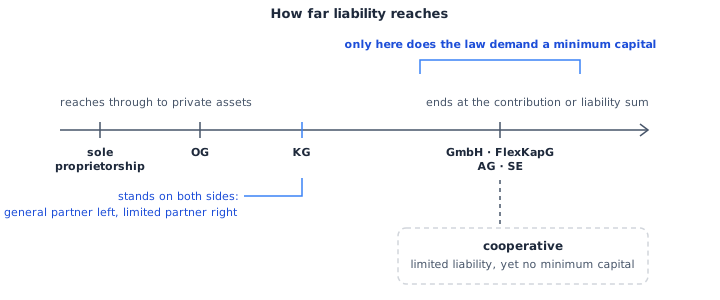
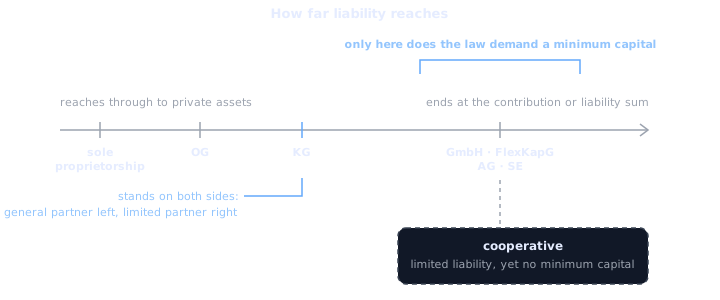
This order is more than an enumeration. From left to right, liability withdraws from private assets.
Your turn3 of 21
Four people hold stakes in different companies, all of which close with debts far exceeding the company's assets. For whom must one expect that private assets will be drawn on as well?
Whoever limits liability has to give the law something for it
The diagram shows two things at once, and the connection between them carries the whole article.
If a person answers with everything she owns, then the creditors have a security nobody has to see to separately: that person's assets. That is why the law demands no minimum capital for the sole proprietorship and for the partnerships. Founding is simple, and the liability is paid for with your own house.
If liability ends at what was paid in, on the other hand, that security is gone. In its place the law puts an amount that has to be present in the company from the outset, and that is the minimum capital of the corporations. Limited liability is therefore not a gift, it is paid for.
The WU text does not spell this connection out. For every form it states separately whether a minimum capital is demanded and how far liability reaches; that the one has to do with the other is our reading, and it is meant as a memory aid. One form falls out of it anyway: the cooperative limits liability and still gets by without a minimum capital. Learn the four families separately, therefore, and use the connection only to check yourself.
Your turn4 of 21
A fellow student derives a rule from the axis of legal forms: a form in which all participants have limited liability demands a statutory minimum capital. Which form refutes this rule?
In a sole proprietorship the decision and the risk fall to one person
In a sole proprietorship a single person runs the company. She makes the decisions, she carries the entrepreneurial risk, and she is liable without limit for all the debts of the company: not only with what belongs to the company, but with her private assets as well.
Four statements follow from that, and every one of them is examined.
Founding requires no minimum capital. That is why the form is so widespread among small companies: it can be set up comparatively simply, and nobody asks for proof of capital along the way.
The owner as a rule raises the capital alone. If the savings do not suffice, the remainder usually comes from a bank. Further providers of equity are not something this form provides for.
Employees are allowed. The name is about ownership, not about headcount. Whoever founds alone may hire whomever the business needs: a baker with a saleswoman at the counter and an apprentice in the bakehouse still runs a sole proprietorship.
The risk cannot be handed on. Nobody has a say, and nobody carries it with her. Independence and sole liability are two sides of the same thing here.
The last point reaches beyond the company. If a sole proprietorship goes under, then often it is not only the company that is finished: the owner as a private individual ends up in financial difficulty as well. A failed self-employment frequently ends in personal bankruptcy (Privatkonkurs), that is, in debt settlement proceedings for a private individual.
Your turn5 of 21
A sole proprietor runs a bicycle shop with two employees. The shop closes with 50,000 euro of debt, and only 12,000 euro is still to be had in the business. What applies to the remaining 38,000 euro?
A partnership spreads what one person no longer carries
A partnership has at least two participants. They provide the capital and answer for the debts at the same time. Whether they also work in the company depends on the type of their participation.
The usual path into this family leads through growth. Once a sole proprietorship outgrows what one person can run and pay for at the same time, it can be converted into a partnership. Three burdens are laid on several shoulders in the process: the financing, the liability and the responsibility for management.
What this family cannot do follows from the same construction. In a partnership there are seldom many participants, and a small circle seldom raises high sums. That is why they often hang on financing through bank loans. Note the direction of that sentence: the reason is the small circle and not a large one.
Your turn6 of 21
An OG needs 400,000 euro for a new workshop hall and, like many partnerships, finances it through a bank loan. What reason does the Skriptum give for this family often depending on bank loans?
In an OG every partner is liable for the whole amount
The general partnership knows only one type of partner, and the same applies to all of them.
- At least two people found it. With one alone, only the sole proprietorship would remain.
- All of them are entitled to conduct the business and obliged to do so. The right to have a say is at the same time a duty here.
- Each of them is liable with the whole of her private assets, and for the full sum of the debt at that. This is called joint and several liability.
- There is no statutory minimum capital, just as there is none for the sole proprietorship.
The third point regularly gets softened into a division by heads. With three partners and debts of 90,000 euro, each is by no means liable for 30,000 euro. A creditor may turn to a single one of them and demand the full 90,000 euro from her; how the three settle it among themselves is their business and not his.
Your turn7 of 21
Two brothers run a joinery as an OG, and it closes with 60,000 euro of debt. The bank turns only to the elder brother, because there is nothing to be had from the younger one. The elder says no more than his half, that is 30,000 euro, can be claimed from him. Which statement of the Skriptum refutes him?
The KG allows a partner who gives money without working in the business
The limited partnership distinguishes two types of partner, and that is its entire purpose.
| Feature | General partner | Limited partner |
|---|---|---|
| at least | one person | one person |
| conducting business | yes | no |
| working in the firm | yes | no |
| liability | personal and unlimited | up to her liability sum, usually her contribution |
| rights besides that | control, access to the books |
The general partner is thus put on a level with an OG partner: working in the firm, participation in the capital and liability are the same. The limited partner gives up the conduct of business and gets an upper bound on his risk in exchange. That upper bound is the liability sum (Haftsumme) entered in the commercial register, and it usually equals the agreed contribution. Once the limited partner has paid in his contribution to that amount, he is not liable to the creditors for anything beyond it. That does not leave him without influence: he keeps rights of control, and he is allowed to inspect the books of the partnership.
Put the question the way it presents itself before joining. A doctor is considering putting 18,000 euro into a friend's pottery workshop without ever lifting a finger there, and wants to know what that costs her at worst. As a limited partner whose liability sum, as usual, equals her contribution, it costs her those 18,000 euro and not one euro beyond, however high the debts of the workshop run up in the end. The friend as general partner stands differently: should the debts exceed what is still to be had in the business, the remainder is demanded from her private assets, and there is no upper bound for that. The sum of the debt is not parcelled out in the process: neither by heads nor by shares does a quota arise from it that would fall on the doctor.
Two confusions suggest themselves here. First, the size of a contribution does not depend on whether somebody works in the firm: what characterises the limited partner is precisely that he does not work in it, and how large his contribution turns out is agreed independently of that. Second, the upper bound applies to him alone; the contributions added together do not form a bound for the partnership as a whole.
Your turn8 of 21
A teacher has put 20,000 euro into a wine business as a limited partner; as usual, her liability sum is set at this amount. She does not work there. When the wine business runs up 300,000 euro of debt, her brother-in-law says she now has to pay part of it out of her savings. Which statement of the Skriptum refutes him?
Corporations separate the money from the management
In a corporation the shareholders make capital available to the company without having to work in it or to run it. As a rule they are liable only with what they have contributed. For this participation the law prescribes a minimum amount of capital.
This separation is the reason why high sums can be raised with this family. Whoever gives money without having to work may live far away and follow an entirely different profession. Whoever risks only the money put in parts with it more readily. Out of few partners who risk everything, this is how you get many who risk little.
Raising capital and conducting business can therefore fall apart. They do not have to, because a shareholder may perfectly well conduct the business too. Nobody is obliged to, though, and that is the difference from the OG, where conducting the business belongs to being a partner in the first place.
Your turn9 of 21
A doctor from Innsbruck holds 60% of the nominal capital of a Viennese GmbH and keeps working in her practice. Her fellow shareholder demands that, as a shareholder, she must also conduct the business. What applies?
A corporation is itself a person, but it cannot sign
Corporations have a legal personality of their own. In law they count as a legal person; their counterpart is the natural person, that is, the human being.
A natural person is a human being. A legal person is an entity to which the legal order grants a capacity of its own: it can conclude contracts, do business, and in court both sue and be sued. Act by itself it cannot, however; for that it needs human beings.
From that last sentence follows why every corporation has prescribed bodies. A GmbH cannot sign, so the managing director signs for it. An AG cannot negotiate, so the management board negotiates for it. Who may appear for a company is therefore not an internal arrangement but a question of the legal form.
The other way round, a sole proprietorship has no legal personality of its own. There the owner acts as a human being, and that is exactly why her private assets answer for the debts as well. The two sentences belong together: where there is no separate person, there is nothing for the private assets to withdraw behind either.
Check the direction of these terms as well. A registered company does not become a natural person by being registered; natural persons are exclusively human beings.
Your turn10 of 21
A GmbH rents a warehouse. Who is the party to the lease, and who puts the signature under it?
The GmbH demands 10,000 euro of nominal capital, half of it in money
The limited liability company is the most widespread corporation. The capital the shareholders provide is called the nominal capital (Stammkapital); what a single person contributes to it is called a nominal contribution (Stammeinlage). The law fixes four numbers, and the exam tasks take up every one of them.
One shareholder suffices. A second person is not something the law demands here.
The nominal capital amounts to at least 10,000 euro. This figure has applied since 1 January 2024; before that it stood at 35,000 euro. Both numbers appear in the WU text, and the exam asks about the current one.
Every single nominal contribution amounts to at least 70 euro. Do not confuse the 70 euro with the nominal capital: they are the lower bound for a single person's share.
At least half of the nominal capital comes in the form of money. The remainder may be a contribution in kind (Sacheinlage), that is, an asset instead of an amount. With a nominal capital of 10,000 euro that means 5,000 euro in money, the rest as you like.
Work an example through. A GmbH is endowed with the legal minimum, and the three participants divide those 10,000 euro into 6,000, 3,000 and 1,000 euro. All three contributions are above 70 euro, which is fine as far as that goes. If the third person raises her 1,000 euro not in cash but in the shape of the shop fittings, that is covered too, as long as, out of the 10,000 euro, at least 5,000 euro is really paid in as money.
The GmbH is run by one managing director or several. Whether they are shareholders at the same time is left open. They can be, and are then called managing shareholders, but they can equally come from outside. Payment follows the role and not the person: conducting the business earns a salary, the capital contribution earns a share of the profit. Anyone filling both roles accordingly receives two things on two separate grounds.
The liability stands in the name of the form already. The shareholders are liable only with their nominal contribution; their private assets stay out of it.
Your turn11 of 21
Three people found a GmbH with the statutory minimum nominal capital of 10,000 euro. Two of them pay in 7,000 euro between them, the third contributes the shop fittings worth 3,000 euro. An acquaintance thinks this is not allowed and says the whole 10,000 euro must be paid in cash. Which statement of the Skriptum refutes him?
The FlexKapG lowers the entry threshold to one euro
For a short while now there has been a form leaning on the GmbH, the flexible corporation. In two points it resembles its model, in two others it departs from it.
The same are the nominal capital of 10,000 euro and the fact that a single shareholder suffices. Whoever thinks the younger form demands more capital is confusing it with the AG.
Different is first of all the smallest permissible nominal contribution: here it amounts to 1 euro instead of 70 euro. Only with that do very small participations become practicable. Different, second, is that there are company-value shares (Unternehmenswert-Anteile) here, a category of their own within the nominal capital. They are intended for the staff: whoever holds such a share receives his portion of the profit, but he cannot help decide with it, because no vote hangs on this share.
This combination is where the purpose of the construction becomes visible. A company can give its staff a share in the profit without the balance of votes shifting with every new participation.
Your turn12 of 21
A software firm organised as a flexible corporation wants to give its staff a share of the profit. One of the two founders fears that every new share for the staff will cost her a piece of her majority. Which statement of the Skriptum takes away this worry?
Your turn13 of 21
Two founders want to set up a flexible corporation and each puts in 1 euro. With this form, they think, one euro is enough, and the company is thereby equipped. Which statement of the Skriptum shows that this does not suffice?
The AG breaks the capital into shares and the top into two bodies
In the stock corporation the capital provided is called the share capital (Grundkapital), and it amounts to at least 70,000 euro. Because it is broken into shares, the shareholders here are called stockholders.
For liability the same applies as with the GmbH. Stockholders do not answer personally for the debts of the company; what they can lose is the money that sits in the price of their paper, and nothing beyond that.
At the top stand two bodies, and the exam asks about their relationship. The management board conducts the business on its own responsibility and represents the AG towards the outside. It is appointed and removed, however, neither by itself nor by the general meeting, but by the supervisory board.
Large companies with a high need for capital are frequently organised as an AG, and for the same reason frequently as a GmbH. Both forms bring together larger sums than a partnership could.
Your turn14 of 21
At the general meeting of an AG many stockholders are unhappy with the management board. One of them proposes to get rid of the board right there by a vote. Which statement of the Skriptum shows that this does not work?
The SE is an AG whose legal frame does not change at a national border
The European company, in Latin Societas Europaea, is modelled on the stock corporation and therefore belongs to the corporations as well. The Austrian construction group Strabag is organised this way.
Its use lies in a single circumstance. The legal frame of this form stays the same no matter in which member state of the European Union or of the European Economic Area the company has its seat. For a group with branches in several states that means one set of rules instead of many. To a company whose business ends at its own national border it correspondingly offers little.
The minimum capital prescribed here is 120,000 euro, that is, more than the 70,000 euro of the Austrian AG. Switching from the AG to the SE therefore does not lower the threshold, it raises it.
Your turn15 of 21
An Austrian AG with 90,000 euro of share capital sells only at home. Its management board is considering switching to the SE, because the European form is supposedly more modern and saves capital. What should be made of this?
The cooperative supports its members and counts heads rather than shares
A cooperative joins at least two persons together, and both natural and legal persons qualify. Its purpose is to support the trade and the economic activity of its own members. The Austrian legal form is called the registered cooperative (e. Gen.); at European level the Societas Cooperativa Europaea (SCE) stands alongside it.
Two places in this definition are worth holding on to. It is not only human beings who may join together, but companies too. And it is the members who are supported, not the cooperative itself: what stands in the foreground is not earning profits but doing business together.
What that looks like is shown by the two paths the WU text names. Production facilities and operating equipment can be used jointly, and buying or distributing can likewise be done jointly. Both reach an order of magnitude a single member firm does not reach, and out of that come synergy effects. Eight farmers sharing a combine harvester buy one harvester instead of eight.
What happens to surpluses follows from the same purpose. Either they stay in the cooperative and are invested there again, or the members receive them paid out by way of a refund (Rückvergütung). Anything third is not provided for by this form.
Four further features belong to it.
No minimum capital. What a share costs the cooperative lays down itself in its statutes; there is no statutory amount for it.
Limited liability, customarily at double the amount. Beyond the share subscribed, the member answers once more for the same amount, but no further. The share, then, is not the upper bound of the risk but half of it.
A changing body of members. Joining and leaving are simple, so the number of members fluctuates, and whoever wants to take part for a while only can join just as well as someone who stays.
One member, one vote (Kopfstimmrecht). In a vote each person has one vote, regardless of how large her share in the capital is. The statutes may depart from this.
It is at the one-member-one-vote rule that the cooperative and the corporation part company most clearly. In the AG what decides is how many shares somebody holds; in the cooperative what decides is how many members want something.
With the bodies, confusion is as frequent as with the AG. The cooperative is run by the management board, which its own members make up. That does not make it the highest body: the essential decisions are voted on in the general meeting. From 40 employees on, a supervisory board is added as well.
Your turn16 of 21
A farmer subscribes a share of 1,000 euro in a dairy cooperative. Seeing that the cooperative gets by without statutory minimum capital, he reckons that at worst he will lose these 1,000 euro. Which statement of the Skriptum shows that he underestimates his risk?
Where additional equity comes from follows from the legal form
If a company needs more equity than it has, then its legal form says where it can come from. These answers do not have to be memorised, they can be derived from what has gone before.
Sole proprietorship and OG. There is nobody apart from the participants themselves, so they have to put more in. If they do not, only outside capital remains, that is, the loan. Issuing shares on an exchange is a matter for the AG and no route at all for an OG.
KG. The general partner stands as an OG partner does and has to put in more himself. The limited partner has a lever of her own: she can increase her capital contribution.
GmbH. Two routes are open. Either the existing shareholders increase their contributions, or a further shareholder comes in.
AG. New shares are issued. The existing stockholders can buy them, and if they do not, new ones can.
Cooperative. Further members are admitted. Since joining is simple anyway, this is the most obvious route of all for it.
One thing stands out about this list. The further right a form stands on the axis from the third section, the more easily it gets money from people who do not want to work in the business. That is exactly what limited liability is there for.
Your turn17 of 21
A KG needs more equity. The general partner cannot put in anything more, but the limited partner has savings. Which route fits the legal form?
Some have to go into the commercial register, others may
The commercial register is a central and public database of companies kept by the courts. Any person may inspect it. It makes registered companies transparent, which eases the closing of deals: whoever wants to go into business with a company finds the essentials about it there.
This definition clears up two misunderstandings. The commercial register is kept by the courts and not by the chamber of commerce. And any person may inspect it, not only somebody who is entered there himself.
Who has to go in is decided in essence by the legal form. The OG, the KG, the GmbH, the AG and the cooperatives have to be entered, without regard to how large they are or how much they turn over. With the sole proprietorship it is different: it goes in only from a certain size on, and for that the WU text names two thresholds.
- more than 700,000 euro of annual turnover in each of two years in a row, or
- more than 1 million euro of turnover in a single year.
Check both thresholds one after the other, otherwise the commonest trap springs. A sole proprietor turns over 750,000 euro in the first year and 660,000 euro in the second. The first threshold is not met, because not both years lie above it, and the second is not met either, because a million was exceeded in neither of the two years. So she does not have to. In the third year she turns over 1.1 million euro: now the second threshold carries on its own, and no second year is needed for it. The WU text names the same 700,000 euro for the cash-basis accounting as well (p. 66), there briefly as turnover per financial year. In law (§ 189 UGB) the same rule applies there as here; in the exam you answer in each place with the wording of the WU text. Cash-basis accounting is dealt with by the article on accounting.
Every sole proprietorship may have itself entered voluntarily, small ones included. Some do, because transparency towards their business partners is worth something to them. Most small ones nevertheless do not.
What the entry contains answers exactly the questions from the beginning of this article:
- the business name (Firma), that is, the legal name of the company, woom GmbH for instance,
- the seat and the object of the business,
- the names of the shareholders, but not those of the stockholders of an AG,
- how much capital limited partners and GmbH shareholders have contributed,
- and who may conduct the business.
Two points from this get turned around readily. The business name is the name and not the place; where a company has its seat is entered separately alongside. And the stockholders of an AG expressly do not appear in it, although the shareholders of other forms very much do.
Your turn18 of 21
A sole proprietorship turns over 680,000 euro in its first year and 900,000 euro in its second. An acquaintance of the owner says that with the 900,000 euro in the second year she is above the 700,000 euro line and must now enter the commercial register. Which statement of the Skriptum refutes him?
Your turn19 of 21
Before the first deal with a GmbH, a supplier wants to know who conducts its business. A colleague advises him to ask the GmbH itself, saying the commercial register does not show this anyway. Which statement of the Skriptum refutes the colleague?
Your turn20 of 21
Two graphic designers run a small studio as an OG with 90,000 euro of annual turnover. They think they only have to go into the commercial register from 700,000 euro of turnover. Which statement of the Skriptum refutes them?
Austria's commonest legal form is the simplest one
From the article on companies and value creation you know that around 99% of Austrian companies are SMEs and around 90% have fewer than ten employees. The distribution of legal forms looks correspondingly.
- Around 85% of companies are sole proprietorships, and among newly founded ones the share is the same.
- About every tenth company is a GmbH.
- The OG and the KG account for about 2% each.
- All the remaining legal forms stay below that again.
Do not confuse these 85% with a number that reads the same in the article on companies and value creation. There the share meant is that of companies staying under one million euro of annual turnover, here it is the share of sole proprietorships. The two numbers come out the same and measure different things.
Do the arithmetic briefly and two common misstatements drop out. Taken together, the OG and the KG reach around 4%, not a quarter. And about every tenth company is organised as a GmbH, not every second one.
The picture fits the size classes from the article on companies and value creation. Whoever works alone or in a pair needs neither share capital nor a supervisory board; the simplest form is enough for him. Conversely it is precisely the largest companies in the country that are frequently organised as an AG or as a GmbH, exactly because they need a lot of capital. The two sentences do not contradict each other: one counts companies, the other weighs them.
Your turn21 of 21
A newspaper writes that most Austrian businesses are GmbHs, given that nearly all of the country's large companies have this form. Which statement of the Skriptum refutes the report?
You should be able to fill the table in yourself from the four questions
Cover the three right-hand columns and go through the forms from top to bottom. Whoever has the axis from the third section in view gets by without memorising for most of the rows.
| Legal form | Who runs it | Minimum capital | How far liability reaches |
|---|---|---|---|
| sole proprietorship | the owner herself | none | unlimited, private assets included |
| OG | all partners | none | unlimited, each for everything |
| KG | the general partners | none | limited partner up to his liability sum (usually = contribution) |
| GmbH | one or several managing directors | 10,000 euro | only the nominal contribution |
| FlexKapG | as with the GmbH | 10,000 euro | only the nominal contribution |
| AG | the management board | 70,000 euro | only the share money put in |
| SE | the management board | 120,000 euro | only the share money put in |
| cooperative | the management board | none | the contribution, as a rule doubled |
Our own compilation from the data on pp. 53-58. The fourth column names only the limited partner for the KG, because the general partner is liable as an OG partner is. Who runs a FlexKapG is not something the WU text states; that one cell follows the GmbH the form leans on.
Was this article helpful?