Company Finance (Finanzierung)
The article on legal forms showed who puts up a company's capital and who answers for its debts. It left the other half of the question open: where does the money come from once the shareholders can no longer or will no longer add any, and what does the person handing it over ask in return?
That is the subject here. The exam items on this section nearly all come down to two distinctions, and anyone who keeps them apart can derive the rest: does the capital belong to the business or is it borrowed, and does it come out of the company's own sales or from outside?
What gets financed is not the business but two very different kinds of payment
Money is not something a business needs once; it needs it continuously, and the occasions behave in completely different ways.
Financing means raising the funds a business needs to make its payments. Those payments fall into two groups: one-off acquisitions that serve the business for years, and recurring payments that come due afresh every month.
The first group is called investments (Investitionen). The business acquires machinery, a vehicle fleet, computer equipment, and these acquisitions arrive at long intervals. Years pass between one lorry and the next.
The second group repeats month after month: buying goods and raw materials, wages and salaries, energy, rent. Here the gap between two payments is measured in weeks, not years.
Exam statements swap these two categories all the time, and there is a single test that separates them: how soon does the payment come round again? Buying goods comes round every week, which is why it is not an investment, however large the individual invoice. Fitting out a shop comes round once in ten years, which is why it is one, however small it looks beside the annual turnover.
Needing both at once is the normal case, not the exception. A haulage business that buys two lorries in January pays wages, diesel and insurance across those same twelve months. No business has only one kind of need.
And both start before the first sale. Founding a company already calls for money for premises and their fittings, and whether that money is there in sufficient amount is, according to the textbook, one of the things that decide whether a start-up succeeds at all.
Your turn1 of 18
A bakery replaces its oven with a new one roughly every eight years. The apprentice thinks that because the oven is bought again and again, it is a recurring payment and not an investment. Which statement from the textbook refutes him?
Your turn2 of 18
A hair salon buys a styling chair for 900 euro that is meant to last ten years, and spends around 1,500 euro every month on shampoo and hair dye. The owner thinks the chair is too cheap to be an investment; the hair dye, which comes to 18,000 euro a year, is more likely one. Which statement of the Skriptum refutes her?
Between paying and being paid there is a gap
Once the business is running, sales bring money back in. That does not settle the problem, because the two flows of money do not meet in time.
A trading business settles its invoices on the date the supplier sets. What customers pay for those same goods arrives weeks later. In between lies a stretch of time in which the money is already gone and nothing has yet come in: the business has stock on the shelf and an empty account. That stretch has to be survived, and what helps it survive is called short-term financing need.
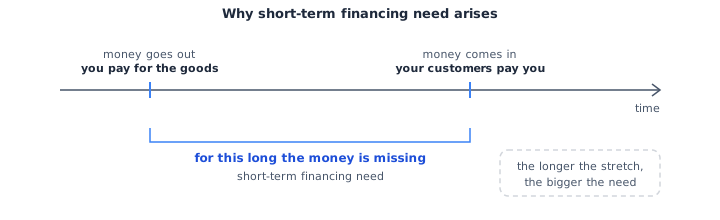
One rule follows from this drawing, and the exam likes to inflate it into a regulation. How long the money stays tied up should match how long the financing is available. Paying for a machine that will work for ten years with a six-month loan goes wrong: repayment falls due long before the machine has earned back its price.
That does not make it forbidden. The textbook writes that financing for long-term investments must be available long-term, and by that it means an economic necessity, not a legal duty. The same holds the other way round: nobody has to take out a ten-year loan for next month's wages.
Your turn3 of 18
An electronics dealer resells every device at a mark-up and makes a profit. Even so, his account is regularly empty for a few weeks. Which statement from the textbook explains this?
Equity belongs to the business, debt is borrowed for a time
The first of the two big distinctions asks whether the provider can demand the money back.
Equity is the capital that the founders or the shareholders put into the business themselves. It covers not only money paid in but contributions in kind as well, that is, assets instead of amounts. Bringing in a delivery van and two computers raises equity exactly as a bank transfer would.
Debt capital is capital made available to the business by third parties, as a rule by a bank or a supplier. It is usually available only for a fixed period, has to be repaid and mostly carries interest as well. Whoever provides it is a creditor.
What follows from the word "borrowed" carries the rest of this section. Someone who puts in equity has no date on which it comes back, and as a rule no time limit at all. That is why equity suits acquisitions that stay tied up for years. Someone who provides debt capital has a date, and that date determines what a loan is good for.
Financing themselves entirely from equity works for very few businesses. The textbook calls this expressly unrealistic, from which it follows that in practice the question is not "either or" but "in what proportion".
The chief representative of debt capital is the loan. Alongside it stand amounts owed to suppliers, and for very large companies bonds come in as well; both get a section of their own further down.
Your turn4 of 18
Two people found a business. One transfers 30,000 euro, the other brings in a delivery van of the same value, and a bank loan is added. An acquaintance says only the transfer is equity. Which statement from the textbook refutes him?
Whoever gets no security gets a say instead
Four questions are enough to tell the two kinds of capital apart completely. The textbook sets them side by side in a table, and they hang together more closely than the four rows suggest.
| Question | Equity | Debt capital |
|---|---|---|
| How long does it stay in the business? | long-term, usually with no time limit | short or long, as agreed |
| What does it cost? | at most a share of the profit | interest, and the amount itself must be repaid |
| May the provider have a say? | depending on the legal form, to a varying extent | usually not |
| Does the provider get security for repayment? | no | yes, if the loan is sufficiently secured |
Our own compilation from Tab. 3 on p. 60.
Read the last two rows together and you will not have to learn the table by heart. Someone who holds security and gets the money back on a date does not need a say: whether the business does well or badly changes nothing about the claim. Someone with neither date nor security is at the mercy of how the business fares and is compensated for that with rights to have a say. How far those rights reach depends on the legal form, and the article on that subject has already shown the differences between an OG, a GmbH and an AG.
Two places in the table are awkwardly worded, and both are worth saying out loud once.
The second row names a share of the profit for equity. Elsewhere, however, the textbook writes:
"Für Eigenkapital müssen in Zeiten, in denen keine Gewinne erwirtschaftet werden, keine Zinsen gezahlt werden wie für einen Kredit." ("For equity, unlike for a loan, no interest has to be paid in periods in which no profits are earned.")
Wirtschaft verstehen (WU Vienna, admission procedure 2026), p. 59
That can be misread as saying equity earns interest in good years. It does not. Equity carries no interest whatsoever; what it can cost in good years is a share of the profit, and even that is voluntary. Management is just as free to leave the profit in the business.
The fourth row asks about security for the repayment of equity, although equity is not repaid at all. So the answer "no" is more a side effect of the question than a statement in its own right. It can still be remembered in the direction that is useful: a bank demands security, an incoming shareholder gets none.
Your turn5 of 18
A partner has put 40,000 euro of equity into a business. After a good year he demands interest on it, of the kind a bank would get for a loan, since there is a profit after all. Which statement of the Skriptum refutes him?
The supplier helps finance the business, and the cash discount makes that expensive
Loans do not come from banks alone. According to the textbook, long-term loans are granted mainly by banks, while over short periods suppliers appear alongside the banks as important lenders. Fix the direction of that sentence in your mind, because reversed it produces one of the most common false exam statements.
How a supplier turns into a lender can be seen on the invoice. If a delivery does not have to be paid for at once but only at a later date, it is a delivery "auf Ziel", on payment terms. Until payment falls due the business works with goods it has not paid for, and what stands open in the meantime is a trade payable (Lieferverbindlichkeit).
This delay is rarely free. Whoever pays immediately is often allowed to deduct something from the invoice amount, and that deduction is called a cash discount (Skonto). Whoever uses the payment period forgoes it and thereby pays for the time gained.
Work it through on an invoice of 8,400 euro. Anyone transferring within ten days may deduct 3%; anyone waiting longer owes the whole sum and has until the fortieth day to pay it.
- The deduction comes to 252 euro, so 8,148 euro would be payable.
- Whoever uses the full period pays those 252 euro on top and in return keeps 8,148 euro for thirty days longer.
- Measured against the 8,148 euro still in hand, 252 euro is around 3.09% for thirty days.
- A year holds twelve such stretches, so the price of this delay is around 37% a year.
The textbook does not work this calculation through; it gives only the result, namely that the effective interest rate of a cash discount usually turns out very high. What effective interest means, and why it rather than the nominal rate makes two offers comparable, is in the article on money, currency and interest.
The practical conclusion surprises many people. Someone without enough money in the account to take the discount may under some circumstances be better off overdrawing the account briefly and paying at once. The script presents this route as possible rather than as the rule: it can be the economically more sensible variant (S. 60). How it turns out depends on what the bank charges for the overdraft, because the roughly 37% is the price of the delay and not the price of the bank credit. Using the payment period is therefore, at any rate, not automatically the thrifty choice.
From the seller's point of view, incidentally, that same payment period is a marketing instrument: the article on markets and target groups files delivery and payment terms under price and terms policy. Here the very same arrangement stands on the buyer's side, and there it is a source of finance.
Your turn6 of 18
A supplier grants forty days and deducts 3% if payment is transferred within ten days. The customer lets the forty days run out and thinks that is thrifty. Which statement from the textbook describes what he has done economically?
Your turn7 of 18
A plumber buys pipes from a wholesaler and each time pays for them only six weeks after delivery. He says he has no borrowed capital, since he has not taken out a loan at any bank. Which statement of the Skriptum refutes him?
Internal and external ask about the source, equity and debt about the claim
The second big distinction asks not who the capital belongs to but where it comes from.
We speak of internal financing when the source of the funds lies in the company's own sales. If it lies outside the business, this is external financing. From outside, both equity and debt capital can flow in.
The last sentence of that definition matters most, and it is the one most often answered wrongly. Capital from outside is not automatically debt capital. If a business takes on someone as a shareholder and that person puts capital in, the money undoubtedly comes from outside, yet it remains equity.
The two distinctions are therefore two independent questions and not a series of four terms. Treating them as a pair of axes lets you place any form of financing instead of memorising a list.
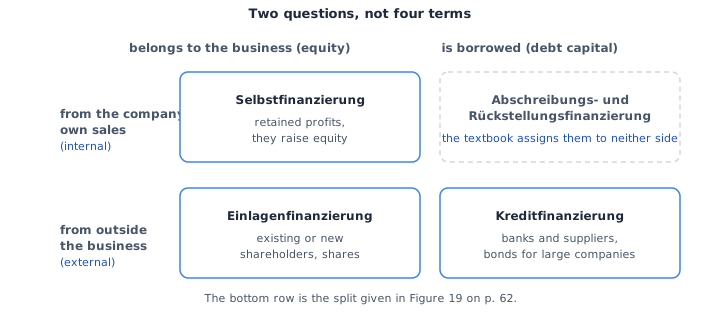
Three of the four fields are unambiguous, and the bottom row comes straight from the textbook: it divides external financing into contribution financing (Einlagenfinanzierung) by existing or new shareholders and loan financing (Kreditfinanzierung) by banks or suppliers.
The fourth field is deliberately empty. Depreciation-based and provision-based financing are unambiguously internal financing according to the textbook, but nowhere does it say whether they count as equity or as debt. So do not classify them yourself: what matters for the exam is that they sit on the internal side. The same caution applies to defining internal financing by way of sales. With a provision, the money strictly speaking does not come from sales; it stays in the business because no payment goes out. The textbook nonetheless counts it as internal financing, and in case of doubt the textbook governs.
Placing an item is therefore purely an exercise in asking the questions. A bank loan: from outside, borrowed, hence loan financing. A supplier credit lands in the same field, only the lender does not sit in a bank. What an incoming shareholder puts in: from outside, but with no claim to repayment, hence contribution financing. Retained profits: from the company's own sales and with no claim to repayment, hence self-financing.
Your turn8 of 18
A business takes on a further shareholder who contributes 50,000 euro. An employee classifies this as debt capital, because the money comes from outside. Which statement from the textbook refutes him?
Retained profits are the simplest form of internal financing
Self-financing means that a business does not distribute the profits it has earned but leaves them in the company. Those profits thereby raise equity and stand ready for further ventures.
That retained profits enlarge equity you know from the article on companies and value added. What is new here is the role they play in doing so: they are a source of finance, and the one source nobody has to be asked for.
The textbook names four reasons why this carries a business better through a crisis.
It depends less on providers of debt capital. Nobody has to apply for money that is already theirs, and such an application certainly cannot be turned down.
It pays no interest for it. Interest on debt falls due whether the year was good or bad; retained profits cost nothing.
It withstands more loss-making years. Losses eat into equity. Where there is plenty of it, a business survives several loss-making years in a row without slipping into over-indebtedness. If it melts away quickly instead, until the debts exceed everything the business owns, then the business is over-indebted and economically at risk.
It stays technically up to date. Profits that are put back to work renew plant and operating equipment, and a modernly equipped business stays competitive.
The third point gets twisted in both directions in exam statements. Plenty of equity protects against over-indebtedness, it does not encourage it, and a single loss-making year is nowhere near enough to over-indebt a well-equipped business. Conversely, plenty of debt does not make a business more crisis-proof but more fragile, because interest and repayment run on in bad years too.
Keep two terms apart here that blur easily. Over-indebtedness compares assets with debts. Solvency compares the invoices falling due with the money actually to hand. One can occur while the other does not; how solvency is planned belongs to accounting and is in the next section of the textbook.
Your turn9 of 18
A business has a loss-making year behind it. It is financed with its shareholders' equity and a running bank loan. One shareholder says that without a profit nobody has to be paid anything this year. Which statement from the textbook refutes him?
Depreciation is earned, but it is not paid out
The second form of internal financing looks at first sight like bookkeeping and is nevertheless a source of money.
Depreciation puts a figure on the loss in value that machinery, vehicles or computers suffer in the course of a year. It counts among the company's expenses, yet no payment goes out against it: the asset was paid for back when it was acquired.
The financing effect arises in four steps, and every single one of them is examined.
- The business calculates its prices so that they cover all expenses, and usually a profit on top.
- Among those expenses is the loss in value of the assets, that is, the depreciation.
- If the goods find buyers at exactly those prices, the loss in value has been recovered along with the rest of the proceeds. The depreciation is then said to have been earned.
- Because no payment goes out against that loss in value, the money stays in the business for the time being and can be used for other investments until the next acquisition.
Figures make this concrete quickly. A joinery has paid 480,000 euro for its machines and reckons on eight years of use. That puts 60,000 euro of depreciation on each individual year, and that amount is built into the price of the furniture. If the joinery achieves those prices, 60,000 euro comes in every year for eight years with no payment going out against it. At the end of the eight years this adds up to exactly the 480,000 euro the machines cost.
The third step carries a condition that is readily overlooked. If the business sells below the calculated prices, the depreciation is simply not earned, and the effect fails to appear. The financing effect hangs on the market, not on the bookkeeping.
What else a price is set by, and why the company's own costs form only the lower limit, is in the article on the marketing mix. Here all that matters is that depreciation belongs among those costs.
Your turn10 of 18
A joinery has paid 480,000 euro for machines, reckons on eight years of use and achieves the furniture prices it calculated. The owner is surprised that year after year about 60,000 euro more stays in the account than the reported profit would suggest. Which statement from the textbook explains this?
A provision costs profit before it costs money
The third form of internal financing works on the same pattern, only it looks forward.
A provision is an accounting precaution against an expense that may arise in the future: for a court case the business might lose, for holiday entitlements, for pensions or for severance payments. Setting one aside burdens the result: the current year reports that much less profit, while everything stays put in the account.
The financing effect is the same as with depreciation, and it has the same cause: an expense with no payment. The money earmarked for the future case lies in the business until then and can be used for other purposes in the meantime.
How long "until then" lasts decides how much this source is worth. If a court case is settled this very year, the precaution taken for it helps only briefly. Pensions are quite a different matter: providing today for members of staff who will stop working twenty or thirty years later means having those funds at your disposal for that long, which is why the textbook speaks here of a long-term financing effect.
Avoid the commonest false inference here. A provision is not a payment to anybody, nor is it a sum of money set aside. It is an entry in the books, and its financial effect consists precisely in the fact that nothing is paid out.
Your turn11 of 18
A business forms a provision for a court case that will be decided only in a few years. The bookkeeper asks what amount she must transfer for it today to a separate savings account. Which statement from the textbook answers her question?
From outside, equity arrives as a contribution and debt as a loan
That brings us to the bottom row of the pair of axes. Whoever brings equity in from outside is either a shareholder already or becomes one in the process.
In a GmbH these contributions are called Stammeinlagen or Geschäftsanteile. They may differ in size from one person to the next; what is tied down is only the total, which must reach the statutory minimum share capital. How high that stands, and what other figures apply to a GmbH, is in the article on legal forms.
Taking on new participants who make a capital contribution is open to the other legal forms as well. What these participants receive in return simply goes by a different name there, and which name depends once again on the legal form.
On the other side stands debt capital from outside. The most important providers are, as shown above, suppliers and banks. Large companies also have bonds open to them.
Your turn12 of 18
In one year a GmbH raises money in four ways. Which of these ways is contribution financing?
A share certifies a stake, and it brings the company money only at issue
In a public limited company (Aktiengesellschaft) the shareholders are called Aktionäre, and the capital they raise is called Grundkapital or Aktienkapital. It is broken up into shares, and that is its real purpose: an amount no single person could raise is cut into many small pieces that many people can raise. Large amounts of capital thereby become easier to obtain, not harder.
A share is a security covering a stake in the share capital of a public limited company. Whoever owns one holds a part of the company. What a share costs is called its price (Kurs), and that price forms out of supply and demand.
That a price arises in the market rather than being set is the same mechanism the article on markets, price formation and competition describes for every other price. Neither the company nor the stock exchange sets it.
Now the distinction on which most exam items in this section hang. Investors' money enters the company's till exactly once, namely when it issues the papers. That event is called an issue (Emission), and it alone finances the company.
What happens to the papers afterwards passes the company by. If a shareholder hands her holdings on to somebody else, the purchase price moves from one securities account to another, and the company is not party to that deal at all. If the price lies above the earlier purchase price, the seller pockets the difference. Trading in older holdings therefore brings the company nothing.
The share capital is not repaid at all. The company keeps it with no time limit whatsoever, and anyone wanting out looks for somebody wanting in. That is precisely where it differs from a loan, which falls due on a date.
How this pays off over long periods the textbook puts in figures: adding growth in value and profit distributions together, shares have brought their holders an average return of 6.5% a year since 1900, against 0.6% a year for savings deposits. The averaging runs over more than a hundred years, and an average says nothing about the single year: individual years can be deep in the red.
Your turn13 of 18
A classmate says that whoever buys shares always pays another investor; the company limited by shares itself never gets money from share buyers. Which statement of the Skriptum refutes her?
In a capital increase the subscription right protects existing shareholders' stakes
If a company needs more equity, it increases its share capital and issues new shares for the purpose, which are called young shares (junge Aktien). That creates a problem for everyone already involved: as the number of shares grows while their own holding stays the same, their percentage stake in the company shrinks.
Against this stands the subscription right (Bezugsrecht). It gives everyone already invested first refusal on the new papers; whoever takes it up keeps their quota of the share capital unchanged.
Anyone who does not want to or cannot buy more is not left without recourse, because the subscription right itself can be sold. Whoever hands it over leaves the way in to others, and those others thereby become shareholders. Two confusions are easy to fall into here: the new papers are called young shares and not subscription rights, and whoever sells only the right pays not a cent for the papers themselves, because they are precisely not acquiring them.
Your turn14 of 18
A company issues young shares. On the same day a long-standing shareholder sells part of her holding on the stock exchange at a gain. The board counts both amounts among the funds flowing to the company that day. Which statement from the textbook refutes it?
Your turn15 of 18
A company increases its share capital. One shareholder has no money to spare and fears he can only watch his stake shrink. Which statement from the textbook shows him what he can do instead?
A bond certifies a claim and has a maturity date
Very large amounts are hard to take up as a loan from a single bank. For large companies and for states there is therefore a second route to debt capital.
A bond is a security that certifies a claim. Whoever buys one holds a claim against the issuer, that is, against the large debtor who is borrowing money by this route. That debtor may be a company or a state. On what terms the money is borrowed, above all interest and duration, is agreed from the outset. Other names for the same paper are Schuldverschreibung, Rente and Bond.
How one large amount becomes many small ones is shown by the denomination (Stückelung). The total amount required is called the nominal amount of the bond and is broken into part-amounts, so that many different lenders can each take on one or several of them. If a group issues a bond of 24 million euro and denominates it in units of 100 euro, that produces 240,000 part-amounts; whoever buys thirty of them makes 3,000 euro available to the group.
There are two moments at which to get in: right at the issue, or later while the paper is still running. The price of a bond is likewise called its Kurs, and it too arises out of supply and demand, exactly as with a share.
When the agreed period runs out, the creditor gets the money back: the issuer repays it, as a rule at the nominal value or at a price fixed back at the issue. There is a word of its own for this, namely redemption (Tilgung). What it means is repayment to the creditors and by no means the issue of further papers.
There are accordingly two ways of earning on a bond, and the second is not open to everybody.
- The money made available carries interest, in the manner the bond terms provide for.
- If the price rises, the spread between the purchase price and the selling price can be earned on top. This second return does, however, require the bond to be given up early: whoever leaves it lying until the time has run out receives the nominal value at the end and nothing else.
Interest ranks among the most important terms of a bond and not among its incidentals. It may stay the same throughout or it may move; you know both forms from the article on money, currency and interest. If it moves, it follows the general level of interest rates, and the reference figure used for that is often the Euribor.
Euribor stands for Euro Interbank Offered Rate. What it measures is the rates at which banks make euro amounts available to one another for short periods, averaged across many institutions. It is not a single figure: there is a separate rate for every usual term. These rates are applied as the starting figure wherever an interest rate is meant to move, so also for bonds with a moving rate. Such papers are called floaters.
Your turn16 of 18
A group needs 24 million euro. An analyst asks why it does not simply take the amount as a loan from its house bank but issues a bond instead and denominates it in units of 100 euro. Which statement from the textbook answers this?
Your turn17 of 18
A bond carries a moving rate tied to the Euribor. An investor nonetheless expects to receive the same interest over the whole term. Which statement from the textbook refutes her?
A share and a bond differ in what they certify
Both are securities, both are issued, both have a price arising out of supply and demand. Everything else follows from a single question: does the paper certify a stake or a claim?
| Feature | Share (Aktie) | Bond (Anleihe) |
|---|---|---|
| What is certified? | a stake in the share capital | a claim against the issuer |
| What does the buyer become? | a co-owner of the company | a creditor of the issuer |
| For the business it is | equity | debt capital |
| How long does it run? | unlimited, no repayment envisaged | until maturity, then redemption |
| What does it bring the buyer? | profit distributions and price gains | interest and possibly a price difference |
| Who can issue it? | the public limited company | large companies and states |
Fix the second row in your mind and several common false statements fall away by themselves. Whoever buys a bond does not become a co-owner of the company but its creditor. And because a creditor, by the table in the third section, usually has no say, holders of bonds expect no voice in running the company either, but their interest and their money back.
Your turn18 of 18
An investor buys shares and bonds of the same energy group on the stock exchange, both at a price arising from supply and demand. What is she afterwards in relation to the group?
Was this article helpful?