Business Accounting (Rechnungswesen)
A business can have an excellent year behind it and still stumble on a Tuesday morning over an invoice for 12,000 euro. That is no contradiction. It is the starting point of this whole section: success and money are two different quantities, they are measured separately, and they come apart regularly.
This is exactly why a business does not calculate once but runs several calculations side by side. Whoever remembers which question each of them answers has this section under control, because false statements about it usually rest on a swap: either of two areas or of two terms.
Accounting is organised by questions, not by departments
Business accounting falls into several areas. What separates them is not the person doing the arithmetic but the question an answer is sought for.
| The business question | The area in charge |
|---|---|
| Are the funds sufficient, or is extra money needed? | Cash budgeting (Finanzrechnung) |
| What does the business own, and out of what was it paid? | Bookkeeping (Buchhaltung) |
| Has it grown richer or poorer over the period just ended? | Bookkeeping (Buchhaltung) |
| What does a single item or a single service cost? | Cost accounting (Kostenrechnung) |
| How much does one item sold contribute towards coverage? | Cost accounting (Kostenrechnung) |
Own compilation after Tab. 4 on S. 64.
Five questions but only three areas: this is where the table in the script is most easily misread. Two questions there are assigned to bookkeeping and two to cost accounting. The second and third rows therefore belong together, and for a reason of substance that returns later in this article: whoever knows what a business owns and what it owes can also read off whether it has grown richer.
Cash budgeting covers financial planning, budgeting and cash flow. Bookkeeping produces the balance sheet along with the profit and loss statement. Cost accounting, finally, works its way down to the individual product.
Remember the areas by how they relate to time and you will stop confusing them. Cash budgeting looks forward, because the planning is for the coming month. Bookkeeping looks back at a financial year that has ended. Cost accounting looks inward, at a single item.
Your turn1 of 21
The owner of a painting business wants to know two things: whether she will need a bridging loan next month, and whether her business has grown richer over the past year. Which areas of accounting answer the two questions?
Staying able to pay is a task of its own
A business must be in a position to settle its invoices as they fall due at any time, both those for running expenses and those for investments. This property is called liquidity or solvency (Liquidität, Zahlungsfähigkeit).
What happens when it is missing is existential in the literal sense: the business faces insolvency. What brings it down, then, is not a poor result but the circumstance that on a particular day the money for a payment due was not there. The only guard against this is planning, and the tool for it is called a financial plan or budget.
A financial plan sets all planned incoming payments against all planned outgoing payments for a manageable stretch of time, often for one month. It thereby answers a single question: is anything left at the end, or is something missing? If something is left over, that is a surplus of incoming payments (Einzahlungsüberschuss). If something is missing, that is a shortfall (Fehlbetrag), and the shortfall also measures the financing need.
In its construction such a plan is no different from what a private household draws up for its month. On one side stands what comes in, on the other what goes out, and the interesting part is the difference.
The case in which more comes in than goes out is the pleasant one, yet it too calls for a decision. A surplus left sitting in the bank account is not working. If it is large, it is worth considering putting part of it to work. Two things have to be kept in mind: outgoing payments may outweigh again in the coming weeks, and for payments nobody foresaw the business needs a reserve it can reach quickly. That is precisely why the entire surplus is not tied up.
The other case is the dangerous one. If more goes out than comes in, solvency is under threat and the business has to act at once. The script lists several possibilities for this without presenting them as a complete list; they are examples, not an enumeration of every route.
- Cut spending wherever that is possible without damage.
- Negotiate a longer payment period with the business's own suppliers, that is, be allowed to pay later.
- Grant its own customers only short payment periods, that is, be paid sooner.
- Keep less in the warehouse, because stock ties up money.
- Take out a short-term loan from the bank.
Do not test this list by memorising it, but by its direction. All five measures move the same lever: money should come in earlier and go out later. This is why a longer payment period helps where the business itself pays, and a shorter one where it collects. Swapping the two makes matters worse. And nowhere does it say that a short-term bank loan is ruled out as a countermeasure: it is expressly one of the routes.
If it does not stop at a one-off squeeze but insolvency keeps threatening, these means will not do. Then the capital base itself is up for debate, and one route there is to take on further shareholders who put in capital and thereby secure liquidity for the long run.
Financial planning is hardest of all, incidentally, right at the start. A founder already faces considerable outgoing payments while incoming ones are still absent, and there is no experience to estimate what will come in. This is why providers of capital as a rule require a financial plan when approached for financing, and why it should be calculated cautiously: an over-optimistic plan convinces nobody who sees such plans often.
What a business then covers the identified need with is a separate question. It belongs to the article on financing, which takes apart equity and debt as well as internal and external financing. Here the task ends with knowing the need in good time.
Your turn2 of 21
A bakery expects 62,400 euro of incoming payments and 68,900 euro of outgoing payments for July. The owner sees no reason to act, as the bakery has sales every day. Which statement from the textbook refutes him?
Between an expense and a payment lies the distinction that matters
In connection with the financial plan, four words come up that appear to mean the same thing in everyday speech and here precisely do not.
Incoming payment and outgoing payment (Einzahlung, Auszahlung) denote actual movements of money: something arrives in the account or leaves it. Income and expense (Einnahme, Ausgabe) are the wider terms. Most of the time both pairs coincide, yet they can come apart, and in two ways.
The first way is a matter of timing. Income can arise long before the money arrives. If a business delivers in March against an invoice and is paid only two months later, the event belongs economically to March but the money to May. For solvency in March that sale is therefore worthless: it is not yet in the account.
The second way is a matter of substance, and it is the more important one. Some items have no payment against them at all. The standard example is depreciation (Abschreibung).
A machine bought three years ago and paid for at the time loses value year after year. That loss of value is charged as an expense, yet not a cent flows out because the invoice was settled long ago. It therefore does not belong in the financial plan: only amounts that genuinely leave the account stand there. What exactly this circumstance means for financing a business is developed in the article on financing; here all that counts is that nothing of the kind shows up in the financial plan.
From both follows which pair of terms is the more precise one in cash budgeting. Because what is at stake there is money actually available, incoming and outgoing payment are the more exact words, not income and expense. Exam statements like to reverse this order.
Your turn3 of 21
A garden centre books the monthly loss in value of its delivery van in April. A temporary helper enters this amount under the outgoing payments in the financial plan for April. Which statement from the textbook shows her mistake?
A positive cash flow means an inflow, not a profit
The same thought takes on a name of its own as soon as one looks at it over a whole period.
The cash flow of a period is obtained by setting the incoming payments and the outgoing payments of that period against each other. If it turns out positive, then on balance money has flowed into the business, and that is an indicator of solvency. A negative cash flow means the opposite: over that time more flowed out than in.
What a business needs this inflow for is what makes the figure important in the first place. Investments are paid for and loans repaid out of money that has flowed in. Neither can be met out of a reported profit alone, because a profit is not an account balance.
With that the central distinction of this article is reached. The two quantities of a period do not coincide, nor are they meant to, because they measure different things. Both divergences occur.
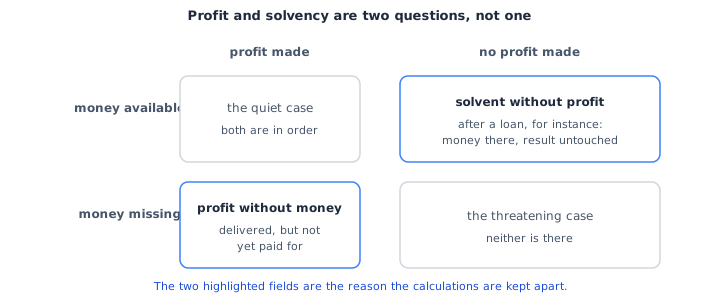
The upper right field surprises most people. If a business takes out a loan, money is in the account the next day and solvency is restored. The result is untouched by this, because borrowed money is not revenue; it is a debt. Anyone inferring a profit from a loan drawn down has confused the two axes.
The lower left field is the case this article began with. Whoever delivers in spring and is paid in summer has already earned the success and still had no money in between. If a large invoice falls into that gap, a good result does not help.
And the third confusion concerns responsibility. The annual profit is not determined in the cash flow statement but in bookkeeping. Movements of money are not the same as success.
Your turn4 of 21
A construction business closes the year with a profit and still cannot settle an invoice falling due the following February. A supplier thinks this impossible: whoever shows a profit also has money. Which statement from the textbook refutes him?
Your turn5 of 21
In December a business takes out a bank loan of 50,000 euro. The owner is pleased, saying that the annual result will thereby come out 50,000 euro better. Which statement of the Skriptum refutes him?
Determining the profit is compulsory, keeping a cost accounting system is not
With that the article moves into the second area, and that one begins with a legal duty. Every business is required by law to establish its result for each financial year, that is, profit or loss. This is not a recommendation and not a question of size.
The nearest reason for it is tax. Taxes on income are levied on the result, and who owes them depends on the legal form: in one case the entrepreneur herself pays, in the other the company. What each legal form means is set out in the article on legal forms.
Because bookkeeping thereby provides information to the outside while documenting the business at the same time, it carries a second name.
Bookkeeping also goes by the name of external accounting (externes Rechnungswesen), because its results are meant for outsiders and give them information. Cost accounting, by contrast, is called internal accounting (internes Rechnungswesen), because it is used only inside the business itself. That is also why it is not prescribed.
Keep the two labels apart by the direction they face and you will not need to memorise them: external means outward, internal means inward. Reversed, this produces one of the most frequent false statements in this section.
Equally false is the assumption that the result is of interest to the tax authority alone. It is of interest first of all to the management itself, because it shows how successfully the business has been run. And it is of interest to further groups: the script names in first place those who provide capital, alongside them the shareholders, the business partners and the staff, without closing off that enumeration.
From the established result there also follows a decision that rests with management: is the profit withdrawn and distributed, or does it stay in the business in order to finance new machinery, say? What the second choice achieves is treated in the article on financing under the name of self-financing.
Your turn6 of 21
An electrician runs a business as a sole trader with 180,000 euro of annual turnover. He has no cost accounting, and he thinks that at this size he need not establish his annual result either. What applies to him?
Your turn7 of 21
A managing director says: 'Cost accounting is our external accounting, because we show it to the bank; bookkeeping is of interest to the tax office alone.' Which statement sets this right?
How the profit is determined depends on legal form and size
The duty applies to everyone, the procedure does not. Which of the two procedures is permitted is decided by two features: the legal form and the level of turnover.
The simpler procedure is the income and expense account, EAR for short (Einnahmen-Ausgaben-Rechnung). It sets a year's expenses against its income and involves markedly less work than the other procedure. Note a subtlety here that is often examined: what is essentially meant by expenses are the amounts that have flowed out, yet the loss in value of the assets is counted in. So it does not fall by the wayside here either, even though not a single euro leaves the account on its account.
The more demanding procedure is double-entry bookkeeping. It leads to a balance sheet and to a profit and loss statement, and these two statements together form the annual accounts (Jahresabschluss).
Who may use which procedure fits into three sentences.
- Sole proprietorships and partnerships may choose the EAR as long as their turnover for the financial year stays below 700,000 euro.
- Once they cross that threshold, they must move to double-entry bookkeeping.
- Corporations are caught by double-entry bookkeeping in any case, however small their turnover.
The third point is the trap. A GmbH with 520,000 euro of turnover may not use the EAR, although it lies below the threshold, because for it the legal form decides and not the turnover. Conversely a sole proprietorship with 250,000 euro of turnover may choose the EAR but has to switch if it turns over 830,000 euro two years in a row. The WU text states this limit as turnover per financial year (p. 66), and in the exam you answer with that wording. In law (§ 189 UGB) the same rule applies to bookkeeping as to the commercial register (p. 57): more than 700,000 euro in two years in a row or more than 1 million euro in one year. The entry is dealt with by the article on legal forms.
To be distinguished from establishing the result, finally, is publishing the annual accounts. The first is required of everyone, the second only of some.
A public limited company and a large GmbH must publish their annual accounts. Businesses entered in the commercial register (Firmenbuch) report certain figures from them to the commercial register court, and specifically selected figures, not their documents as a whole. Whoever falls under neither of these duties publishes nothing but must still establish the result. What decides here is always legal form and size, never the industry.
Your turn8 of 21
An OG turns over 620,000 euro in the financial year, a GmbH 210,000 euro. The managing director of the GmbH wants to draw up an income and expense account like the OG, since her turnover is much smaller. Which statement from the textbook refutes her?
Your turn9 of 21
For years an OG has regularly turned over around 900,000 euro a year. A partner still wants to stay with the income and expense account, because as a partnership the OG is not a corporation. Which statement of the Skriptum refutes him?
The balance sheet sets against the assets what they were paid out of
The first of the two statements is a snapshot. It applies to a reporting date, usually the last day of the financial year, and it answers two questions at once.
The balance sheet shows on one side what assets a business has at its disposal on a particular day, and on the other where the means for them came from. The asset side is called Aktiva, the capital side Passiva. Because every piece of property must have been paid for somehow, both sides are always equal in size.
The last sentence is the key to this section and no formality. Aktiva and Passiva do not show two different things but one and the same from two directions: once as objects, once as the origin of the money. This is why the two totals necessarily agree, and this is why that common total carries a name of its own, the balance sheet total (Bilanzsumme).
On the capital side two kinds of capital stand side by side, equity and debt. What separates the two is developed in the article on financing. For the balance sheet a single arithmetical relation is enough.
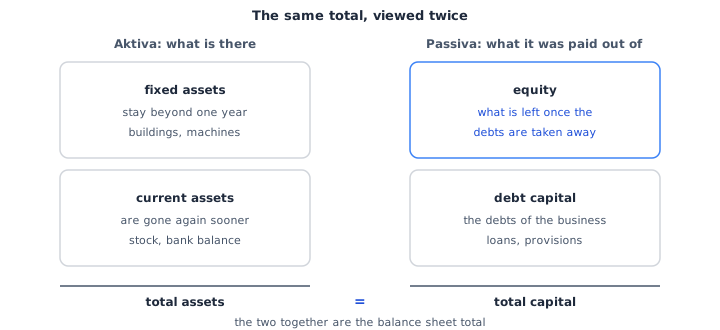
Take the assets and subtract the debts, and what remains is the portion for which no debts were taken on, and this remainder is the equity. From it one can read how well off a business stands on its reporting date: the larger the share it covers out of its own means, the better.
This calculation is the core of almost every balance sheet exercise. If a business reports 900,000 euro of fixed assets and 1,600,000 euro of current assets, its balance sheet total comes to 2,500,000 euro. If 1,750,000 euro of that is debt capital, then 750,000 euro of equity remains. Do not mix up which figure stands for what: the balance sheet total is the sum of the assets, and what remains after the debts have been subtracted is the equity.
At this point the script is imprecise in its wording, and it is worth saying so once. It writes that in the balance sheet the assets are set against the debt capital. What face each other on the two sides, however, are assets and total capital, otherwise the two would not be equal. What is meant is the arithmetical operation by which one finds the equity, namely assets less debts. Both statements in the script are correct, they merely describe different things, and whoever runs them together will get confused when calculating.
Your turn10 of 21
A balance sheet reports 900,000 euro of fixed assets, 1,600,000 euro of current assets and 1,750,000 euro of debt capital. An intern calculates 2,500,000 less 1,750,000 and enters the result as the balance sheet total. Which statement from the textbook shows his mistake?
Debit says what for, credit says where from
In bookkeeping the two sides of the balance sheet carry further names, and those names are more than vocabulary: they explain why the assets stand on the left.
What stands on the asset side goes into the debit (Soll), and what stands on the capital side into the credit (Haben). That both sides are the same size is called equality of debit and credit in this language, and it holds for every balance sheet, whatever legal form the business has.
The reason behind it is a simple question about the direction of the money. The debit records what the means were used for, that is, their application. The credit states where they came from, that is, their origin. Because the assets show what the money is now tied up in, they belong to the application; because the capital shows who provided it, it belongs to the origin.
The same logic holds not only for the finished balance sheet but already for every single transaction it is assembled from. Application to the debit, origin to the credit: that is the whole rule.
Your turn11 of 21
A student thinks the assets stand in the debit because the business owes them to someone. Which statement from the textbook refutes him?
One year decides at what height on the asset side something stands
The asset side is itself divided once more, and the dividing line is a statement about time.
Fixed assets (Anlagevermögen) are everything meant to serve the business beyond one year, such as buildings and machines. Current assets (Umlaufvermögen) are the part that usually disappears again sooner, such as stock. What decides, then, is the intended length of stay and not the value of the object.
Always test an allocation by time, therefore. A workshop building and a lathe serve for years and thereby belong to the fixed assets. Raw material on the shelf is destined to be processed and counts among the current assets, however long it may in fact lie there. The bank balance belongs there too, because money is the most mobile part of the assets of all.
If current assets clearly predominate at a business, it is called current-asset-intensive (umlaufintensiv). At a manufacturing business that is not unusual, because it needs parts for production and often keeps finished products ready alongside. A large stock is therefore no reproach in itself. It is an occasion to check: could less be kept in store without production coming to a halt? If the answer is yes, money currently sitting on shelves is freed up.
Your turn12 of 21
A bakery owns an oven, a delivery van, stocks of flour and a balance in its business account. A temporary helper assigns the flour to the fixed assets because it is stored on the premises. Which statement from the textbook refutes her?
A balance sheet wants to be read, not merely drawn up
What all this effort is good for only becomes clear when a finished balance sheet is evaluated. The script demonstrates this on a bicycle manufacturer, whose figures are summarised here.
| Aktiva | Euro | Passiva | Euro |
|---|---|---|---|
| Fixed assets | 3,320,000 | Equity | 4,139,250 |
| of which land and buildings | 750,000 | of which contributions | 525,000 |
| of which technical plant | 2,330,000 | of which profit | 3,614,250 |
| of which financial assets | 240,000 | Debt capital | 5,499,000 |
| Current assets | 6,318,250 | of which provisions | 2,000,000 |
| of which stock | 5,400,000 | of which bank loans | 3,199,000 |
| of which receivables | 598,000 | of which trade payables | 300,000 |
| of which bank balance | 320,250 | ||
| Balance sheet total | 9,638,250 | Balance sheet total | 9,638,250 |
Figures after the balance sheet example on S. 66; the subtotals have been added.
Four observations can be read off it, and each of them is an exam statement in raw form.
The business is current-asset-intensive. Current assets of 6,318,250 euro face fixed assets of 3,320,000 euro, and the largest single item is stock. For a bicycle manufacturer that is plausible.
It rests mostly on borrowed money. Of the balance sheet total, 5,499,000 euro falls to debt capital, that is, around 57%, and the greater part of it consists of bank loans. A strong dependence on debt capital is typical of Austrian small and medium-sized businesses, and this capital structure therefore does not stand out.
The retained profit strengthens it. At 3,614,250 euro the profit makes up the greater part of the equity. If it stays in the business, it improves both the equity and the capacity for internal financing.
The golden balance sheet rule is satisfied. This rule of thumb requires that assets tied up for a long time also have financing available for a long term. Here fixed assets of 3,320,000 euro face equity of 4,139,250 euro, and equity is available without any deadline. The long-term assets are thus covered out of the business's own means alone, and part of the debt is probably long-term as well. That this is an economic rule of thumb and not a legal requirement is shown by the article on financing on the very same reasoning.
A fifth statement in the script, by contrast, calls for caution. It assigns this business to the small enterprises, and it does so purely because its balance sheet total lies just under 10 million euro. Size classes, however, do not hang on that one figure but first of all on the number of employees and alongside that on turnover or balance sheet total; which thresholds apply is set out in the article on enterprises and value creation. How many people are employed here the example does not say at all. Take away from this passage, therefore, only what it reliably supports: a balance sheet total of this order is nothing unusual for an Austrian business.
And one more confusion lies in wait when two reporting dates are compared. If the equity has grown, the business made a profit; if it has shrunk, it suffered a loss. Exam statements like to reverse the direction.
Your turn13 of 21
On the reporting date a hotel business shows 1,800,000 euro of fixed assets, 1,200,000 euro of current assets and 2,100,000 euro of debt capital. A year earlier its equity stood at 1,000,000 euro; nothing has been withdrawn or contributed since. Which statement about this balance sheet is correct?
The profit and loss statement subtracts the expenses from the income
The second statement of the annual accounts measures not a state but a period of time.
The profit and loss statement, G&V for short (Gewinn- und Verlustrechnung), starts from sales revenue together with other income and takes the expenses away from it. These include, for example, wages and salaries, materials, rent for business premises, insurance and energy. What the tangible assets lose in value counts here as well, as does the creation of provisions. If anything is left after all these deductions, a profit has arisen.
That depreciation shows up here does not contradict what was said above about the financial plan. It is precisely the difference between the two calculations: the profit and loss statement measures success and therefore counts the loss in value, while the financial plan measures money and therefore leaves it out.
The statement is built as a chain of intermediate results, and what is usually examined is whether you branch off at the right point.
| Item | Euro |
|---|---|
| Sales revenue | 70,656,000 |
| less cost of materials | 53,175,000 |
| less staff costs | 7,900,000 |
| less depreciation | 1,800,000 |
| less other operating expenses | 2,875,000 |
| Earnings before interest and taxes (EBIT) | 4,906,000 |
| plus interest income | 12,000 |
| less interest expense | 99,000 |
| Financial result | -87,000 |
| Result before taxes | 4,819,000 |
| less taxes | 1,204,750 |
| Result for the year, that is the profit | 3,614,250 |
Figures after the example on S. 68.
Watch the order, because that is where the most frequent trick question hides. EBIT carries its meaning in its name: it is the result before interest and taxes have been taken into account. Only afterwards do interest income and interest expense come together and yield the financial result, which here is negative because more interest was paid than received. Together with EBIT it leads to the result before taxes, and only once the taxes have been deducted does the result for the year appear. Anyone deducting the interest expense above EBIT takes it away twice and ends up wide of the mark.
Cross-check with the balance sheet above: the 3,614,250 euro is the very same amount standing there on the capital side within the equity. That is no coincidence but the link between the two statements.
With that the second way of determining the profit is reached. A profit makes the equity grow, and therefore one does not have to read it off the profit and loss statement at all: the equity at the beginning can just as well be compared with that at the end of the financial year. Both routes must give the same amount, and because there are precisely two routes, this is called double determination of profit and the technique that goes with it double-entry bookkeeping.
An example of this is quickly worked out. If the equity stands at 640,000 euro at the start of the year and at 712,000 euro at the end, and nobody has withdrawn or contributed anything, then the profit amounts to 72,000 euro. Two false conclusions suggest themselves here. Double does not mean that tax falls due twice; it means that two routes of calculation must lead to the same result. And those 72,000 euro are not lying around anywhere in cash, because a profit is not an account balance, as the field at the bottom left of the diagram above has shown.
Your turn14 of 21
A profit and loss statement gives: sales revenue 3,000,000, cost of materials 1,600,000, staff costs 750,000, depreciation 130,000, other operating expenses 200,000, interest expense 25,000, no interest income, taxes 70,000 euro. A colleague subtracts the interest expense before EBIT and reports an EBIT of 295,000 euro. Which statement from the textbook shows his mistake?
Your turn15 of 21
An OG's equity stands at 410,000 euro at the start of the year and at 458,000 euro at the end. The partners neither withdrew nor contributed anything this year. One of them thinks that without the P&L nothing can be said about this year's profit. Which statement from the textbook refutes him?
The cash flow statement reveals where the flow came from
Published annual accounts consist of more than the balance sheet and the profit and loss statement. A cash flow statement (Cashflowrechnung) is added, also known as the statement of money flows. For the period under review, usually a financial year, it shows what money flowed in and what flowed out.
Its real use, however, lies not in the overall total but in the breakdown. It is built so that the cause of the movements can be recognised, and it distinguishes three areas for that purpose.
Operating activities. In German Betriebstätigkeit. This area is the most important of the three because it concerns the actual business. Here one sees whether the core of the business carries and yields surpluses. Investors therefore look above all at this part.
Financing activities. In German Finanzierung. Here appears what comes in from financing transactions, for instance because new shareholders were taken on and equity flowed in with them, or because loans were raised and debt capital came in with those. On the opposite side stand interest payments, dividend payments and loan repayments.
Investing activities. In German Investition. This area shows whether funds went into long-term acquisitions, for instance into the purchase of fixed assets. In the other direction money can also arise here, namely when fixed assets are sold, a plot of land or a building, say.
Allocate transactions by the question of what they concern, not by the direction of the money. If a plot of land is sold, that belongs to investing, although money comes in, because fixed assets are affected. If a loan is repaid, that belongs to financing, although money goes out, because the capital base is affected. And what new shareholders put in belongs to financing as well and not to operating activities, however well the core business may be running.
Two confusions are especially frequent here. The areas are not called procurement, production and sales; that would be a breakdown by business function and not by the origin of the funds. And the most important area is operating activities, not investing.
Your turn16 of 21
A business sells a plot of land it no longer needs for 300,000 euro. An employee puts the amount under financing activities in the cash flow statement, because money comes in, just as with a loan. Which statement of the Skriptum refutes her?
Your turn17 of 21
A partner is admitted to the company and brings 80,000 euros, which go straight into the well-running core business. An analyst therefore puts the amount under operating activities in the cash flow statement. Which statement from the textbook refutes him?
Costs are not the same as expenses
With that the third and last area is reached. A business has to know what a single product costs, because in the long run it cannot survive if its income does not cover its costs.
Costs are the consumption, valued in money, of what goes into production: the use of machines, of labour and of materials, for example. This consumption is therefore measured not in hours or in units but in money, and that is why it can be added up across quite different kinds of input.
Most of the time costs lie close to the expenses of bookkeeping, yet the two do not coincide completely. There are costs for which no expense is booked in the accounts, and the best-known example of this carries a name of its own.
What is charged as an entrepreneurial wage is what sole proprietors, members of an OG or general partners may expect for working in their own business. They draw no salary for it, which is why no expense is booked on that account. In cost accounting it is nevertheless included, because the work has been performed.
What the size of this amount is measured against is a question you already know. The yardstick is opportunity cost, that is, what the same person could have earned in another occupation. What opportunity cost is in general is developed in the article on scarcity and opportunity cost; here the forgone earnings are the yardstick for comparison.
One more peculiarity belongs to cost accounting itself, already hinted at at the outset. It is not prescribed. Its business value is nonetheless great, because it makes steering and monitoring possible, yet the smaller a business is, the more often it is missing. A small joinery that keeps books and does without cost accounting breaks no rule.
Your turn18 of 21
A sole proprietor builds into her calculation an amount for her own work, although she draws no salary. She does not know how high to set it. Which statement from the textbook answers her question?
Fixed costs stay put, variable costs grow with the quantity
Within costs, one distinction separates everything that follows, and it asks what happens when more is produced.
Fixed costs (fixe Kosten) arise regardless of how much is produced in a period. Variable costs (variable Kosten) grow with the quantity produced, as a rule in the same proportion.
This can be played through at a bicycle manufacturer. Whether 200 or 2,000 machines are produced in a month changes nothing about the salaries of the management, the rent for the site if rent is payable, the insurance, or, at least in part, the depreciation. These amounts arise in any case. What does arise with every additional bicycle, by contrast, is essentially the parts it is assembled from.
What this separation is good for shows itself in a concrete decision. If an additional order is up for discussion, the question to ask is not what a bicycle costs on average but what additional costs this one order triggers. The fixed costs run on regardless; the order does not change them.
Your turn19 of 21
A print shop has 24,000 euro of fixed costs a month (rent, salaries, insurance) and 1.50 euro per brochure for paper and ink. At 8,000 brochures a month it arrives at 4.50 euro of cost per item. A customer wants an additional 2,000 brochures. What costs does this additional order trigger?
The contribution margin decides the borderline case
From this follows a rule for prices that surprises at first and then makes sense.
If the price achieved lies above the variable costs of an item, the surplus helps to carry the fixed costs. This surplus is called the contribution margin (Deckungsbeitrag). Setting it in relation to the selling price yields the contribution ratio (Deckungsquote).
Work through a bicycle that can be sold for 400 euro and whose variable costs come to 180 euro. The contribution margin is then 220 euro, and that is 55% of the selling price. Those 55% are the contribution ratio.
The price should of course carry all the costs, the variable ones as well as the fixed. In the short run, however, a lower price can be sensible too. Think of goods from the previous season that no longer sell at the regular price: if the reduced price stays above the variable costs, a contribution margin still comes out of it, and the fixed costs arise in any case. Letting the item go at that price is therefore more sensible than not selling it at all.
The limit of this reasoning lies exactly at the variable costs. If the price drops below them, the sale no longer contributes anything towards the fixed costs and instead enlarges the loss with every item. This is why the variable costs should come back in without exception.
If a business knows its total fixed costs and its contribution ratio across all models, it can work out from what turnover onwards it reaches the profit zone. This value is called break-even turnover, and with the same meaning break-even point.
The thought behind it is a proportion. Out of every euro taken in, 55% stands ready to carry the fixed costs. If the fixed costs amount to 4 million euro, then those 4 million euro correspond to those very 55%, and the full 100% is what is sought.
The business must therefore turn over just under 7.3 million euro for all its costs to come back in. Whatever it sells beyond that contributes to the profit and thereby secures its continued existence.
How a price comes about beyond this, and why its own costs form only the lower limit, is treated in the article on the marketing mix. Here it is enough to grasp that cost accounting gives the price its floor.
Your turn20 of 21
A hotel still has ten rooms free for the coming weekend. Each causes 30 euro of variable costs per night; with its share of the fixed costs it would be 90 euro. A tour group offers 60 euro per room and night. The manager turns it down because this price does not cover the costs. Which statement of the Skriptum refutes him?
Your turn21 of 21
A joinery sells a chair for 240 euro and spends 150 euro of variable costs per item. For the whole year it reckons with 900,000 euro of fixed costs, and across its range with a ratio of 37.5%. An employee takes 37.5% of the fixed costs and reports 337,500 euro as the break-even turnover. Which statement from the textbook shows his mistake?
Was this article helpful?