Market, Target Groups and Positioning
So far the company has stood on its own: what makes it a company, what it adds, which legal form it appears in. Outside, however, someone is waiting who is supposed to buy, and whether they do decides everything else. A company whose offering nobody needs does not cover its costs, runs into payment difficulties and in the end gives up. Orienting itself towards the market is therefore not optional.
This article is about how a company gets the market it faces into view at all: how it describes that market, how it takes it apart into groups and how it finds itself a place in it. The four areas with which it then works that place belong here as well and are treated here in full, because without them the rest cannot be ordered. The Marketing-Mix topic goes further from a different side, from the benefit a product offers and from its life cycle.
Marketing orients the company, it does not merely advertise it
Hardly any term in this chapter is so reliably thought too small. Colloquially marketing counts as whatever the advertising department does. The WU material contradicts that assumption explicitly.
Marketing means orienting the whole company, and everything it offers, systematically towards what its customers need and want. All operational areas are meant, not only those that deal with customers.
Two words carry this definition. Systematically means that the orientation is not something that occurs now and then, but is pursued continuously. The whole company means that manufacturing belongs to it as well, along with development, procurement and dispatch. Whoever produces past the demand has no advertising problem but a product problem, and a better advertisement will not help them.
Advertising does not thereby disappear. It merely moves into its place: it is one section of marketing, and a small one. Setting prices belongs to marketing just as much, although it has nothing to do with advertising.
The WU material lists five tasks by which you can read off whether a company runs its marketing in full.
- Recognise the need. Know what today's customers require and what tomorrow's will require.
- Plan the offering accordingly. Derive the range from that knowledge and not the other way round.
- Communicate the benefit. Whoever has not heard of an offering cannot want it either.
- Keep prices within reach. The price has to sit so that customers can buy and are willing to buy. Both at once.
- Organise availability. The goods have to be ready at the time and in the place where they are sought.
The fourth point carries a double condition that is readily read by halves. Being able and being willing are two different things: a price can be affordable and still be felt to be too high, and it can sit so low that customers could pay it but begin to doubt the value of the offering.
Your turn1 of 17
A furniture maker sells hardly anything, its wardrobes do not fit into small city flats. The management wants to double the advertising budget, and development is to carry on as before. Which statement of the WU material speaks against this plan?
Four questions order what a company decides in the market
Everything a company decides in the market comes down to four questions. Each question has a German area name and an English one, and both are examined.
| Question | Area | English |
|---|---|---|
| What is offered? | Produkt- und Sortimentspolitik | PRODUCT |
| At what price? | Preis- und Konditionenpolitik | PRICE |
| Where? | Distributionspolitik | PLACE |
| With what message, to whom? | Kommunikationspolitik | PROMOTION |
Assign a measure to an area by asking which question it answers. An additional model variant answers the question of what and therefore falls under product and range. A discount campaign answers the question of price. Own branches answer the question of where. A poster campaign answers the question of the message. All four English names begin with P, which is where the short form 'the four Ps' comes from.
The next three sections go through the first three areas in turn, because each of them holds a trap. The fourth, communication, is the very section that the whole of marketing was confused with above: advertising, sales promotion and public relations.
Your turn2 of 17
A coffee roaster plans four measures for its customers in the restaurant trade and assigns each to one of the four Ps. Which assignment is correct?
In marketing almost everything is a product
The word product means far more here than an object you can pick up. A bicycle is one, a packet of sugar likewise, but the list by no means ends there.
Every service counts as a product just as much. A fitness studio, a tax consultancy and a tutoring institute run marketing exactly as any manufacturer does. Beyond that, ideas and campaigns can be marketed, whole organisations as well as individual people, and finally places too. An aid organisation does it, a party or a citizens' initiative does it, and a city courts visitors quite as much as a region or a country does.
Exam statements twist this point almost always in the same direction: they claim that only tangible things count, or they exclude parties and public bodies from the concept of marketing. Both are false, and both are cleared away in the same place in the WU material.
A second point concerns the edge of the product. Whoever sells a device and adds advice, training and ongoing support to it has not merely accompanied their product but extended it. In the sense of marketing the product covers both: the thing itself and the services rendered around it. Product and range policy therefore covers three things, namely how broad the range is, how the individual item is designed and which additional services come with it.
Your turn3 of 17
A city courts visitors, and a tutoring institute courts pupils. An acquaintance says this is not marketing, because neither of them makes goods. Which statement of the WU material refutes her?
With price the conditions count too
The area is not called price and conditions policy for nothing. It covers the level of the price, covers how it is graded, covers discounts, campaigns and special prices, and along with those it covers the terms of delivery and of payment. Whoever may pay for goods thirty days later has received a different condition from someone who transfers the money at once, even if the same figure stands on the price tag.
Two false conclusions lie close at hand here.
The first turns discounts into a makeshift. They are a regular instrument of this area and not an admission that something has gone wrong. And they belong to price, not to communication, however loudly a campaign is advertised.
The second underestimates how strongly price works. With many goods the purchase decision is guided predominantly by it. In food retailing, for instance, a large part of the customers simply reach for the cheapest offering on the shelf, and the willingness to spend more for higher quality often has a limit. Whoever assumes that good quality carries any surcharge through has overlooked that limit.
Your turn4 of 17
A company grants regular customers thirty days to pay and advertises this with posters. A colleague assigns both measures to communication policy, because both are advertised. Which statement of the WU material refutes him?
The best point of sale is not the largest
Distribution policy concerns the question of the route by which the goods reach the customers. The WU material names examples for this without closing the list: selling through wholesale and retail, own branches, selling over the internet, franchising and the use of sales representatives. There is no fixed number of routes, and others are not excluded by this.
Why the route matters is quickly said: a faultless article lying in the wrong place will go on lying there. The sentence holds even when there is nothing to fault about the article itself.
Less obvious is that a conflict of aims sits here that neither side resolves. If a company brings a superior device into a large number of barely specialised shops, it does reach many people, but the device then no longer counts as exclusive. If it confines itself to a few selected specialist shops, it preserves the reputation but runs the risk that too few become aware of the device at all. A route that delivers both at once is not available; the choice follows from what the product is meant to be.
For online trade two things hold. It can be chosen as the sole sales channel and equally as an addition to others. And setting up the shop settles nothing: the site has to be kept current continuously, it has to be comfortable to operate, and it has to be ensured that search engines find it and that enough interested people land on it.
Your turn5 of 17
A maker of expensive headphones that count as exclusive wants to offer them in addition in every supermarket and every drugstore, so as to reach as many people as possible. What must it expect?
The four areas cancel each other out if they do not fit together
Up to here the four areas have stood side by side. They acquire their actual sense only from being coordinated with one another, and continuously at that, rather than case by case or in phases. What looks sensible taken singly is capable of undoing another decision.
Price shows this most clearly. A high-quality bicycle costs a great deal to produce, and comparable bicycles sit in a similar price band. Now many buyers read out of a high price that the goods are correspondingly good and correspondingly rare; the price therefore works beyond the paying. If the manufacturer sets it too high, possible buyers move to a different bicycle. If they set it too low, many doubt the quality or stop regarding the bicycle as something special. The highest possible price is therefore not the safe choice, and a low one does not strengthen trust in the least.
The point of sale and the advertising message demand the same coordination. An exclusively priced bicycle on a discounter's shelf contradicts itself, and advertising that promises thrift does not go with a price in the upper range.
This coordination is not easy. Its basis is data from market research: it supplies the information on which the market-oriented questions can be answered at all. Whoever holds that such data contribute little to this is deleting the only aid available at this point.
Your turn6 of 17
A maker of high-quality hiking backpacks wants to offer its new backpack well below the price of comparable models, so that customers come to trust it. What must it expect?
Marketing goals reach from recognition to covering costs
Almost all marketing measures have in common that they are meant to reach the target group, that is precisely those people the offering aims at. Alongside that they aim at being well known and being seen positively, and where the image has already suffered, at correcting it.
The WU material names further goals in a chain that leads from the customers to the money.
- Keep existing customers and win new ones. Both stand side by side; no precedence for new customers is to be read out of it.
- Hold or enlarge the company's own share of the total market.
- Hold or enlarge turnover.
- And by that route at least work cost-coveringly or achieve profits.
The last point refutes a widespread exam statement. Turnover and covering costs are not exempt from marketing at all, but stand at the end of exactly this chain. Marketing goals do not stop where money is concerned.
Your turn7 of 17
The manager of a gym says: our marketing is meant to make us known and bring in new members; whether revenue covers costs is a matter for accounting and not a marketing goal. What should be made of this?
A marketing concept ties goals and measures together
So that these goals do not remain declarations of intent, a concept is developed.
A marketing concept is the comprehensive plan with which a company intends to reach its marketing goals. It takes its measure from the market, formulates the goals precisely and coordinates all measures of market orientation with one another, above all Product, Price, Place and Promotion.
Three properties of this definition are attacked in exam statements.
It takes its measure from the market, not from the executive floor. What the management wishes for is not the yardstick; the market is.
The goals are formulated precisely. Goals kept general are no good, because there is nothing about them to measure.
It reaches far beyond advertising. It coordinates all four areas and everything that serves market orientation.
What all of this is for, the WU material says in a sentence that is easily read over: such a concept is meant to lead to satisfied customers, and this satisfaction is the condition for a company having success. It is therefore not a pleasant consequence of success but lies ahead of it.
Your turn8 of 17
Four breweries present the draft of their marketing concept. Which draft meets what the WU material demands of a marketing concept?
Market in marketing means a group of people
Here two concepts that carry the same word part company, and the exam reaches into exactly that parting.
In the general economic sense market stands for supply and demand coming together over a particular good. What is meant is a process, namely the determination of price and quantity, and how that process runs is set out in the article on market, price formation and competition. Marketing uses the same word for something else.
Every person and every company with a need that the offered product is suitable to satisfy belongs to the market. The market here is therefore a set of demanders and not the process in which trading takes place.
Three consequences follow from this immediately, and all three are examined.
Whoever has never yet bought anything still belongs, provided the need exists. Having bought is not a condition of belonging; how much was actually bought is a different quantity, and it is called market volume.
A market can exist before anyone offers a fitting product. The need comes first, the offering comes after.
And the two concepts do not coincide. One describes a process, the other a group of people. A statement that equates them is therefore false, however correct the individual half may sound.
Note as well what the general concept precisely does not contain: a place. Both sides are related to a particular good, and the trading venue belongs to the definition just as little as it did in the first chapter. Exam statements readily slip that word in and then additionally ascribe the version thus falsified to marketing, by which they miss twice over.
Your turn9 of 17
A start-up is developing a sensor that alerts relatives when an elderly person falls in their flat. A comparable device is not yet offered anywhere, and so, an investor says, there is no market for it yet. What follows from the marketing concept of the market?
Market potential is the upper limit, market volume the actual sales
A market understood this way can be captured in figures. Three indicators are especially current for this, and the first two go together.
Market potential is the largest quantity that could be sold of an article at all: the imagined case in which every member of this market really does acquire it. Market volume, by contrast, states how much of that was actually sold in a given period.
The potential therefore describes the size of a market exhausted without remainder. This state is practically never reached, and so the volume lies below it.
Take a device: at most 800,000 units of it would find a buyer in a year, and 640,000 are sold. Then the market potential amounts to 800,000 units, the market volume to 640,000 units, and the market is 80% exhausted.
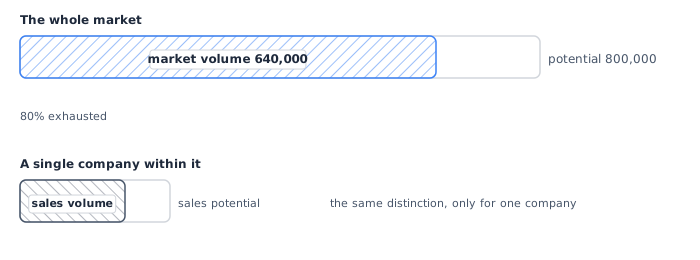
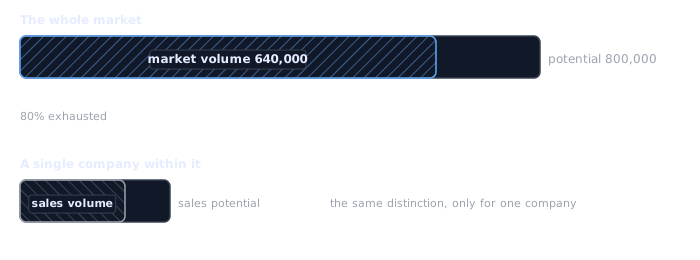
The most frequent confusion consists in taking the market potential for the quantity sold. It is the opposite: the quantity that could be sold and precisely is not.
Your turn10 of 17
In Austria at most 250,000 heat pumps could be sold in a year. 175,000 units were sold, 35,000 of them by a single manufacturer. To what percentage is the market exhausted?
A saturated market is not lost
If the market volume moves close to the market potential, the market is nearly saturated. Much more cannot be sold then, because almost everyone who wants the product already has it.
From which share on this holds, the WU material does not say. It names no threshold, only the direction, and a percentage from which a market would have to be called saturated is not given there. In the example above, the 640,000 units sold are faced by another 160,000 that are still open; the room above has grown small, but it has not disappeared. Judge therefore by the distance between volume and potential, and do not look for a boundary that the WU material does not state.
Hold on to the direction, because it is regularly swapped. Saturation means volume close to the potential. If the volume lies far below it, the market is precisely not saturated but still has room.
A saturated market is nevertheless not hopeless, and the WU material names two ways of making it unsaturated again. One changes the product, for example through new models with functions that did not exist before; a need thereby arises among people who seemed already supplied. The other looks for classes of buyers that have not been addressed so far. Whoever thinks only of a price reduction has overlooked both.
Your turn11 of 17
In a district 12,000 households would come into question as customers for a garden care service; so far 4,500 have hired it. The owner considers this market saturated. Which statement of the WU material refutes him?
Sales potential and sales volume apply to one single company
The same distinction between the possible and the actual exists one level down, and the change of level is the whole of the exam theme.
Sales potential, also called Absatzpotenzial, is the quantity of a product or a product group that a particular company is in a position to sell, or hopes to sell, in the most favourable case. Sales volume, also called Absatzvolumen, is what that company actually sold of it.
The words market and sales at the start of the term therefore carry the distinction: what begins with market applies to the whole market, what begins with sales applies to a single company. Market potential and sales potential consequently never mean the same thing, and whoever equates them has confused one company with all of them together.
A second statement follows from the word potential alone. It denotes the best possible case, and there is no going beyond the best possible: the sales volume cannot exceed the sales potential of the same company.
Your turn12 of 17
An ice-cream parlour could sell at best 900 scoops on a summer day, and it sold 650. In the whole city 20,000 scoops could have found buyers that day, and 14,000 were sold there. Which assignment is correct?
Absolute market share measures against the market, relative against the strongest competitor
The third indicator says how large a company is within its market. It exists in two versions, and the exam relies on the two being confused.
Absolute market share says which part of the market volume a company gathers to itself with its turnover, and is given as a percentage. Relative market share compares that same turnover instead with the turnover of the strongest competitor and is a bare ratio.
The calculation runs as follows:
The share can be determined in two ways: by quantity, that is in units, or by value, that is in euro. Which quantity you choose depends on which says more about the market. A statement that admits only one of the two ways is false.
Look at how differently the two figures describe the same company. A manufacturer turns over 30 million euro, the market volume amounts to 200 million euro, and the largest competitor turns over 50 million euro.
| Indicator | Calculation | Result |
|---|---|---|
| absolute market share | 30 times 100 divided by 200 | 15% |
| relative market share | 30 divided by 50 | 0.6 |
Fifteen percent sounds respectable, and yet the second figure says that this company falls markedly short of the strongest. If it grows to 60 million euro while the market volume and the competitor stay where they are, the absolute share rises to 30% and the relative one to 1.2.
The threshold the WU material names lies exactly at one: a relative market share above one means that nobody turns over more than this company, that it is therefore the market leader. Below one at least one competitor stands above it.
Two traps are worth naming separately. The absolute share rises with the company's own turnover as long as the market volume does not change; a statement that has it falling while turnover grows reverses the direction. And the reference quantity must not be swapped: the absolute share relates to the market volume, the relative one to the largest competitor, never the other way round.
Your turn13 of 17
A company has a turnover of 40 million euros, the market volume is 160 million euros, and the largest competitor turns over 80 million euros. In a brochure the company calls itself market leader, because it holds a quarter of the market. Which statement refutes the brochure?
Segmenting means taking the market apart into groups that can be addressed
A market in the sense of marketing is rarely of one kind. What the people in it need and how they buy diverge widely, and for that reason it mostly does not pay to design a product for the total market and to advertise it identically everywhere.
Segmenting means taking the market apart into groups of buyers whose members resemble one another in particular characteristics. As such characteristics the WU material names age, income and consumption habits. These groups are the target groups.
The gain from this lies in precision. Once it is known who is being addressed, all four areas can be brought into sharper focus: the product itself, its prices, the routes on which it is offered, and the advertising for it. An indeterminate public cannot be served in a targeted way in any of the four.
Having segmented, however, commits a company to nothing. Which segments it works on it decides afterwards, and it may confine itself to a few. That follows from the sequence in which target-group-oriented marketing runs, which the WU material lays out in three phases.


Memorise the order as a whole, because it is examined from both ends. Positioning comes last and not first, and between the taking apart and the positioning stands the decision as to which of the resulting segments are to be worked on at all.
Your turn14 of 17
A running-shoe maker has divided its market by age, income and training habits into five buyer groups. What comes next?
The target group includes those who do not pay
Who counts as belonging to the target group is usually taken more narrowly than the WU material takes it. Buying is only one of several roles.
The target group covers all the people and organisations the marketing measures are meant to reach. The WU material separates four roles within it: whoever influences the purchase decision, whoever takes it, whoever buys the article, and whoever uses the article once it is bought.
Two of these roles are readily taken for one, namely deciding and buying. They often coincide, but they need not: in a company the specialist department picks the device, while purchasing orders and pays for it, and whoever decides then sits at a different desk from whoever places the order. That is why the WU material keeps the two apart.
A children's bicycle demonstrates all four roles in a single case. The parents occupy two of them at once: they decide which bicycle is acquired, and they pay for it as well; the advertising is therefore addressed to them. It is ridden by the child, who pays nothing and yet tends to have a say. If paediatricians recommend particular models, they buy nothing themselves and still act on the decision considerably. All four roles belong to this manufacturer's target group, and marketing that thinks only of those who pay leaves the rest unaddressed.
The exam statement due here confines the target group to those who buy. It is false, and false by the three remaining roles: those who influence, those who decide and those who use.
Your turn15 of 17
A maker of children's bicycles wants its marketing to address only the parents, because only they pay. Which statement of the WU material speaks against this?
Positioning decides what a product is taken for
Once the target market is settled, the third phase remains: giving the offering a place in that market.
Positioning says how a product is perceived by consumers with regard to its essential properties and how it is meant to be perceived. It therefore concerns the image in the head of the target group and not the technical construction of the product.
Two things at once are aimed at in doing so. From everything the competition offers, the article is to be distinguishable clearly and without risk of confusion, and the target group is to want it for precisely that reason. If both succeed, it has attained what the WU material calls a Unique Selling Proposition.
The USP is the feature with which an article stands out from everything offered alongside it, and which the target group at the same time particularly values. A property that meets only one of the two conditions is not yet a USP.
The manufacturer woom, which builds children's bicycles, traces its USP back to two properties: its bicycles are meant to count as particularly well suited to children and as ones that last a long time. The two together distinguish it from the remaining suppliers and are at the same time what matters to parents.
Three misunderstandings lie close at hand.
A USP does not arise by itself. A good product does not yet have one. It is worked out when the company determines what it wants to stand out by and what the target group values in that.
Positioning comes after segmenting. It is the third phase and not the first.
Positioning addresses the target group, not the competition. The product is to stand out from the competition, granted; but what is addressed by it is the target group in all four roles, those who influence and those who use just as much as those who decide and those who buy.
Your turn16 of 17
A start-up wants first to settle what its drink should be taken for, and only then to divide the market into buyer groups. Which statement of the WU material speaks against this order?
Your turn17 of 17
A maker of hiking boots says its boot is technically the best on the market and therefore already has a unique selling proposition. Which statement of the WU material refutes it?
Was this article helpful?