The Marketing Mix
The article on market and target groups brings the company up to its market. It shows how a market is described and taken apart into target groups, which four questions order what a company does in the market, and what a product is meant to be taken for. That settles whom a company wants to address. What it addresses them with is not yet settled.
Here the four areas get filled in. Each of them calls for decisions that can be named: what benefit a product is meant to provide, how it changes over its lifetime, how its price comes about, by what route it reaches the customer, and by what means it is talked about. The exam statements of this topic come down to these five questions.
The mix ties every decision to the benefit and to the phase
The WU material puts a sentence at the head of the chapter that looks like an announcement and in truth carries the whole topic. Product-policy measures are to keep two things in view at once: what the product does for the customer, and which stage of its life it currently occupies.
Two bindings follow from that, and both are examined.
Every measure hangs on the benefit. Whoever cannot say what a product is good for can neither justify a price nor formulate a message. That is why benefit comes before everything else in the next section.
Every measure hangs on the phase. The same decision is right at one moment and wrong at another. Advertising spend that makes a new product known in the first place is unavoidable at the start and thrown away at the end. Discounts and promotions defend the share against imitators during maturity and eat into profit there; during growth, by contrast, the setting of the price decides how far the market position can be extended.
The article on market and target groups shows that the four areas have to fit each other so that they do not cancel each other out. That condition remains, and a second one joins it: they must also fit the moment at which they are taken. A mix is therefore not something laid down once and then worked through.
Your turn1 of 21
A new cordless vacuum cleaner sells more strongly month by month, profit rises along with it, and the first imitators appear. According to the WU material, what matters most in this phase?
What is bought is a purpose, what is paid for is often more
Whoever spends money expects something in return. That expectation falls into two parts, which the WU material keeps cleanly apart, because exam statements mix them up regularly.
The Grundnutzen is what a product is primarily there for. With a bicycle it is the riding, with a notebook the ability to install programs on it and to work with them.
The Zusatznutzen is everything that goes beyond that primary purpose. It falls into two forms: the Geltungsnutzen, the prestige that comes with ownership, and the Erlebnisnutzen, the pleasure of use or a feeling of safety.
The notebook lets you hold the two apart. Running programs on it is the purpose for whose sake it is acquired. That you can work with it in any location, that it weighs little and that it looks handsome no longer belongs to that purpose, and still bears on the buying decision.
Three misunderstandings suggest themselves, and all three occur as exam statements.
A product does not have either one or the other. The Zusatznutzen is added to the Grundnutzen, it does not replace it. Without a primary purpose there would be nothing for anything to be added to.
Prestige is never the Grundnutzen. Whoever looks for a device's primary purpose in the standing of its owner has swapped Geltungsnutzen and Grundnutzen.
Advertising does not create the Zusatznutzen. It can make it visible, but the thing itself has to arise in the product. A bicycle that gives no pleasure is not turned by any campaign into one that does.
When this question is to be asked, the WU material says explicitly, and that too is examined: during development, and then once more during marketing. Thinking about what benefit a product should have only after its launch is too late for both.
Your turn2 of 21
A manufacturer advertises its vacuum cleaner on the grounds that it cleans thoroughly, that working with it is pleasant, and that the device makes an impression in the neighbourhood. An employee takes the impression in the neighbourhood to be the Grundnutzen, because it does the most to make people buy. Which statement of the WU material refutes him?
Your turn3 of 21
A dealer says of an expensive designer bicycle that whoever buys it only wants to be seen. For these customers, he says, the bicycle has no Grundnutzen at all, it provides merely Geltungsnutzen. Which statement of the WU material refutes him?
Revenue and profit diverge across five phases
Hardly any product stays on the market permanently. Sooner or later a new one displaces it, and the road there runs, in the ideal type, through five stages.
The Produktlebenszyklus describes how the revenue and the profit of a product develop from its launch to its disappearance. It is divided into five phases: Einführung (introduction), Wachstum (growth), Reife (maturity), Sättigung (saturation) and Degeneration (decline).
The decisive point about this picture is that two different quantities are drawn in it. Revenue and profit do not reach their peaks at the same time, and whoever takes the two curves for one answers half of this topic wrongly.
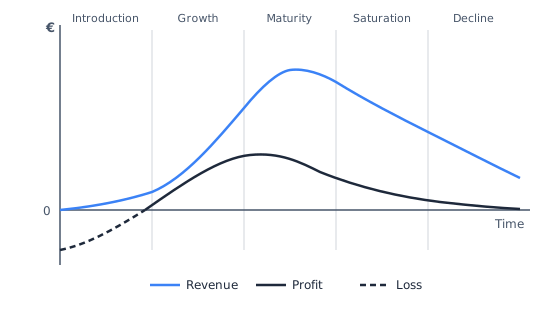
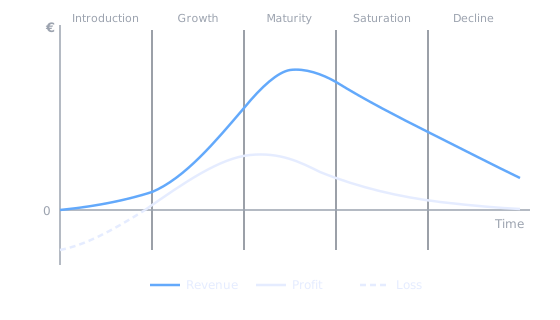
Read the figure from left to right, and watch the stretch in which the lower curve still runs below the zero line. There the product is already selling and still losing money.
| Phase | Revenue | Profit | What occupies the company |
|---|---|---|---|
| Introduction | rises slowly | negative at first | becoming known |
| Growth | rises steeply | rises with it | setting the price right |
| Maturity | reaches its peak | already falling | holding the share against imitators |
| Saturation | falls | falls | deciding how to proceed |
| Decline | small | costs only | carrying out the decision |
In the introduction a new product is brought onto the market with advertising measures in the first place. If it finds buyers, revenue grows only slowly at first. Against it stand the outlays for development and for that launch advertising, and these are high. That is why profit typically crosses the zero line only towards the end of this phase. If the response fails to come, the product usually disappears again quickly, because the costs run on while revenue never gets going.
In growth revenue picks up steeply, and profits follow it. The success does not, of course, escape the competition, and imitators are to be reckoned with from now on. That someone imitates a product is therefore no sign of failure but the opposite of one. It is precisely here that the shaping of the price decides which position in the market can be held and extended.
In maturity revenue reaches its highest level. Profits are nevertheless already sinking, and the reason lies with the competition: to hold their own against it, more has to be spent on advertising and on sales-promoting actions such as discounts and promotions, and that outlay eats into the return. Whoever looks only at revenue takes this phase for the best one.
In saturation both quantities give way, and the market begins to shrink. In decline, finally, the product contributes nothing more and causes only high costs. At this point the WU material speaks with two voices: the text names only high costs, whereas the curve in its Figure 25 approaches the zero line from above and does not drop below it. Our drawing reproduces the curve; what gets examined is the statement in the text.
Your turn4 of 21
A product has been on sale for half a year. Revenue is growing slowly, but the bottom line still shows a loss. The sales department therefore already considers the product a failure. Which statement of the WU material speaks against this conclusion?
Your turn5 of 21
A product reaches its highest revenue, yet profit is already falling back. The management puts this down to development costs that still have to be worked off. Which statement of the WU material explains the fall?
How long a phase lasts is not for the company alone to determine
Some products last for decades, others are gone after two years. Neither the whole cycle nor any single phase has a fixed duration, and the notion that every product runs its course in the same time is one of the commonest false exam statements.
How long a product lives depends, according to the WU material, on many factors. It gives four of them as examples, without closing the list, and all four lie outside the company.
- Consumer behaviour. If the preferences of buyers shift, the whole range shifts with them.
- Technical progress. As soon as a technically better device is available, the predecessor's time is over, even though there would be nothing wrong with its quality.
- Statutory provisions. A new regulation can make a product unsaleable without anything about the product having changed.
- The intensity of competition. On a densely occupied market one offering replaces another at ever shorter intervals.
These four examples alone explain why the timing of a phase cannot be written into the calendar in advance; further influences are expressly not ruled out. A company can shape and extend its life cycle, but it cannot schedule it.
Your turn6 of 21
Many suppliers crowd into the market for headphones, and each model of one manufacturer is replaced by the next after a short time. A colleague thinks that how long a product stays on the market depends on its quality alone. Which statement of the WU material refutes him?
The end is decided before the end arrives
At one point of the cycle the WU material demands a decision, and it says exactly when it falls due: at the beginning of saturation, that is, before decline has been reached. Two roads lie open.
Withdrawal. The product is taken out of the range.
Relaunch. The product is changed and thereby started afresh.
The reason for this early deadline lies in the decline phase itself. There the product brings in nothing more while the costs run on. Whoever begins to consider only then is already considering at the company's expense. The deadline is therefore no bureaucratic detail but follows from the course of the two curves.
A relaunch is emphatically not a farewell. This gets confused regularly because both roads stand open at the same point: one takes the product out, the other sends it back in altered.
Your turn7 of 21
For a muesli bar, profit has been falling for two years, and for one quarter revenue has now been declining too. The product manager wants to decide on withdrawal or relaunch only once the bar causes nothing but costs. According to the WU material, when must the decision be made?
Three product-policy measures, told apart by the fate of the old product
What a company can do with its offering, the WU material sorts into three groups. The quickest way to keep them apart runs through a single question: what happens to what was there before?
In a Produktinnovation a new product joins the existing ones and supplements them. Nothing falls away. It comes in two forms: as Produktdifferenzierung, which makes the range deeper, and as Produktdiversifikation, which makes it broader.
In a Produktvariation an existing product is changed, and what is offered afterwards is only the changed version. The previous one falls away.
In a Produktelimination a product that is no longer successful is taken off the market. That too is a product-policy measure and not a mere omission.
Between innovation and variation there is thus exactly one difference, and several exam statements hang on it. After an innovation the old and the new stand side by side on the shelf. After a variation only the new one stands there.
The depth and breadth of a range are likewise a safe exam target, because they are so easy to swap.
| What the company does | What happens to the range | What it is called |
|---|---|---|
| further models within the same product group | it becomes deeper | Produktdifferenzierung |
| an entirely new product group | it becomes broader | Produktdiversifikation |
A bicycle manufacturer makes both vivid in one example. If it adds further bicycle models to the ones it already has, it stays within its product group, and its range gains in depth. If instead it takes on sportswear, rainwear and fitness equipment, it enters new product groups, and its range gains in breadth. Both count as innovation, because in both cases something is added without anything falling away.
A side note on naming, which saves confusion: in the overview figure of the WU material the third measure is called 'Elimination' for short, in the running text beside it 'Produktelimination'. The same thing is meant.
Your turn8 of 21
A tool maker brings out a revised version of a drill and strikes the old one from the price list. With a second machine it puts a further version alongside without touching the existing one. An apprentice calls both measures Produktvariation. Which statement of the WU material refutes him?
Your turn9 of 21
A bicycle maker first adds further bicycle models to its range and later also sportswear. The head of marketing says both steps make the range deeper, because something is added each time. Which statement of the WU material refutes her?
Whoever enters a market first pays for the door
Before even the first of these measures stands a consideration that the WU material attaches to market entry. Two attitudes are possible, and neither of them is fundamentally the wiser.
Markteröffnungskosten are the outlays that fall to the first supplier in a market, before anyone there knows the product at all. They include the development costs and the costs of communication.
Whoever pushes ahead bears these costs and with them a higher entrepreneurial risk, because at that moment nobody knows whether the market will accept the offering. Whoever waits first observes how things go on and then follows with a similar product. Waiting is thus one of the two regular options and not some kind of failure to act.
Two confusions are usual here. The first turns market-opening costs into a consequence of failure: they arise at entry, no matter how the matter turns out. The second moves them to the other end of the cycle and counts discounts from the saturation phase among them, although those have nothing to do with entry.
Your turn10 of 21
A business enters a market nobody has occupied yet, as the first supplier. The controller wants to book market-opening costs only if the product turns out to be a failure. Which statement of the WU material refutes her?
Price counts most where the offerings resemble one another
How heavily price weighs depends on how similar the offerings are. The exam likes to turn this relation around, so it is worth remembering it in the right direction.
Where many products and services stand side by side whose benefit to buyers is roughly equal, hardly anything else remains on which a decision could fasten. In that situation price takes on a decisive role. The WU material names four fields in which a low price counts for many buyers: groceries, everyday clothing, air travel and mobile phone tariffs.
It is the other way round when a product possesses a well-established Unique Selling Proposition and a matching image. What a USP is and how it comes about is in the article on market and target groups; what counts here is its effect on price. Once it is established, buyers are often willing to pay more, because for them the offering is precisely not interchangeable.
Between these two poles a company's pricing policy takes its place.
- Hochpreispolitik, high-price policy, at one end.
- Niedrigpreispolitik, low-price policy, at the other, for which the WU material also uses the word Diskontpreispolitik. The two expressions denote the same line and not two different strategies.
The payment conditions join the price; they are named explicitly and do not fall by the wayside merely because they appear on no price tag. The article on market and target groups deals with them under the full name of this area, which there reads 'Preis- und Konditionenpolitik'.
Your turn11 of 21
Two providers raise their prices by 10%: a mobile network operator whose tariff barely differs from the competition's, and a maker of hiking boots whose brand has been known for years for a special sole. With which of them is it more likely that the customers will go along with the higher price?
Three questions set the price a lower and an upper limit
For setting the price the WU material names three factors that count above all in practice. They stand there as three questions side by side, yet they do different things, and whoever sees that need not learn the list by heart.
| Factor | What it says about the price |
|---|---|
| the product's own costs | where the price must at least lie |
| the price of comparable rivals | what the market is already used to |
| the customers' willingness to pay | where the price can at most lie |
The lower limit the company draws itself, since its costs are to come back in at the very least. The upper limit it precisely does not draw: it lies where the customers stop going along. A price above that threshold stays without effect, and the most careful costing changes nothing about that.
From this follows the trap that turns up in exams regularly. Covering costs alone does not yet make a price enforceable; it must also sit together with what the customers are prepared to lay out, and with what comparable suppliers charge. How many employees a company has does bear on its costs, but does not belong among these three factors.
How price and demand hang together in general was derived in the first chapter: at high prices the quantity demanded is as a rule low, at low prices high. For the company setting a price, a rule of action follows in both directions. If demand picks up, room arises to raise the price somewhat, because more interested buyers compete for the same quantity. If it slackens, the price frequently comes back down so that the quantity sold does not collapse.
Your turn12 of 21
A business has calculated its price so that it covers all the costs of the product, and therefore considers it enforceable. Which statement of the WU material refutes this?
Your turn13 of 21
A coffee roaster has to charge at least 18 euro a kilo to cover his costs. To win customers he wants to offer the kilo at 15 euro for good, since more is bought at a low price. Which statement of the WU material refutes him?
Seller's market and buyer's market take turns
Which side of a market influences the price more strongly depends on which of the two sides is scarce. Two situations with their own names follow from that.
A Verkäufermarkt exists when demand is greater than supply. The supplying side can then influence the price more easily than the buying side; prices are rather high or rising. The buyers' side has comparatively little bargaining power and room for manoeuvre.
A Käufermarkt exists when supply is greater than demand. Now the buying side can act on prices and commands more bargaining power.
Both situations are temporary, and the WU material describes how one passes into the other. A seller's market attracts, with its high prices, further companies that make the same good. Supply grows, prices give way, and as soon as supply exceeds demand, the seller's market has turned into a buyer's market. There prices sink until a portion of the suppliers no longer care to offer at that level. Those companies drop out, supply becomes scarcer, and the price rises anew.
The exam statement built out of this description asserts permanence: that a buyer's market once arisen stays in place, or that a seller's market holds because new suppliers find no way in. Both contradict the movement the WU material describes explicitly.
Keep these two terms apart from the market forms of the first chapter. Monopoly, oligopoly and polypoly count how many participants stand on each side. Seller's market and buyer's market ask not about the number but about which side is scarce at the moment.
Your turn14 of 21
On a market, demand has exceeded supply for months, and prices are high. A trader expects this situation to last. Which statement of the WU material speaks against that?
In three effects the higher price sells better
The rule so far assumes that a higher price deters. The WU material states explicitly that customers' reactions to price changes are not always entirely rational, and it names three cases in which a higher price is precisely what triggers the purchase.
| Effect | Why the dearer item is bought |
|---|---|
| Snob-Effekt | to make one's own ability to pay visible |
| Mitläufer-Effekt | because the surrounding circle does the same |
| Qualitätseffekt | because better quality is suspected behind the higher price |
The reasons differ, the outcome is the same in all three cases: what is bought is the dearer offering. That is why these effects are taken into account when the price is set, rather than dismissed as exceptions.
A note for anyone who has met the term elsewhere: in the economics literature the snob effect usually denotes that a good loses its appeal once many people own it. The WU material takes it more narrowly and ties it to displaying one's own ability to pay. What is examined is the WU material's version.
Your turn15 of 21
A wine merchant raises the price of a red wine from 9 to 16 euro without changing anything about the wine, and afterwards sells more bottles than before. Many buyers explain that such an expensive wine must be better. Which effect is at work?
Direct or indirect is decided by whom the intermediary belongs to
Distribution policy answers two questions, not one. The first concerns the sales channel, that is, how the product reaches the customer. The second concerns the transport route. Whoever shortens distribution policy to transport has left out the more important of the two questions.
In direkter Absatz the product passes from the manufacturing company straight to the final buyer. Whether the goods come from the head office or from a company-owned branch changes nothing about that.
In indirekter Absatz one or more trading businesses lie between the manufacturer and the final buyers. Wholesalers sell on to further traders, retailers to the ultimate consumers.
The dividing line does not run where many suppose. It asks not how many stations the goods pass through or how far they travel, but whether an outside trading business stands in between. A company's own branch belongs to the manufacturer and therefore does not make the route indirect, even if it lies far away. A specialist dealer, by contrast, is a business of its own, and with it the route becomes indirect, even if its shop lies opposite the factory gate.
Both routes can be run alongside each other. If a producer keeps its own online shop and supplies specialist shops besides, then one channel runs direct and the other indirect.
Your turn16 of 21
A furniture maker delivers part of its goods from its own branch and passes the rest on to independent specialist shops. An employee considers both channels indirect, because in both cases the goods go through a point of sale. Which statement of the WU material refutes him?
Your turn17 of 21
A brewery supplies an independent drinks shop that lies directly opposite the factory gate. Because the goods only cross the street, the master brewer takes this to be direct sales. Which statement of the WU material refutes him?
Franchising hands over a finished business model for a fee
One sales channel the WU material treats separately, because it cannot be assigned cleanly to either side and because it gets misunderstood regularly.
In franchising the Franchisegeber leaves a legally independent partner business, the Franchisenehmer, three things at once in return for a franchise fee: the brand name, the range of goods and the whole of its marketing know-how, meaning the fitting-out of the shop, the advertising and the internet presence.
Two statements about this relationship are examined readily, and they appear to contradict each other until you read them closely.
Economically as well as legally the Franchisenehmer is independent. It is not a part of the grantor's business and not a branch of it, even if from the street no difference can be seen. What connects the two is a contractual arrangement.
Bound it is nonetheless. It takes on the grantor's marketing concept and business model, and the contract holds it to them as far as the contracting parties have laid down. Its freedom therefore reaches exactly to that boundary, and both hold side by side.
The fee usually consists of two parts: a fixed amount and a share of turnover. The one part arises regardless of how business goes, the other grows along with it.
Your turn18 of 21
A bakery chain grants licences to partner businesses, which carry its brand name and adopt its marketing concept. One partner thinks that as an independent business he may design his advertising as he pleases. Which statement of the WU material refutes him?
Advertising medium and carrier get swapped regularly
At the head of communication policy stands advertising, and inside it sits a pair of terms that the exam asks about reliably, because it can be twisted round so conveniently.
The Werbemittel is the designed message itself. The Werbeträger is the medium through which that message reaches its audience.
The test for it is simple: the Werbemittel is made, the Werbeträger is booked.
| Werbemittel | Werbeträger |
|---|---|
| advertisements and inserts | daily papers, weeklies, illustrated magazines, trade journals, event programmes |
| TV spots and radio spots | television and radio |
| advertising films | cinemas, theatres, events |
| posters and advertising boards | poster walls, advertising columns, public transport facilities, sports grounds |
| circulars, leaflets, brochures, catalogues | post, commercial distributors, events, newspaper inserts |
| notices, blogs, forums, banners, websites | social media such as Facebook, Instagram, Twitter and YouTube |
After Tab. 7 on p. 81; the examples in both columns are those of the WU material.
Work through one row of it so that the pair sits. The advertisement has been designed, it is the Werbemittel; the trade journal in which it appears carries it to the readers and is the Werbeträger. Likewise with a banner: what was designed is the banner, what carries it is the website or the social network on which it appears.
The last row of the table calls for closer reading, because 'websites' stands there in the left-hand column. The contradiction resolves at the question of whose website is meant. A company's own internet presence is something the company designs, and it stands on the left with good reason. The outside site on which it places a banner merely carries that message and therefore stands on the right.
Your turn19 of 21
A sporting goods retailer has a 20-second spot produced and books airtime for it on a private broadcaster; in addition he has posters designed and hung in the city's trams. Which assignment is correct?
Communication is more than advertising
Advertising is the first part of communication policy, but it is not the whole of it. The WU material lists four further fields, and the exam statements of this topic consist mostly of assigning one of them to the wrong field.
- The company's own presence on the internet, that is, its website and its presence in social networks.
- Sales promotion (Verkaufsförderung), that is, individual campaigns meant to push sales.
- Personal selling, that is, the conduct of the sales staff.
- Public relations (Öffentlichkeitsarbeit), listed in the WU material under the name Public Relations. It is the point at which communication detaches itself from the individual product and concerns the whole company.
What belongs to public relations is listed more precisely than the rest, and it is exactly this list that gets asked about: the holding of press conferences, press releases, the targeted informing of particular groups such as investors, for which the WU material uses the expression Investors Relations, and finally sponsoring. A press conference therefore belongs to public relations and not to sales promotion, even though both are meant to benefit sales.
Two forms the WU material singles out as especially significant.
Social media marketing covers a company's marketing activities in social media, as a rule advertising and public relations. For public relations by this route there is a term of its own: Social Media Relations.
Note the scope of this definition, because a popular trap lies here. Social media marketing covers both, advertising and public relations, and not advertising alone. What makes it interesting for companies is the kind of access: they can reach a large number of possible customers quickly and directly, show their products and generate a mood in their favour.
Event marketing covers events with an experiential character that are meant to trigger a strong activation process in the customer. They direct attention to a company, to a product group or to a single occasion.
Which events fall under it the WU material takes broadly: fashion shows and trade fairs as well as exhibition and shop openings, along with cultural and sporting events. A shop opening with a supporting programme is therefore no trimming outside marketing but an instance of this category.
Your turn20 of 21
A furniture maker places an advertisement in a trade magazine and calls a press conference on the same day. The assistant books both under advertising. Which statement of the WU material refutes her regarding the press conference?
Your turn21 of 21
A furniture store runs paid advertising posts on Instagram and also publishes its press releases there. The marketing manager counts only the advertising posts as social media marketing. Which statement of the WU material refutes her?
Was this article helpful?