Digital Transformation (Digitale Transformation)
The articles of the third chapter looked at the company from the inside: what it makes, which legal form it appears in, whom it sells to, where its money comes from and how it accounts for all that. Technology appeared in none of them. That is not something any company today can keep up.
A supermarket does not know that a shelf is running empty because somebody went and looked; a system records the stock and triggers the reorder. A delivery service does not tell its customers where the parcel currently is because the driver phones in. On the shop floor, systems steer the sequences and report faults before anyone notices them. The WU text uses the English expression ubiquitous computing for this, in German die Allgegenwärtigkeit von Rechensystemen: an area in which you come into no contact with technology at all is hardly to be found any more.
This article covers the first half of the fourth chapter, that is pages 83 to 92. It explains what Digitalisierung and digitale Transformation denote, at which three points they change a company, what a business process and what a business model is, and what the two revenue models live on that the WU text singles out. How the internet works technically, how it differs from the World Wide Web, and what holds business informatics together as a field, belongs to the second half of the chapter and to the article on business informatics.
Digitalisierung is the use of technology, digitale Transformation its consequence
Both words come up in the same breath, and the exam exploits exactly that.
Digitalisierung means that digital information and communication technology is put to use. Digitale Transformation is the change that this use drives forward, namely in the economy, in public administration and in private life. The one is the means, the other its consequence.
Fix the direction in your mind, because it gets swapped readily. The technology is applied, and the change follows from it. Anyone saying it the other way round, that Digitalisierung is the change and digitale Transformation the use of technology, has exchanged the two terms.
Note also where this change takes place. Three fields are named, and the economy is only one of them: a municipality taking building applications through a portal belongs here just as much as a private person with a heating system that sets itself. And a company that merely converts its internal sequences does not drop out because its customers notice nothing of it. Why that is so is what the next section shows.
Ubiquitous computing carries one more trap. The expression says that computing power sits everywhere, in the alarm clock as much as in the production plant. It does not say the opposite, namely that it is drawn together in a few central places.
Your turn1 of 21
A registry office will in future only allow appointments to be booked through a website. Someone objects that this is no part of the digitale Transformation, because an authority is not a company. Which statement of the WU text refutes this objection?
Your turn2 of 21
A municipality will in future accept building applications through a portal, and an application's route no longer leads through the town hall. How are the two terms distributed over this case?
The change acts in three directions, and all three run towards one point
To show what can change inside a company, the WU text spans three axes and calls them the three dimensions of digitalisation. Each axis has a name for where it leads.
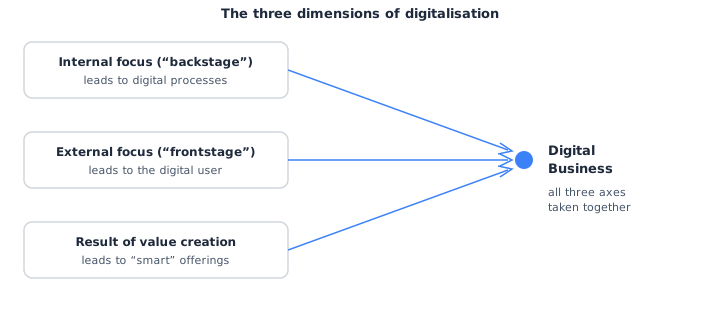
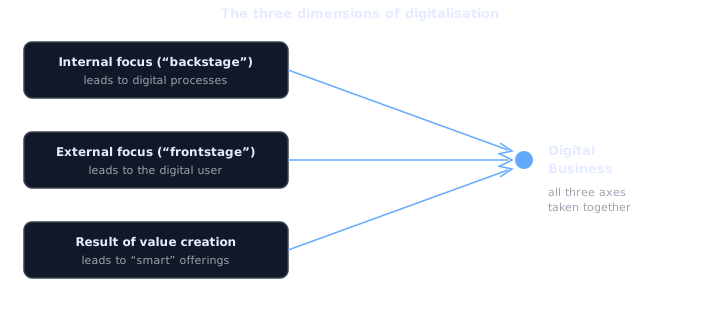
Own diagram after figure 28 of the WU text (p. 84), which in turn follows Leimeister (2021), p. 6.
Two things can be read off this drawing, and both are examined.
First, the three directions are not alternatives a company would have to choose between. They are axes of one shared space, and they meet at a point. Second, that point has a name: Digital Business. What is meant by it is the digitalised company as a whole.
What does not follow from this is that a company would have to work on all three axes at once. It may confine itself to one, and that confinement is itself a decision. The next three sections go through the axes one at a time.
Your turn3 of 21
A furniture maker steers its production digitally, advises its customers through an online planning tool and builds sensors into its office chairs that report a poor sitting posture. According to the drawing in the WU text, what do these three steps run towards?
The first direction leads backwards, into the company's own sequences
The first dimension is called the internal focus. A company's internal focus lies on using its resources economically and turning them into products and services. Value is meant to arise in the process, which puts this axis right next to the value creation you know from the article on companies and value creation.
The image of the stage is meant literally. What happens behind the scenes never comes into the customer's view, and that is exactly where the sequences lie that bring the value about in the first place. So "invisible" does not entail "unimportant": the bakery whose system supplies the branches earns its money not in spite of that sequence but through it.
Systems reach further and further into such sequences: they extend the individual steps and take over the steering of them. The sequence is then called a digitally supported business process. Watch the word "supported": what is required is not that a sequence runs without any human involvement. In the example further down an employee even sets a marker in the system herself at the end, and it is a process all the same.
A business process is a workflow made up of several activities that hang together logically. It makes a contribution to a business objective of the company, and that contribution is the value it creates. It can be carried out again as often as you like. Its beginning is clearly fixed and so is its end, whereby several ends are permitted.
Four features sit inside this, and every single one of them turns up in tasks.
Several activities, not one. A single task is not yet a process, even if it comes up regularly. Several steps are needed, and they have to relate to one another in substance.
A contribution to a business objective. Not every chain of manual steps counts, only the one at whose end something comes out for the company.
Repeatability. The same process runs again the next time. It is not fixed anew for each repetition.
A clear beginning, one or several clear ends. The beginning is unambiguous. For the end, the WU text expressly allows several, and this is where anyone regularly comes unstuck who pictures a process as a line with exactly one terminal point. Handling an order ends, depending on the case, at delivery or at collection in the shop, and both are defined ends of the same process.
What a company gets out of it is quickly said. Whoever keeps an overview of a sequence decides faster and more precisely, because they know where they stand in it and what comes next.
Your turn4 of 21
In a hotel a system checks the free rooms for every online booking, creates the reservation and sends the confirmation; at the end a receptionist checks the payment details by hand. Is this a digitally supported business process?
A recorded sequence can be handed on, an unwritten one cannot
A process can sit in the heads of the staff or be held fast in a system. Holding it fast goes by the word documentation, and the drawing that belongs to it is called a process model: a visual image of the sequence and its steps.
The benefit shows on the first day at work. Anyone arriving as an intern who has to learn how purchasing is done there can either piece it together laboriously or look at a drawing and have an overview within minutes. Without documentation, only the first route is left to every new recruit.
Three confusions suggest themselves here, and all three are avoidable.
- A process model is not a business model. What a business model is gets settled in a later section of this article; the two words resemble each other, the things behind them do not.
- Nor is a process model a statement of costs. It shows steps and their order, not amounts.
- A sequence is recorded so that others understand it, not so that it can no longer be altered. Documentation neither freezes a process nor turns it into one in the first place: it is one as soon as the four features above apply.
What such a sequence looks like in detail, the WU text demonstrates on an online order placed with a bookseller. The process begins the moment the order arrives. An internal system assembles it and reports it to whichever employee becomes free next. She works through several partial steps: she calls up where the title lies in the warehouse, picks the copy and prepares the order the way the chosen route demands, differently for dispatch than for collection. Depending on how the stock stands, further processes may start up internally. The matter is over as soon as delivery has happened or the goods are lying ready in the shop. At the end the employee sets the marker in the system for the completed order and turns to the next one.
Two points here are worth a second look. The customer is not left without news during this time, since she is informed about the current status of her order. What she gets to see is that status and not the chain of internal steps running behind it. And the matter does not in every case end at her front door: collection in the shop is the second end of the same process.
Your turn5 of 21
In a pharmacy every prescription order runs to the same scheme and closes, depending on the case, with dispatch or with handover at the counter. A colleague doubts that this is a single business process, as the sequence has two different outcomes. Which statement of the WU text removes this doubt?
Your turn6 of 21
In a law firm an assistant empties the letterbox every morning, and that is her only activity in it. A colleague calls this a business process because it is repeated daily. What is correct?
The second direction leads forwards, to the customer's side
The second dimension carries the name frontstage and is a company's external focus. It means the side on which company and customers stand in contact with each other. Anyone calling it "internal" because the customer data is after all processed inside the company has confused it with the first dimension.
Who counts as a customer here is drawn more widely than the word suggests. Depending on the setting it can be a private person, another company, or a public institution. A sporting goods manufacturer supplying private individuals, clubs and a provincial administration is dealing with customers in all three cases.
Their requirements and needs are in the foreground: offerings are to be shaped in the customer's interest. What is new about this axis is not that customer wishes matter, for they did so before any internet selling as well. What is new are the possibilities of taking them into account more efficiently and more precisely.
How much lies in this is shown by an example from the shoe trade. In buying shoes almost everything hangs on one question that is hard to answer: does this model fit this foot? There are narrow feet and broad ones, models cut larger and smaller, and whoever orders online only finds out on unpacking. The chain Humanic therefore measures the foot in the shop with a scanner, produces a three-dimensional image from it and files it in the customer account. On site as well as with the next online order, this digital footprint can be matched against the desired model.
The advance lies in the fact that a requirement can be captured at all which nobody could state precisely before. It does not lie in the chain having to carry fewer models, and it is not confined to the shop on site either: for the next order from home the same image stands ready. And the foot stays a foot, the shoe a shoe: what is digitalised here is the relationship with the customer, not the offering. That places the case in the second dimension, not the third.
Your turn7 of 21
A bicycle dealer takes his customers' body measurements in the shop and files them in the customer account, where they stand ready for the next order from home as well. Which statement of the WU text names where the gain of this procedure lies?
The third direction leads into the offering itself
What comes out at the end of value creation is the subject of the third dimension: it asks how this result can be extended by technology. The products and services themselves are meant, and for them the word "smart" is readily used.
What it means can be shown on a construction set of bricks that is thoroughly analogue by nature. You build whatever occurs to you, or you follow an instruction sheet. If this instruction sheet comes as a file instead of on paper, that is digital, but it remains an addition: the same thing gets built as before, and nothing about the experience changes. It looks different once a digital exploration mission is added, over the course of which it is decided which toy comes out at the end. Now the technology reaches into the offering itself, the experience feels "smart", and the attachment to the product grows.
The answer to the question of when something may be called smart hangs on this. Not on how much technology is built in, but on whether the customer experiences more from it than before. In the simplest case it stays at an addition. In the best case the experience acquires a mark from it that lasts.
One thing all this expressly does not mean. Digitalising a product does not mean abolishing the analogue product and replacing it with a digital one. The bricks stay in the box; the mission comes in addition.
Your turn8 of 21
A maker of model kits first encloses the same building instructions as a file and later an app that follows the build and generates changing assignments from it. Which statement of the WU text explains why only the second step makes the offering smart?
Out of one or several directions comes a digitalisation strategy
Along these three axes a company can act, and it may take up one of them or several. From this choice a digitalisation strategy can be derived that helps it with future decisions, because it follows a clear vision. A supplier who first converts his own sequences and aligns his further plans with them is doing exactly that.
Taken together this yields the digitalisation of the whole company, and the expression Digital Business stands for it. Do not confuse it with online selling and online purchasing: what is meant is the company as a whole and not one channel of distribution.
What successful digitalisation rests on, the WU text says in a single sentence, and it contains two restrictions that are easily read past. Sensible aspects within the company are to be extended through the use of digital technologies. The WU text names examples for this, among them the sequence of work steps, communication and the consideration of customer needs, and expressly leaves the enumeration open.
The first restriction sits in the word "extend". What exists is supplemented, not replaced across the board; whoever swaps everything for something new at once is not doing more but something else. The second sits in the direction: the transformation is not to stand in the way of the benefit. The benefit of a product and the customer's experience are to be extended as innovatively as possible, and a conversion that makes the company more efficient while damaging the benefit is not covered by this. Nothing is exempt from any of it: communication within the company stands on the list of examples too.
Your turn9 of 21
A dairy converts only its bottling line to digital control. Nothing changes for the customers or for the product. A consultant holds that one can speak of digitalisation only once all three axes are being worked on. Which statement of the WU text refutes him?
The business model records what a company means to live on
Up to here it was about how technology changes a company from the inside. But it also changes what the company earns its money with in the first place, and for that a second term is needed.
How far this reaches can be seen in offerings that looked different ten years ago. An annual ticket for public transport today sits in an app and is managed and shown through a customer account. Groceries are ordered through a website and delivered to the door, both by services founded for that purpose and by the retail chains themselves. All these offerings rest on technology, and with it business models have become possible that would earlier have been unimaginable.
A business model records the route by which a business idea becomes an offering: how a company produces its product or its service, by which route it makes that available, and how it distributes the offering. The arithmetic behind it belongs to this. What goes in as resources stands against the revenues, and out of that comparison a profit is meant to remain. This is the company's value creation.
The order within that sentence is itself relevant for the exam. At the beginning stands the business idea, the model builds on it, and the sequences follow from that. The other way round, no business idea follows from a business process.
Keep business model and process model apart. The process model from the section above draws a single sequence; the business model describes what the company lives on. How the profit is then measured and reported is a matter for accounting and is covered in the article of that name.
Your turn10 of 21
A founder is planning a grocery delivery service. What does her business model set down?
Technology intervenes at two points and multiplies the value at the end
How the use of IT and value creation hang together, the WU text presents as a chain. Go through it from bottom left to top right.
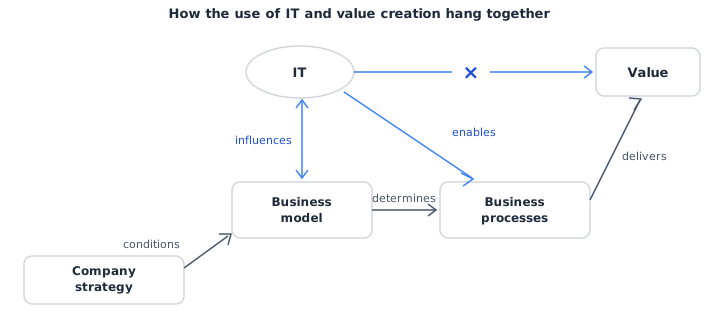
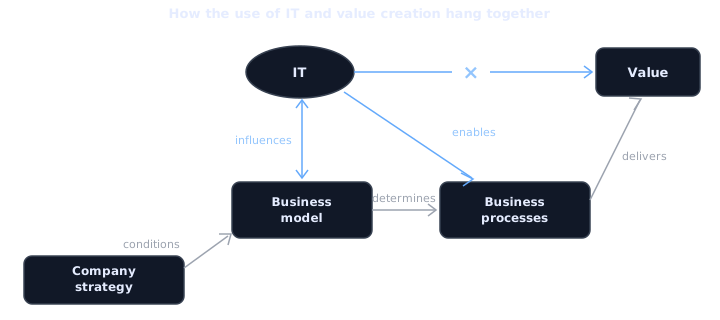
Own diagram after figure 29 of the WU text (p. 87), which in turn follows Leimeister (2021), p. 19.
The chain itself has four links and a fixed direction. At the beginning stands the company strategy, and it conditions the business model. The business model determines the business processes. The processes deliver the value. Anyone reversing this direction and saying that the sequences determine the model has read the drawing the wrong way round: first it is settled what the company lives on, then the sequences for it follow.
Technology stands aside from this chain and intervenes in it at two points. It influences the business model, and in both directions at that, since the arrow carries a head at each end. And it enables the business processes.
The most important is the third effect, right at the top of the drawing. What the sequences deliver in value is not supplemented by the use of technology but multiplied; that is why a multiplication sign stands there and not a plus sign. By what means, the WU text says with two examples: with information and communication technology a larger number of customers can be reached, and products can be offered in individualised form. Both act on the revenue side. The WU text expressly presents the two as examples and so does not close the series; named, however, are exactly these two. Should a further effect be offered to you, check two things: whether the WU text names it at all, and whether it takes hold on the revenue side.
Your turn11 of 21
An advertising agency first records its sequences and then wants to derive from them which business model it pursues. Which statement of the WU text stands against this approach?
Your turn12 of 21
A start-up has fixed its corporate strategy. According to the chain in the WU text, what comes next?
The music business shows that a business model can change more than once
How far such a change can go, the WU text demonstrates on the music industry, and on one and the same good across three models.
Around the year 2000 you bought music as a sound carrier, that is as a record or a CD, and you bought it as a package: several tracks on one carrier, not to be had singly. Apple broke this model open with the iPod and the legal online distribution of individual tracks through the iTunes Store, in combination with novel playback devices. Spotify changed the manner of consumption a second time: tracks are no longer downloaded and acquired but streamed over the internet, and what is paid for is not the single track but a subscription through which millions of users reach nearly all available titles.
Three times the same good, three times a different business model, and every time the trigger was the use of information and communication technology. That is exactly what the sentence means with which the WU text closes this section: digitalisation brings not only a switch from analogue to digital but rebuilds whole industries together with their products, services and the business models behind them.
Your turn13 of 21
A publisher sold audiobooks around 2000 as CD boxes, later individual chapters as downloads, and today streams its whole catalogue for a monthly fee. Which statement describes this development the way the WU text interprets the case of the music industry?
Three digital business models differ by who is allowed to offer
The WU text picks out three models that were made possible by information technology. They are examples and not a complete classification, but the exam asks about them, and they can be told apart by a single question: who is allowed to offer anything here?
| Model | Who lists | What the operator provides | Examples |
|---|---|---|---|
| Web shop | only the seller who runs it | sale of its own goods | Amazon.de, Zalando.de |
| Online trading | private individuals as well | access for buyers and sellers | willhaben.at, eBay.de |
| Social network | the members, with own posts | a virtual community | Facebook, X, LinkedIn |
Own compilation from the details on p. 88.
With the web shop you order directly from the operator. The goods travel straight to customers or to individual companies, and the price is fixed, because a single seller runs the shop.
On the online trading place buyers and sellers meet, and the operator belongs to neither group: he does not sell himself but keeps the platform open through which both sides come in. Because private individuals are allowed to offer there as well, the price is not given in advance. Interested parties search for products, get in contact with possible sellers and agree a price with them.
The social network is a virtual environment, that is a community on the net in which people with the same interests exchange views and get in touch with friends. Nothing is sold there to the members, and it is a business model nonetheless: it earns its money among other things by selling advertising space. Using it feels free of charge because somebody else pays, and not because the operator forgoes revenue. What a platform lives on says nothing about which of the three it is: that is decided solely by who is allowed to offer there.
Your turn14 of 21
On the first platform only the operator offers goods. On the second, users may list themselves and negotiate the price with interested parties. Which statement of the WU text decides which model is present in each case?
Your turn15 of 21
On a platform, members with the same interests exchange views through posts of their own. Nobody sells goods there; the operator lives off selling advertising space. Which of the three models is present?
Pure play and clicks and mortar are separated by the question of premises to walk into
Pure play is what a model is called whose business takes place exclusively online, and most of those just named fall under it. Such a provider is out and about in the digital space and keeps no physical branch a customer could walk into to look at goods. Without the internet such models would not exist, and not in a smaller edition either but not at all.
Alongside it stands the clicks-and-mortar model. Here the physical business continues to exist, and the digital presence, a website or a platform say, comes in as an extension. A bookseller with a shop in the town centre who additionally sells online belongs here: the shop stays the core, the digital part comes in addition. Anyone reversing the order and declaring the shop an extension of the website is describing a different case.
What is decisive here is the exclusivity and not the share of turnover. A trader making nine tenths of his turnover on the net while keeping a single shop open is no pure play.
Your turn16 of 21
A flower shop on the main square will in future also take orders through a site of its own. A competitor delivers the same bouquets but keeps no premises. Which statement of the WU text classifies the two?
Your turn17 of 21
An online bookseller runs a large warehouse on the edge of town from which it ships all orders. Customers cannot get in there; it sells only through its website. Is it a pure play?
The revenue model answers where the money comes from
A business model says how an offering comes about and reaches the customer. One question inside it is important enough to carry a name of its own.
Within a business model, the revenue model answers a single question: what does the company earn its money with? It names the source of the revenues out of which a profit is meant to come in the end.
There are many revenue models, and technology bears on how they are shaped too. A company does not have to commit itself: it can rest on one model or combine several with each other.
Two of them the WU text picks out as examples, because they weigh particularly heavily in connection with digitalisation: the advertising model and the subscription model. They are not the only ones, and anyone taking them for a complete list has drawn the connection more narrowly than it is.
One word more on the expression website, since it is meant broadly here. It covers news sites as well as web shops, social networks and other platforms that make products or services accessible.
Your turn18 of 21
A cooking portal earns its money from commissions that partner shops pay for ingredient orders it passes on, and from cooking classes for a fee. A classmate says the portal has no revenue model, because it uses neither an advertising nor a subscription model. Which is true?
The advertising model turns visitor numbers into revenue
With the advertising model, advertising itself is the source of revenue. Whoever keeps a website with many visitors sells space on it to advertisers and draws revenue from that. The visitor count is the precondition: without an audience the space is worth nothing.
What form this space takes depends on the field of business. A search engine can sell keywords in the search, which the WU text calls AdWords, or advertisements against particular search words, for which it uses the name AdSense. A comparison portal with many visitors can offer classic banner advertising and combine it with particular search terms. Out of mere space there arises in this way an offering cut to the searcher's interest. Providers of daily newspapers use the advertising model among other things to cover the costs of running and providing their online content.
On the two product names: the WU text assigns AdWords and AdSense as just described. In practice the one programme goes by a different name today, and the other is aimed at operators of third-party websites. For the exam, the WU text's presentation holds; the self-check at the end of this article therefore asks no question about these two names.
This model is no marginal phenomenon but one of the most popular of all. Many offerings that feel free of charge to us, a search engine or a comparison portal say, have carried it since the internet's first steps, and our online experience today is shaped by it. With a different revenue model prevailing, the net would look different today.
Which amounts stand behind this, the WU text shows on Alphabet, the parent group of Google. In the year 2023 the group took 86.3 billion dollars in one quarter. Of that, 65.5 billion fell to advertising, that is 75 percent.
Tasks about figures like these rarely ask for the figure itself but for what follows from it, and two moves are enough for that. What remains besides advertising is the turnover less the advertising amount. And how that remainder relates to the advertising you see by doubling or trebling it and comparing the result with the advertising amount.
Practise both on a comparison portal that takes 12 million euros in a quarter, 8.4 million of it with advertising. Besides the advertising, 3.6 million remain. Three times that is 10.8 million, and with 8.4 million the advertising stays below it: three times the remaining turnover is not something it reaches here. Its share amounts to 70 percent. The same two moves fit the Alphabet figures above, and those you now work out yourself.
Your turn19 of 21
A news site takes 7.5 million euros in a quarter, 4.5 million of it with advertising. Which statement describes how this news site's revenues relate to each other?
With the subscription model the customer pays not once but again and again
The second model demands no audience but a running payment. Whoever signs up pays a fee at fixed intervals and receives access to the company's offering for it.
How far this access reaches is open and belongs to the shaping of the model. It can cover the entire offering, as with content providers of the Netflix or Spotify kind, whose subscribers reach everything on the platform, and it can be limited to a part. Both are provided for; anyone thinking a subscription always secures only a part has drawn the range too narrowly. And the fee is never a one-off: were it one, there would be no subscription.
This model has meanwhile spread so widely that many companies have switched to it from another revenue model. With newspapers it used to be possible to read content online without restriction and merely put up with advertising; today content providers rely on the subscription or on a combination of both models. So the two do not exclude each other, and that is the point at which tasks readily set in.
How pronounced such a switch can be is shown by the software provider Adobe. Until 2013 individual programmes such as the house's image editing software could be acquired for life through a one-off payment. Since then a monthly or annual fee is payable for them. The same software, the same benefit, a different revenue model.
To close, keep the two models cleanly apart. The advertising model takes the money from advertisers and lets the use appear free of charge, the subscription model takes it from the user herself. The two therefore stand side by side, and neither is a variety of the other. The question that separates them always reads the same: who pays, the advertisers or the user?
That completes the first half of the fourth chapter. What makes all these offerings technically possible in the first place, that is what a network is, how the internet and the World Wide Web differ, and what holds business informatics together as a field, is dealt with by the article on business informatics.
Your turn20 of 21
A provider of graphics software used to charge a one-off purchase price and is switching to an annual fee. Which statement of the WU text classifies this switch?
Your turn21 of 21
A newspaper will in future let its online articles be read only for a monthly fee, and it continues to show adverts alongside them. What is correct?
Was this article helpful?