Business Informatics (Wirtschaftsinformatik)
The article on digital transformation shows what digitalisation does to a company: how it changes its sequences, its customer relationship and its offerings, and how new business models and revenue models come out of that. One question stayed open there, and it is the technical half of the same matter: what does all this actually run on?
This article covers the second half of the fourth chapter, that is pages 92 to 101. The first part answers the open question: what makes a network a network, why the internet and the World Wide Web name two different things, how browser and server talk to each other, and how a net turns into a market. The second part is about the subject that deals with all of this, and about its central object, the information system.
The internet is a net made of nets, and nothing more than that
Without the internet, little would be left of the digitalisation of a company. The functions you use privately and at work to exchange information all sit on top of it, and for connecting people and companies across the globe there is no more important infrastructure.
Take the word net literally here. What is networked here are themselves nets: networks switched together worldwide add up to the one we are talking about. What an individual connection looks like varies. Deep-sea cables run between the continents; in the flat and in the office the same thing happens without wires. What is reached is nonetheless always the same net: whoever hangs on the router's cable is in the same internet as somebody on the radio network of that same device, and the cables under the sea belong to it just as much.
A network, also called a computer network, brings together data stations that lie apart in space and nonetheless exchange data with each other. Their connection is made by communication devices and communication paths. Data station here means any computer, from the PC through the tablet to the smartphone.
Two words of this definition get swapped against each other regularly, and the tasks take up exactly that. A communication device is a piece of equipment or hardware, the WLAN module in the device say, or the router in the flat. A communication path is the stretch it then travels over, and for that exactly two possibilities remain: through a cable or through the air. A cable is accordingly a stretch and not a device, a router a device and not a stretch.
Your turn1 of 20
A medical practice draws up a list of its communication devices and enters the router, the built-in WLAN module of a laptop and the cable to the printer. Which statement of the WU text shows that one entry does not belong on this list?
The internet and the World Wide Web name two different things
In everyday speech we equate the two words. People say they looked something up on the internet, having used the web through a browser; people say they are sending a message over the web and are in truth using another service, for which the net is merely a means of transport. In the exam this sloppiness is punished.
Regarded as a service, the World Wide Web is an application that sits on top of the internet. It sees to it that information can be made available, found and sensibly displayed. The internet itself, by contrast, is the net beneath it, over which data is sent and received.
Remember the two storeys: the net below, the services above. The web is one of those storeys, electronic mail a second, and the second does not belong inside the first. Whoever counts e-mail as part of the web has pushed the levels into one another.
What do you reach the web with? Mostly with a web browser, and that is why it is called the central interface to the services there. Without exception this does not hold, as a later section shows.
Three things the WU text names in one breath as what the web allows: displaying content, tracking down information and closing deals. The third is easily overlooked, because at first glance the web looks like reading; a purchase on the net runs over it just the same.
Your turn2 of 20
An intern writes in his report that the firm sends its invoices by e-mail over the World Wide Web. Which statement of the WU text corrects him?
Your turn3 of 20
An acquaintance says that internet and World Wide Web are merely two names for the same net. Which statement of the Skriptum refutes him?
Three building blocks from 1989 carry the web to this day
The World Wide Web was invented by Tim Berners-Lee, in 1989 during his work at CERN. The academic paper about it appeared a year later, in 1990, under the title "Information Management: A Proposal". Keep the two years apart: invention and publication do not fall in the same year, and the paper did not bring the web about either. It presents an idea that already existed by then. From today that is more than 30 years.
The content of that paper is examinable too. What it proposes is an order for information on the net: a way of filing it and keeping it available so that others can find it again and open it without effort. The impulse was not a commercial one. At CERN in Geneva the point was to manage results from research among colleagues more easily and pass them on. Selling something over a net was not behind it, however much is sold over the web today.
Three concepts from that time the WU text holds to be indispensable to this day. Keep them cleanly apart, because in tasks they readily swap roles.
| Abbreviation | What it stands for | Its job |
|---|---|---|
| HTTP | Hypertext Transfer Protocol | fixes the sequence of steps by which a browser requests something from a server |
| HTML | Hypertext Markup Language | puts information into a form out of which a browser can make a readable page |
| URL | Uniform Resource Locator | issues uniform addresses and thereby makes what is addressed retrievable |
Own compilation from the details on p. 93.
The commonest confusion concerns the first and the third row: addressing goes through the URL and not through HTTP. On a page there can also be links leading on to other pages; for such connections there is the name hyperlink, and they turn single pages into a web. With the data stations from the first section they have nothing in common.
Your turn4 of 20
A handout claims that Tim Berners-Lee created the World Wide Web in 1990 with his paper. Which statement of the WU text refutes that?
Your turn5 of 20
A colleague notices that many web addresses begin with “http” and concludes from this that the Hypertext Transfer Protocol issues the addresses on the web. Which statement of the WU text refutes her?
A protocol is a set of rules for computers and not a set of minutes
The word protocol misleads, because in everyday speech it means something other than in information technology. The minutes of a meeting are precisely not what is meant here.
A protocol in information technology, more precisely a communication protocol, lays down the way computers are to make themselves understood to one another, and to do so as exactly as possible and without room for misunderstanding. Regulated in it are, among other things, the form of a message, the form of the answer to it, and the permissible characters, contents and representation sizes.
Note the "among other things": what is listed is a selection and not the complete list. In any case all of it is fixed in advance and jointly for both sides. No computer may decide for itself which characters it uses, since that is exactly what would make understanding impossible. And a protocol is needed always, not only once devices from different manufacturers meet.
How strict such conventions are, the WU text shows on the postal route. A letter has to carry recipient and address, plus the sender so that the letter finds its way back if delivery fails. Whoever does not keep to that finds their letter does not arrive. With computers it is the same.
Your turn6 of 20
A classmate claims: two computers from the same manufacturer need no communication protocol, because they use the same characters anyway. How should the claim be judged?
Your turn7 of 20
Which of the following is a communication protocol in the sense of information technology?
Browser and server speak by the pattern of request and answer
For a web page to reach you, your browser turns to a server following the rules of HTTP and demands a file there.
A server is nothing mysterious in this, but simply a computer in a server room whose peculiarity consists in hanging on the net and listening out for incoming requests. On it, many systems often work side by side on quite different jobs. One of them attends to what comes in from the net and carries the name server software. The widespread error that a server carries exactly one system goes past this.
The sequence itself consists of two steps and carries a name of its own. Your browser demands a particular HTML page, in English a request. The server software sends an answer back in return, in English a response. How that turns out hangs on whether the demanded page can be found on the machine at all. This back and forth is called the request-response principle.
Now separate the principle from the architecture it sits in, because several tasks set in here.
The client-server architecture keeps two roles apart, the client and the server. On the server side several applications can work that offer their services over a network, and this network is as a rule the internet. On the other side stands the client, a web browser for instance, which fetches content from there.
The request-response principle belongs inside this architecture and does not stand beside it as a second model. Nor is the architecture outdated: a large part of what we do on the net today still rests on it. And do not confuse the roles. The services are offered on the server side; the one doing the requesting is the client.
Your turn8 of 20
The accounts of a business already run on its server. For the new website the owner wants to buy a second server, because one computer only has room for one system. Which statement of the WU text refutes him?
On this architecture stand the services you use every day
Because architecture and principle are settled, almost anything can be offered on the web. The WU text picks out three forms as examples, and the tasks check whether you keep these three apart.
- A comparison platform shows the customers which providers exist in a market.
- A web shop takes orders and sees them through.
- A content provider puts news onto the net.
The first two get swapped crosswise in tasks: orders are handled by the shop, the overview of the market is supplied by the comparison platform. And the list stays open. The WU text writes expressly "such as", because the possibilities keep growing; news portals count towards it as much as the other two.
The web browser is the usual way into these services; a compulsory one it is not. A company's software can also provide interfaces of itself and through them get in touch with other companies and pass data on. A company whose order data arrives at its supplier without a browser standing open anywhere is making use of exactly that.
Your turn9 of 20
A garage sends its spare-part orders to the wholesaler without anybody opening a browser. An apprentice thinks that is impossible. Which statement of the WU text refutes him?
The net turns into a market, and this market is called the internet economy
As soon as services can be offered in a digital net, something new arises: a market, or more precisely an existing market to which a digital place is added, at which economic deals can be concluded.
One speaks of the internet economy where the internet is used economically in order to carry out deals in which a value arises. What is thereby spanned is a market inside a digital net, that is a digital platform on which quite different market participants come together.
Note the word "added". The existing market does not disappear in the process, it gains a second place. For companies the net thereby becomes a platform in its own right, on which they and their customers find each other.
Sometimes that is not enough, and a third party comes in: a platform operator who puts up the digital platform for one single market. That such an operator is involved at all often goes unnoticed by end customers.
What that looks like, the WU text demonstrates on the Viennese provider refurbed. Firms there list used and professionally refurbished technology. A private person searches the platform for a device, and in the background the operator gathers the cheapest offers of the dealers involved. The purchase contract then comes about between the customer and the dealer, and the same dealer also dispatches the device. Putting the marketplace up digitally is what the operator did: contracting party he is not, dispatcher just as little. A second example of the same build is willhaben, where advertisements from various industries can be placed and the parties involved then find each other themselves.
Such a platform applies to one market at a time and not to all of them at once. An operator for refurbished technology is therefore not an operator for everything.
Your turn10 of 20
A friend takes willhaben for a web shop like any other: the operator sells the items on offer itself and sends them out. Which statement of the Skriptum refutes him?
Your turn11 of 20
A father buys a notebook on a platform for refurbished technology. In the background the operator has gathered the cheapest offers of the dealers involved. The father believes he bought from the operator and that the operator will send him the device. Which statement of the WU text refutes him?
Business informatics lies between two subjects and disappears into neither
With that the technical groundwork is complete, and what remains is the question of the subject that deals with it. Everything that came up in the fourth chapter, from digitalisation inside the company through the change in business models to the consequences of digital nets for economic deals, belongs to business informatics. Its field reaches further still, to the design of systems say, to questions of running a company, and to the ethical consequences for our room to act in a digitalised society.
The subject is usually placed between business administration and computer science. What that placement looks like, the WU text shows with three areas that overlap one another.
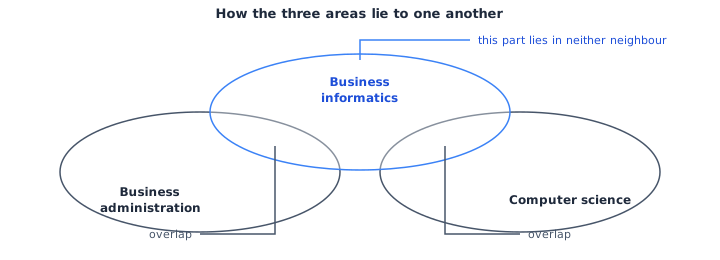
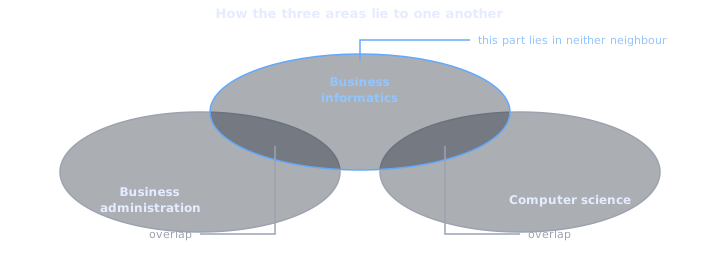
Own diagram after figure 34 of the WU text (p. 96).
Three things can be read off this arrangement.
The two neighbouring subjects do not touch each other. In this drawing, business administration and computer science have no common area. So they do not overlap directly; what mediates between them is business informatics.
Business informatics reaches into both and vanishes into neither. A piece of it lies over the one neighbour, a piece over the other, and a piece over neither of them. From that the same follows in both directions: a topic of this subject need have nothing to do with computer science, and it need have just as little to do with business administration.
Depending on the focus it counts as independent or as cross-disciplinary. Both are possible, and it is decided by where you direct your gaze. At the Vienna University of Economics and Business the emphasis lies on the business administration side and on the question of how technical means from computer science can support it.
Your turn12 of 20
A study adviser thinks business informatics is merely computer science with a commercial coat of paint, and that each of its topics therefore belongs to computer science too. Which statement of the WU text refutes her?
Your turn13 of 20
A brochure presents business informatics as the area in which business administration and computer science overlap directly. Which statement of the Skriptum refutes the brochure?
Six subjects distribute themselves across two points of view
If the two neighbours are widened into perspectives, the subject can be looked at from two sides: technical and behavioural. For each side the WU text names three subjects, both times with the addition "among others"; the lists are therefore open.
| Point of view | Subject | What it deals with |
|---|---|---|
| technical | Operations management (Produktionsmanagement) | producing goods and services, the sequences behind that, plus supply chains, stock and capacities |
| technical | Computer science (Informatik) | planning, designing and implementing systems and technologies, from algorithms to software engineering, semantic web and complex systems |
| technical | Data science | evaluating huge quantities of data, tailoring forecasting models to them, artificial intelligence and machine learning |
| behavioural | Business administration (Betriebswirtschaftslehre) | supporting core processes with technology, driving digital transformation, using innovations, keeping to rules and regulations |
| behavioural | Sociology (Soziologie) | how groups and organisations act on the design of systems and what those systems do to individuals and to society |
| behavioural | Psychology (Psychologie) | the human being at the centre, the effect of technology on them, ethical questions, digital humanism and ethical computing |
Own compilation from the details on pp. 97 and 98.
Cover the right-hand column and assign the six subjects to the two sides, because that is what gets asked. Two of them invite confusion: operations management sounds commercial and stands on the technical side all the same, while business administration itself stands on the behavioural side.
The third column gets asked crosswise too. Three swaps come up again and again.
- Tailoring forecasting models to large stocks of data is the business of data science, not of sociology.
- How groups and organisations shape the design of systems is investigated by sociology, not by psychology.
- Supply chains and capacities lie with operations management, not with computer science.
Two assignments are better memorised straight away in the positive. Data protection appears with business administration, namely where it is about keeping to rules and regulations in a shifting digital environment. Digital humanism and ethical computing appear with psychology, because there the human being and the ethical basis of system design stand at the centre.
Your turn14 of 20
A student assigns operations management to the behavioural side, because the name sounds commercial. Which statement of the WU text refutes him?
Your turn15 of 20
A student assigns the safeguarding of personal information to computer science, because it is about technology for storing and securing. Which statement of the WU text refutes him?
The object of the subject is information systems across their whole life
Only once the subjects lie side by side does it become graspable what the subject is about. At the core there is always the business question together with systems and people, and one term runs through all of it.
Business informatics deals with information systems, namely in the economy, in public administration and in the private sphere. It accompanies such a system across its whole life, that is from development through introduction, operation and use up to replacement. Its self-image is interdisciplinary, with two subjects as its foundation: business administration and computer science.
Four places in this definition get turned around in tasks, and each is worth a second look. The private sphere counts expressly along and does not drop out. All five stations belong to it, not only the middle ones. Two subjects are named as the foundation, and sociology is not one of them. And what an information system supports the company in is of a business nature: a purely technical matter it is not, and designed it is by people.
Your turn16 of 20
Which statement about the subject matter of business informatics is true according to the definition in the WU text?
An application system serves one single business field of tasks
If systems are spoken of in this subject, then depending on the cut two different things are meant. The smaller one comes first.
An application system is cut to a particular business field of tasks and is deployed there too. It can be a single program or several of them. Added to that are the data these programs work with and the technology they run on, a server say or a workstation computer.
The number of programs is expressly left open in this. Whoever pins an application system down to exactly one program has taken it more narrowly than the definition does.
A concrete example the WU text gives with an ordinary spreadsheet program that additionally accesses a database. Systems like this are procured or built for a company or for one area within it: for bookkeeping and cost accounting as much as for human resources, logistics, sales, distribution or marketing. Wherever business tasks arise, software is needed for them.
The expensive part follows after that. Unlike at home, a bought-in system can rarely be used unchanged inside a company; it has to be cut to that company, and this cutting can cost a lot of money and a lot of time. It consists at its core of translating what people need into functions of the application. Precisely for that reason it demands knowledge from computer science and from business administration at once, and precisely for that reason it is a core topic of the subject.
Your turn17 of 20
An advertising agency buys a program for time recording that keeps its records in a database and runs on a server of its own. The managing director thinks the application system is only the program itself. Which statement of the WU text refutes him?
An information system is the fitted frame in which application systems sit
The larger system encloses the smaller. Inside an information system sit several application systems belonging to one business context, and beyond that it is fitted into the structure of the organisation.
An information system is built for the purpose of a particular company and fitted to it. It takes the organisational structures into account and is put together from people and machines, where the machines include computers, application systems, network and communication devices. All those involved generate information, use it, or do both, and communication relationships hold them together.
The difference from the application system can be said in one sentence: an information system is always company-individual, that is always cut to the single company. Which system sits inside which, the WU text shows as a nesting.
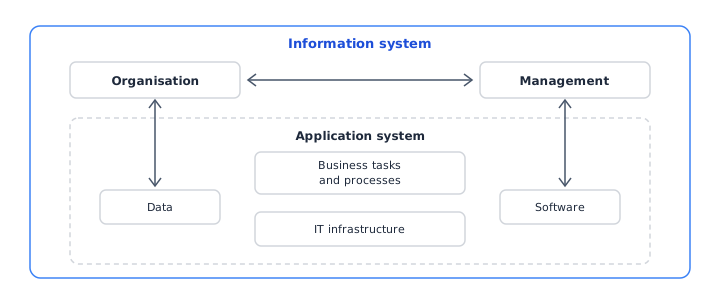
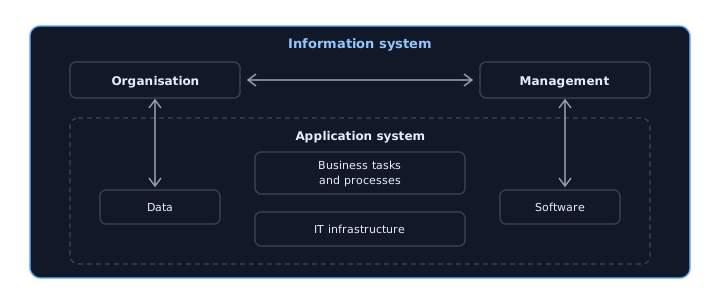
Own diagram after figure 36 of the WU text (p. 100), which in turn follows Laudon et al. (2016), p. 14.
The nesting runs in one direction only, and tasks readily turn it around. Outside lies the information system, inside the application system. The smaller system accordingly contains no larger ones; it sits inside one itself.
Just as important is what stands outside the inner box. Organisation and management lie inside the information system, but precisely not inside the application system. The difference hangs on exactly that: the inner system brings data, software, technology and the business tasks with it; only the outer one draws in the organisation and those who run it.
From that follows how such a system gets into a company. Off the shelf, information systems as a rule do not exist. Often the cutting is accompanied by a consultancy, though that is not compulsory: a company can also put its own people on it.
Your turn18 of 20
A consultant draws a diagram for a business in which organisation and management lie inside the box of the application system. Which statement of the WU text shows that he has entered them wrongly?
Your turn19 of 20
A furniture dealer wants to buy an information system ready-made, the way he installs a program at home, and use it unchanged the next day. Which statement of the Skriptum speaks against this?
Six building blocks make up an information system, and software is only one
An information system is more than software. The WU text breaks it into six building blocks, and three of them are not technical in nature at all.
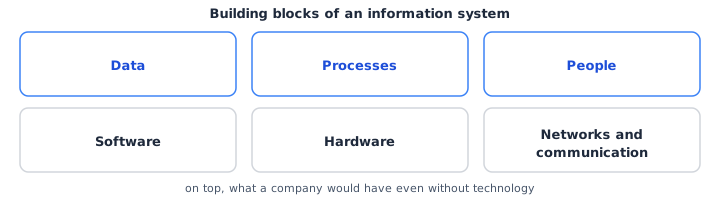
Own diagram after figure 37 of the WU text (p. 101). The figure itself labels the third block on top "Personen"; the running text speaks of people.
The upper row forms the groundwork inside a company. A company uses and generates data while it works through its business cases; these business cases can be held fast as processes in ordered work steps; and worked through they are by people, who fill different roles while doing so.
These people do not necessarily sit inside the company. Expressly named are participants from outside too, the customers say, or a delivery service. Whoever narrows the circle to the company's own staff has shortened the term.
The lower row supplies the tooling. Daily work needs hardware and software: servers, to hold data stocks in one place and secure them, computers and mobile devices for the work itself, plus software either bought in or specially cut. And because data has to travel from A to B and people have to talk to one another, nets inside the house and beyond it come in as well. So the building blocks precisely do not stand on their own: communication relationships hold them together, as already stated in the definition of the information system.
The best known form of a business information system carries a name of its own: the enterprise resource planning system, ERP system for short. Depending on its orientation it covers the essential areas of a company, accounting, materials management and production say. The best known supplier is the German software house SAP, seated in Walldorf, on the market since 1972 and thus for more than 50 years, with several generations of such systems, most recently SAP S/4HANA.
With that the fourth chapter has been gone through, and with it the economics part of the material.
Your turn20 of 20
An intern thinks an ERP system is by nature a bookkeeping program and does not reach beyond accounting. Which statement of the WU text refutes him?
Was this article helpful?