Statements and Implications
The tasks in this topic all look alike. A short assumption sits at the top, for instance that and are real numbers, five claims follow underneath, and the question asks which of them are correct (korrekt). The tick column beside them is headed "Richtig", and both words mean the same thing. There is barely any calculation. What you decide is what a claim actually claims, and what it takes to refute it.
The formula sheet (Formelsammlung) is no help here: it holds no rule of logic, and those you have to bring along. This article builds the logical pieces, from the counterexample through the implication to the quantifiers.
A statement is true or false, a statement form only once a value is inserted
A statement is a sentence that is either true or false, and exactly one of the two. "" is a true statement, "" a false one. The question "How large is ?" is not a statement, because there is nothing about it to judge.
A statement form contains a free variable and turns into a statement only once a value is inserted for that variable. It is written . For the statement form : "", the value is true and is false.
The difference decides how you proceed. A statement you check by settling its truth value. In a statement form there is nothing to settle as long as nobody has said which values it is meant to hold for, and that is exactly what the exam prints above the five claims.
Your turn1 of 7
The statement form : "" is given. Which of the following statements is true?
"Correct" means correct for every admissible choice
Two claims accompany this section. All that is assumed is that two functions and take positive values only. The first claim reads "", the second "". Is each of them correct?
The assumption fixes what is being talked about: that and are real numbers, that a denominator is not zero, that two functions and take only positive values. A claim containing those letters is correct precisely when it holds for every choice the assumption allows. An invisible "for all" therefore stands in front of every claim, even where those words are missing.
An asymmetry follows from this, and it decides how much work a single claim costs.
| What is to be shown | What that takes |
|---|---|
| The claim is correct | an argument that carries for every admissible choice |
| The claim is wrong | one single admissible choice where it stops holding |
A counterexample is a choice of the letters permitted by the assumption for which the claim does not hold. One is enough, and a second one makes the matter no safer. Conversely, no example proves a claim about all values, however many examples happen to fit.
Back to the two claims from the start. The first is settled by a single choice: if is constantly and is constantly , the difference is and hence positive. The second, by contrast, holds, and here no example helps, only the argument: a product of two positive numbers is positive, and nothing beyond that positivity was used.
Your turn2 of 7
The claim 'If , then ' is to be refuted. Which choice does that?
An implication fails in exactly one case
The implication , read " follows from " or "if , then ", claims that whenever holds, holds as well. About the case where does not hold it claims nothing, and it therefore counts as satisfied there.
Of the four possible combinations exactly one makes the implication false.
| true | true | true |
| true | false | false |
| false | true | true |
| false | false | true |
A working instruction follows from this: a counterexample to an if-then claim must satisfy the if-part and violate the then-part, and both at the same time. To refute "If , then " you therefore need a number with that is not larger than : satisfies , and is not larger than . The number is no objection, because there the if-part is already false, and the claim says nothing about that case. The last two rows of the table also explain why an implication whose if-part never holds counts as correct: there is no case in which it promises anything false.
Your turn3 of 7
The claim 'If , then ' is to be refuted. Which choice does that?
The converse, the contrapositive and the negation are three different sentences
Further sentences can be built from an implication, and the exam likes to place them side by side in one task. Two of them look alike, and only one of the two is equivalent to the original.
| Name | Shape | Relation to |
|---|---|---|
| Original | if , then | |
| Converse | if , then | independent, can be true or false |
| Contrapositive | if does not hold, then does not | always equivalent |
| Negation | holds and does not | true precisely when is false |
The sketch shows which four sentences belong together. Follow the horizontal links: the sentences there always share the same truth value.
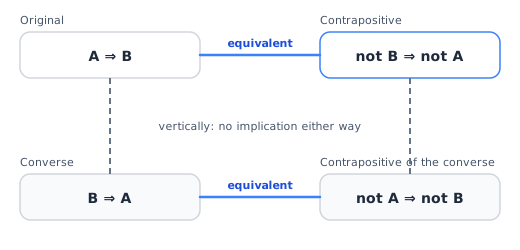
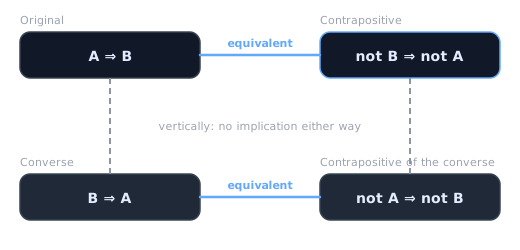
Look at this with a sentence that holds: "If , then ." From and , multiplying by gives first, and multiplying by gives . Together this gives . Three further sentences grow out of this one.
- The converse reads "If , then " and is false: satisfies yet does not exceed .
- The contrapositive reads "If , then " and is correct, because it claims the same thing as the original in a different order.
- The negation reads "There is an with and " and is false, since the original sentence is correct.
In the exam this saves time. If two of the five claims are contrapositives of each other, both share a truth value and you only test one of them; if one is the negation of another, exactly one of the two is correct. Note the shape of the negation while you are at it: it is not an implication itself. "If , then not " does not negate "if , then ", it forms a new sentence that can be just as false.
Your turn4 of 7
Which sentence is equivalent to 'If , then '?
Necessary and sufficient are two readings of the same implication
is sufficient for when holds. is then enough to secure . Whether can also occur without is left open.
is necessary for when holds: without there is no . That is the contrapositive of the same implication, so not a second claim but the same one read from the other side.
| Wording | Means |
|---|---|
| is sufficient for | |
| is necessary for | |
| is necessary and sufficient for |
For : "" and : "" this means: is sufficient for , and is necessary for . Both sentences say the same thing. is not necessary for , however, because satisfies without satisfying .
, read " if and only if ", claims both implications at once: and . If one of the two directions fails, the equivalence is wrong, however impeccably the other one may hold.
Test an equivalence twice, therefore. " if and only if " holds in both directions. " if and only if " is wrong even though one direction is flawless: from you reach equal squares, from equal squares you do not get back, as and show.
Rearranging an equation raises the same question. Adding the same number to both sides, or multiplying both by the same non-zero number, can be undone and leaves the solution set alone. Multiplying by an expression that may be zero cannot be undone: follows from only for , because at the left side holds for every choice of and . Negating both sides, on the other hand, is allowed: from " if and only if " follows "not if and only if not ", and the correct equivalence " if and only if " turns this way into the equally correct " if and only if ".
Your turn5 of 7
What is the relation between : '' and : ''?
And, or, not: what makes a connective true
| and | or | ||
|---|---|---|---|
| true | true | true | true |
| true | false | false | true |
| false | true | false | true |
| false | false | false | false |
The "or" of mathematics includes the case where both parts hold; it is not an "either or". Hence alone already gives " or ", whereas " or " tells you nothing about on its own, since the part that is true may be just .
Negating a connective flips both parts and swaps the connecting word along the way. These two rules carry De Morgan's name.
When negating a comparison, it helps that exactly one of the relations , , holds between two real numbers.
| Statement | Negation |
|---|---|
Both rules work together on the statement form . It holds precisely when or . Its negation negates each part and trades "or" for "and": and , in short . And because exactly one of the three relations holds, " or " does not hold for every real number: zero satisfies neither part.
In numbers, the "or" is most visible in the zero product, and more exam claims rest on this rule than on any other.
Negate both sides, applying the second De Morgan rule as you go, and you get the version that appears just as often: holds precisely when and . Nothing comparable holds for sums, since shows a sum that is zero although neither summand is. As soon as the summands cannot be negative, though, the reasoning returns: from it follows that and , because two non-negative numbers add up to zero only when each of them is zero.
Your turn6 of 7
Which inference holds for all real numbers and ?
Quantifiers bind a statement form, and their order matters
"For every , holds" claims that the statement form is satisfied at every admissible value. It is refuted by one single at which is false.
"There is an with " claims that at least one admissible value satisfies the statement form. It is proved by one such ; refuting it takes an argument that rules out every value.
| Claim | How it is proved | How it is refuted |
|---|---|---|
| for every , holds | an argument for all | a counterexample |
| there is an with | one example | an argument against all |
| there is exactly one such | an example plus proof that no second one exists | two examples, or an argument that there is none |
Negating a universal statement produces an existential one, and the other way round. "Not for every does hold" means the same as "there is an for which is false". And "there is no with " means the same as "for every , is false". In the exam the second rule often appears in disguise: "There is no for which is false" is nothing but the claim that holds for every .
When two quantifiers follow one another, their order decides the content. Two sentences about real numbers that differ in nothing else show it.
- "For every there is a with ." Correct. For every the value does the job, and is allowed to depend on .
- "There is a such that holds for every ." Wrong. That single would have to fit all at once; would require and would require at the same time.
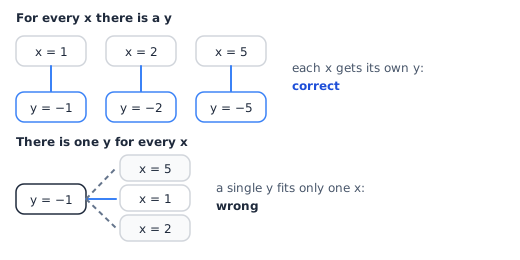
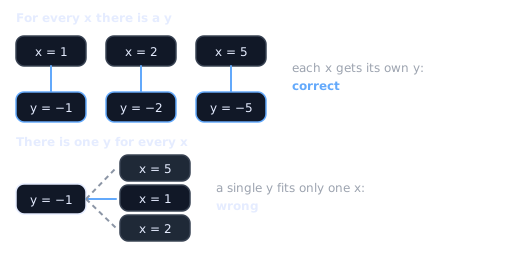
The rule behind it hides in the dependence. With "there is" at the back, the object you are looking for may depend on the one chosen before it. With "there is" at the front, a single object has to serve all cases at once, and that is the far stronger claim.
Once the function is given concretely, test the claims on it. Take .
- "There is an with " is correct, since suffices, and an existential claim needs one value.
- "There is exactly one with " is wrong, since does the same.
- "For every , holds" is correct, since is never negative; the value is reached at , which is why stands here and not .
- "There is an with " is wrong, and it has to be: this sentence negates the previous one.
- "For every with , holds" is wrong. The point satisfies the if-part, and violates the then-part.
Your turn7 of 7
Which statement about real numbers is correct?
What to take away
- Correct means for all. A counterexample refutes, an example proves nothing, and both hold even when the words "for all" are absent.
- The implication is wrong only when holds and does not. The contrapositive is equivalent, the converse is not.
- Sufficient and necessary. " is sufficient for " means , " is necessary for " means , and both together give the equivalence.
- Negation. "For all" turns into "there is" and back, "and" turns into "or", and the negation of is .
Was this article helpful?