Power Functions (Potenzfunktionen)
The tasks in this topic show a power function at the top, sometimes two for comparison, sometimes a shifted or reflected one, sometimes a whole family with a letter in the exponent. Below it come five claims about function values (Funktionswerte), symmetry, monotonicity, solutions and asymptotes, of which one to five are correct. You decide almost all of them with two questions to the exponent: is it even (gerade) or odd (ungerade), and is it positive, zero, negative or a fraction?
The formula sheet (Formelsammlung) is of little help here: of its twelve formulas only one concerns the power function, namely the derivative , and that belongs to the topic of derivatives. The power rules, the meaning of a negative or fractional exponent, symmetry, asymptotes and the rules for shifting a graph are not on it. Even the interval notations on it help only in part: they list only bounded intervals such as and , none with and no set such as . You write an unbounded interval by the same pattern, with a round bracket always on the side of : means , means , and some materials separate the bounds with a semicolon, . Everything else is yours to bring along.
How the five claims are scored, and why a single counterexample settles a claim, is explained in the article on logic (Logik). For power functions this means in practice: a claim about all falls as soon as you find one point where it fails, and usually it is one of the points , , , or .
In a power function the variable sits in the base
A power function has the form with a fixed number as the exponent. In the exam is a natural number such as , a negative integer such as , zero, one or the fraction . A factor in front, as in , changes the height of the values, not the kind of function.
Do not confuse it with the exponential function , where the base is fixed and the variable sits in the exponent. At , gives the value and the value ; at they give and , and the two functions behave differently in almost every question of this article.
For a natural number , is the product of equal factors . From this follows the rule on which most claims depend: with a negative base, the number of factors decides the sign. Every two negative factors give a positive product, so an even power of a negative number is positive and an odd power is negative.
Watch the brackets. means , because the power binds more strongly than the minus sign; only squares the negative number. For the base this gives an alternation that is often needed: is for even and for odd .
Your turn1 of 15
What is the value of ?
An even exponent makes the graph symmetric about the y-axis, an odd one about the origin
The sign rule determines the shape of the whole graph. Here and in the next two sections the exponent is always a natural number ; the exponent zero gets a section of its own. Substitute for : for even the value stays the same, and for odd its sign flips.
A graph is symmetric about the -axis if holds for every in the domain (Definitionsbereich). With every point , the point then also lies on the graph.
A graph is point-symmetric about the origin if holds for every in the domain. With every point , the point then also lies on the graph, and a half turn about maps it onto itself.
A function is strictly increasing (streng monoton steigend) on an interval if there always implies , and strictly decreasing (streng monoton fallend) if it always implies . The statement always belongs to an interval: a function can fall on the left and rise on the right.
The range is the set of all values that actually takes. An equation is solvable exactly when lies in the range.
| even , e.g. , | odd , e.g. , | |
|---|---|---|
| Symmetry | about the -axis | about the origin |
| Values | never negative, smallest value at | every real number, each exactly once |
| Monotonicity | falls on , rises on | rises on all of |
| Common points | , , | , , |
| Quadrants | I and II | I and III |
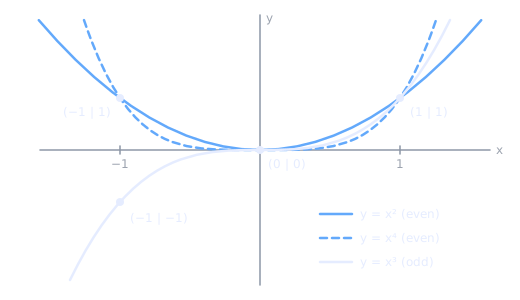
The quadrants (Quadranten) are counted anticlockwise: I is top right, II top left, III bottom left and IV bottom right. The sketch shows three representatives, among them the parabola (Parabel) . All three contain the origin as well as the point ; the two even ones also meet at , while the odd one passes through instead.
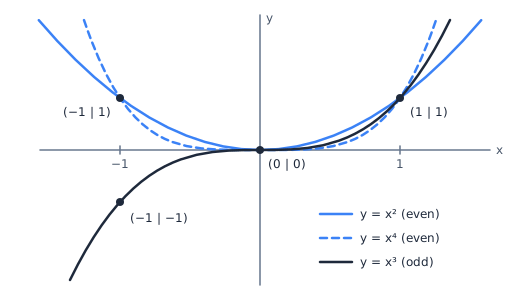
For monotonicity this means: an even power is neither increasing nor decreasing on all of . To the left of zero it falls, because is greater than ; to the right of zero it rises. An odd power keeps rising across zero as well. Its values grow beyond every bound to the right and drop below every bound to the left, so every real number occurs as a value; none can occur twice, otherwise the function would not be strictly increasing.
Your turn2 of 15
Which statement about is true?
The parity of the exponent decides how many solutions a power equation has
An equation with asks at how many points the graph of meets the horizontal line . The answer follows from the table above: an even power takes every positive value twice, zero once and negative values never; an odd power takes every value exactly once.
| even | two solutions, a number and its negative | one, | none |
| odd | one, positive | one, | one, negative |
So has the solutions and . has none, because no even power is negative. has exactly one, namely , and is also the only one: is positive. And has only the solution for every , because a product is zero only when a factor is zero.
You therefore check a claim of the form "has two solutions" with two questions: is the exponent even, and is the right-hand side positive? If either is missing, there is at most one solution.
Your turn3 of 15
Which equation has exactly two real solutions?
For positive x the higher power lies lower below one and higher above one
Whether is greater or smaller than depends on the point. A number between zero and one gets smaller when multiplied by itself, a number above one gets larger.
In general, for two exponents and : the quotient has a positive exponent and is therefore less than one when , and greater than one when . At the point all powers equal .
The rule holds for all exponents, negative and fractional ones included, and it contains two special cases that are often asked about. With it says: for , for every , for instance . With and it says that there: exceeds .
For negative the rule does not apply; there the sign decides first. There an even power has positive values and an odd one negative values, and every positive number exceeds every negative one, however large the exponents are.
If a claim asks about the vertical distance between two graphs at a point, that is the difference of the two function values, not one of the two values alone. At , and are apart. Where two power functions are equal you find by factoring out: means , so , or .
Your turn4 of 15
Which inequality is true?
The exponent one leaves x unchanged, the exponent zero turns every base except zero into one
The exponent one changes nothing: , the graph is the bisector and rises on all of . The exponent zero yields the number one for every base except zero, for instance and .
The division rule of the next section forces this: is and at the same time . At this would read , which is why is not fixed at school, and a power with the exponent zero is defined only for .
Since for every exponent , the graph of every power function contains the point , whether its exponent is natural, negative or a fraction.
Your turn5 of 15
Which statement about is true?
When powers are multiplied, the exponents are added, not multiplied
For powers with the same base the following rules hold, and none of them is on the formula sheet. For they hold without restriction, and with integer exponents also for every . With fractions in the exponent and a negative base, take care: , so for it is and not .
| Operation | Rule | Example |
|---|---|---|
| for |
The most frequent mistakes concern the first three rows. When multiplying, the exponents are added, not multiplied: is and not . When dividing, you subtract, and a negative exponent in the denominator changes its sign in the process: . The exponents are multiplied only for a power of a power. A check with the base exposes each of these mistakes: .
Two rules do not exist, convenient as they would be. cannot be combined into a single power, and is not : , but .
Your turn6 of 15
Which expression equals for every ?
A negative exponent forms the reciprocal (Kehrwert)
For the negative exponent turns the power into its reciprocal, not into its negative. is positive. A power with a negative exponent becomes negative only when the base is negative and is odd: , while stays positive.
So the sign rule holds unchanged, and with it the symmetry: is symmetric about the -axis for even and point-symmetric about the origin for odd . What decides the symmetry is whether is even, not the minus in the exponent.
A gap in the domain (Definitionslücke) is a point at which the function's rule yields no value. For this is the point , because there one would divide by zero; the domain is .
An asymptote is a line to which the graph clings arbitrarily closely for of large absolute value or near a gap: the distance between graph and line becomes smaller there than any given number. For there are two: the -axis as the horizontal asymptote (waagrechte Asymptote), because comes arbitrarily close to zero for of large absolute value, and the -axis as the vertical asymptote (senkrechte Asymptote), because near the gap the values grow beyond every bound in absolute value.
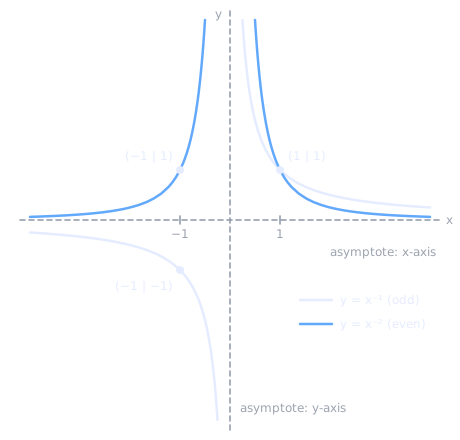
Near the gap the denominator becomes tiny and the fraction huge: and . For even this happens upwards on both sides, for odd upwards on the right and downwards on the left. That is why the two branches of lie in quadrants I and II and those of in I and III. The sketch shows this with the simplest members of both cases, for even and for odd .
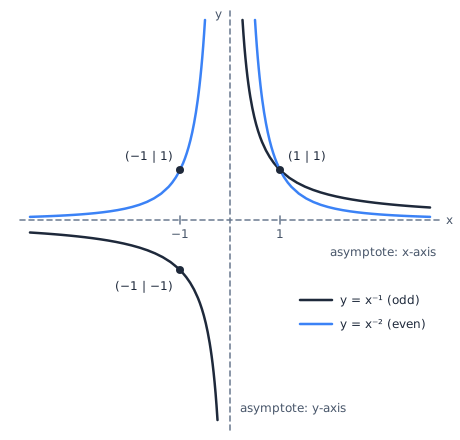
The sketch also shows the monotonicity, and every other negative exponent of the same parity behaves alike. This is where the most common trap lies. falls to the left of the gap and falls to the right of the gap, but it does not fall on the whole domain: , and yet is smaller than . Monotonicity holds on an interval, and is not one. rises to the left of the gap, for instance from to , and falls to the right of it, exactly the other way round from .
| , even | , odd | |
|---|---|---|
| Values | positive only | positive for , negative for |
| Symmetry | about the -axis | about the origin |
| Left of the gap | increasing | decreasing |
| Right of the gap | decreasing | decreasing |
| Asymptotes | -axis and -axis | -axis and -axis |
Your turn7 of 15
For which function does hold at every point of its domain?
Your turn8 of 15
Which power equals for every ?
Your turn9 of 15
On which interval is strictly increasing?
Your turn10 of 15
For which points does hold?
The exponent one half is the square root
is the non-negative number whose square gives , that is . By the rule for a power of a power, . Three properties follow from this.
- Domain . A square is never negative, so no negative number can occur as the square of a real number. The starting point belongs to the graph.
- Strictly increasing, with shrinking gains: to get from the value to the value , the argument (Argument) must grow from to , and for the step to the value already up to .
- Position relative to the line . The two meet at and at . In between the root has the larger value, for instance , after that the smaller one, for instance .
For , , the last row of the rule table with the exponent . This lets you simplify roots: . For sums there is no such splitting: , whereas gives .
Your turn11 of 15
Which order holds for every with ?
When a graph is shifted, its gap, asymptotes and centre of symmetry move with it
| Change to the rule | Effect on the graph |
|---|---|
| with | shift (Verschiebung) by to the right |
| with | shift by to the left |
| shift by upwards, downwards if | |
| reflection (Spiegelung) in the -axis | |
| with | vertical stretch (Streckung), every value times |
What gets confused above all is the direction of a horizontal shift. To move the graph to the right by , is replaced by : the value that previously had at the point now appears at the point , because there is computed.
In general, , with any numbers and , arises from the graph of by moving every point to . From this follows where each feature of the graph ends up.
- Intervals of monotonicity move by : if rises on an interval, rises on the interval shifted by .
- Gaps and vertical asymptotes move sideways by ; becomes . A vertical shift leaves them where they are.
- Horizontal asymptotes move up or down by ; becomes . A horizontal shift leaves them where they are.
- The centre of symmetry (Symmetriezentrum) of an odd power becomes , and the axis of symmetry of an even power becomes the line .
An example: has and . The gap lies at , the asymptotes are and , the centre of symmetry is , and falls on and on . Intercepts are not given by these rules; you compute them by substituting.
Reflecting and stretching act on the values, not on the x-positions. Reflecting in the -axis and stretching it by the factor gives with and . The reflection reverses every statement about monotonicity: rises on all of , falls on all of . A symmetry survives both, because the same factor acts on both sides: , so stays point-symmetric about the origin. The zero (Nullstelle) also stays, since .
Your turn12 of 15
The graph of is shifted to the left and upwards. Which lines are the asymptotes of the new graph?
Your turn13 of 15
On which interval is strictly increasing?
Fixed cost per unit and unit cost are power functions with the exponent minus one
Fixed costs arise regardless of the quantity produced, such as rent or leasing instalments. Variable costs grow with the quantity; if each unit costs an extra euros, the total costs (Gesamtkosten) for units are .
The fixed cost per unit is the share of the fixed costs that falls on one unit: .
The unit cost, also called average cost (Durchschnittskosten), is the total cost per unit. The fraction is split term by term: .
Both are power functions with the exponent , the second shifted upwards by . A firm with fixed costs of 18,000 euros and variable costs of 5 euros per unit shows what follows from this.
| Quantity | Fixed cost per unit | Unit cost |
|---|---|---|
| 1,000 units | 18 euros | 23 euros |
| 2,000 units | 9 euros | 14 euros |
| 3,000 units | 6 euros | 11 euros |
| 9,000 units | 2 euros | 7 euros |
If you double the quantity, the fixed cost per unit halves, because . The unit cost, however, does not halve: it falls from 23 euros to 14 and not to 11.50 euros, because the variable 5 euros per unit remain. Conversely, the quantity for a desired unit cost can be calculated: a unit cost of 8 euros requires a fixed-cost share of euros per unit, that is at 6,000 units, since 18,000 euros spread over 6,000 units give 3 euros per unit.
As the quantity grows, the fixed cost per unit approaches zero and the unit cost approaches the amount , both from above and without ever getting there, because keeps shrinking with every increase in quantity and yet is positive for every . The line is the horizontal asymptote of the unit cost, just as with the upward shift in the previous section.
Your turn14 of 15
A firm bears 42,000 euros of fixed costs, and each unit causes 4 euros of variable costs. At what quantity is the unit cost exactly 10 euros?
Five claims are decided first by the exponent, then by a single point
A procedure that works for this topic:
- Classify the exponent. Even or odd, positive, zero, negative or a fraction: this fixes symmetry, the sign of the values, the domain and monotonicity before you calculate.
- Take away the shifts. If stands in place of or a summand follows, shift the gap, the asymptotes and the centre of symmetry by and , and check the rest on the basic function.
- Calculate values with brackets. With a negative base, first determine the sign from the parity; with a negative exponent, first form the reciprocal.
- Attack universal claims with one point. "For all ", "on all of ", "for every ": the points and and the exponents and refute most of the false versions.
- In a comparison, look for the point one. Does the point in question lie between zero and one or above it? That decides which power lies on top.
A complete example with on :
- . False. ; the exponent is odd, and the minus stays.
- The graph has the origin as its centre of symmetry. Correct. The symmetry is decided by the parity of , not by the sign of the exponent.
- is decreasing on . False. Each branch falls on its own, but is smaller than , although .
- The equation has no solution. Correct. A fraction whose numerator is cannot become zero, and the graph only approaches the -axis without crossing it.
- For , is smaller than . Correct. Beyond one, the power with the larger exponent lies on top, and is larger than . Check at : against .
None of the five decisions needs more than one line of calculation. Two are decided by the parity of the exponent, one by the point one, one by a pair of points to the left and right of the gap and one by the reciprocal.
Your turn15 of 15
Let on . Which statement is true?
Common mistakes
- Confusing a minus sign with a negative exponent. is and positive for every , not .
- Multiplying the exponents when multiplying powers. ; multiplication of exponents belongs only to .
- Forgetting or inventing the second solution. with has two solutions only for even and ; for odd the negative of a solution is not a solution, because the sign stays.
- Claiming monotonicity across a gap. If a function falls to the left and to the right of the gap, that does not yet make it decreasing on the whole domain.
- Taking the higher power to be larger everywhere. For the opposite holds, and for negative the sign decides first.
- Reversing the sign when shifting, or forgetting the asymptote. shifts to the right; a horizontal shift moves the gap and the vertical asymptote, a vertical shift moves the horizontal asymptote.
What to take away
- Parity. Even exponent: symmetric about the -axis, values never negative. Odd exponent: point-symmetric about the origin, the sign stays; if it is also positive, every value is taken exactly once.
- Negative exponent. : gap at zero, asymptotes -axis and -axis, monotonicity only branch by branch.
- Comparison. For the power with the larger exponent has the smaller value, for the larger one; at the point one all equal .
- Special cases. for , , for .
- Shifting. For , the gap, the asymptotes and the centre of symmetry move to the right and upwards, and the intervals of monotonicity move along by .
- Costs. Fixed cost per unit halves when the quantity doubles; unit cost falls towards without halving.
Was this article helpful?