Polynomial Functions (Polynomfunktionen)
The tasks in this topic give you a polynomial function, sometimes multiplied out, sometimes as a product of brackets, sometimes only through its degree and a few zeros. Five claims about the function follow, and the question asks which of them are correct. Almost every one can be settled in one of two ways: by plugging in a single number, or by a rule you read off the formula. How a counterexample refutes a claim, and why "correct" means "correct for every admissible choice", is covered in the article on logic; this one is about the rules themselves.
From the formula sheet (Formelsammlung) you mainly need the solution formula for quadratic equations, formula (1): it comes in as soon as a linear factor has been split off a cubic polynomial and a quadratic factor is left. Polynomial division, Horner's scheme, the rules for the multiplicity of a zero, for the behaviour at the far ends and for symmetry are not on it; you have to bring those along. Besides that, the differentiation rules (2) to (5) give you the derivative of a polynomial if a claim calls for it.
The article proceeds in the order in which you read a formula: first what stands at the front and at the back, then the zeros and how to find them, finally two polynomials compared and a cost function.
Degree, leading coefficient and constant term can be read off the formula
A polynomial function is a sum of powers with natural exponents, each multiplied by a real number: with . The numbers are called coefficients. Negative or fractional exponents and an in a denominator do not occur.
The degree is the highest exponent whose coefficient is not zero. A constant function other than zero has degree .
The leading coefficient is the coefficient in front of the highest power, that is . It need not be the first coefficient in the written formula, nor the largest one.
The constant term is the summand without . Substitute and every other summand drops out, leaving . The point of the graph therefore lies on the -axis, and is also called the -intercept (y-Achsenabschnitt).
shows why you have to look closely. The order of the summands is arbitrary: the degree is , the leading coefficient is because it stands in front of , and the constant term is . That is the largest in absolute value changes nothing about the degree or the leading coefficient.
If the formula is given as a product, you do not need to multiply it out for this. The degrees of the factors are added, their leading coefficients multiplied, and you get the constant term by substituting into every factor. For this means: degree , leading coefficient and . A constant factor such as has degree itself and does not change the degree, but it does change the leading coefficient and with it the sign of every function value.
Your turn1 of 14
Which statement about is true?
At the far ends the summand with the highest exponent decides
For of large absolute value the highest power grows faster than all the others together. How the graph runs at the far left and the far right therefore depends only on the leading term (Leitterm) , and on only two things about it: whether is even or odd, and which sign has.
| Degree | ||
|---|---|---|
| even | up on the left and the right | down on the left and the right |
| odd | down on the left, up on the right | up on the left, down on the right |
"Up" means that the function takes arbitrarily large (beliebig groß) values there; "down" means that its values become arbitrarily small (beliebig klein), that is negative with arbitrarily large absolute value. The tasks also say "wächst über jede Schranke" (grows beyond every bound), speak of "links außen" and "rechts außen" (far left, far right) and mean the region far to the right by "für hinreichend große " (for sufficiently large ). With an even degree both ends point the same way, because . With an odd degree they point in opposite directions, because .
The leading term only prevails for large , not straight away. For we have , although heads upwards on the right; only to the right of is positive, for instance . A claim about the far right or the far left is therefore checked at the leading term, a claim about a particular range by plugging in numbers from that range.
Your turn2 of 14
How does behave at the two far ends?
A polynomial of degree n has at most n zeros
A zero of is a point with . There the graph meets the -axis. The zeros are exactly the solutions of the equation .
- Upper bound. A polynomial of degree has at most distinct zeros. How many it actually has, the degree does not say.
- Odd degree. At least one zero is guaranteed. The two ends point in opposite directions, and a graph without jumps meets the -axis somewhere on its way from one end to the other.
- Even degree. A zero is not guaranteed. is at least everywhere and has none at all.
For degree there may therefore be one, two or three distinct zeros, for degree anywhere from none to four. has only the zero , because never becomes zero.
Where no zero can lie is often revealed by the signs of the summands alone. In every summand is positive for , and so is the sum: there is no positive zero. In each of the first three summands is at most zero for and the last one is negative, so has no zero to the left of the -axis.
A sharper upper bound than the degree comes from the derivative. Between two neighbouring zeros the graph has a highest or lowest point, and there equals zero. If has at most zeros, therefore has at most . By rules (2) to (5) of the formula sheet, becomes when differentiated, and the constant term drops out: the derivative of a polynomial of degree has degree .
For the derivative is . The zero of lies between the zeros and of without being one itself. The zero of , on the other hand, is also one of , namely the double one: at a multiple zero the graph runs horizontally there, so and vanish there together. At a simple zero is never zero.
Your turn3 of 14
How many different real zeros does have?
Every zero yields a linear factor
A linear factor is a factor of the form . It becomes zero exactly at the point . Watch the sign: the zero belongs to the factor .
If the formula is given as a product, you read the zeros off directly, because a product becomes zero only when at least one factor becomes zero. has the zeros , and . The constant factor is a non-zero constant and changes nothing about the zeros.
If is a zero of the polynomial , then can be written with a polynomial whose degree is one less than that of . Conversely, every point at which one of the factors becomes zero is a zero of .
Split off linear factors for as long as possible and in the end a constant remains, or a factor without a real zero. has degree but only the zero : the factor is at least , since is never negative, and does not break down further into linear factors. Whether a quadratic factor breaks down is decided by the discriminant (Diskriminante) , the expression under the root in formula (1): if it is negative, the factor has no real zero.
A divisor (Teiler) of satisfies a necessary condition: every real zero of the divisor is also a zero of . A single violation rules a candidate out. becomes zero at , while does not, so does not divide . The condition is not sufficient, though: about , which has no real zero at all, it says nothing, and passes it for without being a divisor, because contains the factor only once. Only the division settles it: if no remainder (Rest) is left, the expression is a divisor.
Your turn4 of 14
Which of these terms is a divisor of ?
The multiplicity decides whether the graph crosses or touches
If the linear factor occurs exactly times in the factorisation, that is as , then is called a zero of multiplicity . For one speaks of a simple zero (einfache Nullstelle), for of a double zero (doppelte Nullstelle), for of a triple zero (dreifache Nullstelle).
Near all the other factors keep their sign, so there only the factor determines which sign has. An odd power has the sign of its base, an even power is never negative. The rule follows:
| Multiplicity of | Sign of at | Graph at the point |
|---|---|---|
| odd (1, 3, …) | changes | crosses (schneidet) the -axis |
| even (2, 4, …) | does not change | touches (berührt) the -axis |
A triple zero therefore crosses like a simple one; the graph is merely flatter there. When counting: the sum of the multiplicities is at most the degree, and the number of distinct zeros is often smaller. A square such as never takes negative values, and each of its zeros is at least double.
The sketch shows . At the zero is simple, and the graph passes through the axis from below to above. At it is double: the graph comes down onto the axis and turns back.
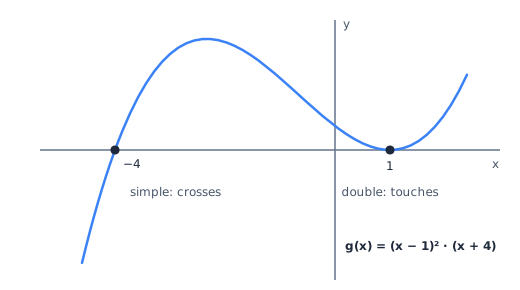
A numerical check at the double zero: and are both positive. To the left and to the right of , thus has the same sign.
Your turn5 of 14
How does the graph of behave at its zeros?
The sign table shows where the graph lies above the axis
Between two neighbouring zeros the sign cannot change, since for that the graph would have to meet the axis. It is therefore enough to test a single number in each section, or, faster still, to read off for each factor whether it is positive or negative there. For :
| Range | ||||
|---|---|---|---|---|
Only the negative factors are counted: if their number is even, the product is positive; if it is odd, negative. At the far right all factors are positive, which agrees with the leading term . A negative constant in front of the product would flip every row of the last column.
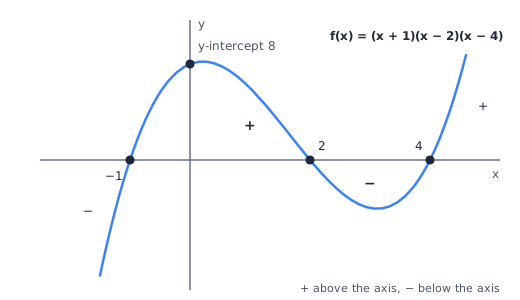
Multiplied out, the same formula reads , and stands at the back as the constant term. In the product form you compute the same value as .
Your turn6 of 14
For which is positive?
An integer zero divides the constant term
If a cubic polynomial is given multiplied out, the factorisation takes three steps: find a zero, split off the linear factor, break down the quadratic factor with formula (1).
There is a rule for the finding. If all coefficients are integers and the leading coefficient is , every integer zero is a divisor of the constant term. Substituting such a zero makes every summand except a multiple of , and their sum has to come to . For only , , and come into question.
The rule only excludes candidates; to find out whether one really is a zero, you have to substitute it. , so is not one. , so is one, and the factor theorem makes a divisor.
The quadratic factor comes from polynomial division (Polynomdivision): is divided by . You divide as with numbers: highest power by highest power, multiply back, subtract, carry on with what is left.
- . Multiplied back , after subtracting is left.
- . Multiplied back , after subtracting is left.
- . Multiplied back , after subtracting is left.
Horner's scheme (Horner-Schema) is shorter. You write the coefficients , , , in a row and the point in front of it. You bring down the first coefficient, then multiply the latest result by each time and add the next coefficient.
| Point | ||||
|---|---|---|---|---|
| times | ||||
| sum |
The last number in the bottom row is the remainder, the others are the coefficients of the quotient (Quotient): , remainder . The quotient has degree , one less than . Formula (1) gives its zeros , that is and , and so .
If a polynomial is divided by , the remainder equals . In particular, the division leaves no remainder exactly when is a zero of .
This lets you find the remainder without any division. Divide the same by and the remainder is ; Horner's scheme at the point gives the row , , , , so . If the divisor carries a plus sign, , it has the form , and the remainder belongs to the point .
Your turn7 of 14
What remainder does leave on division by ?
Your turn8 of 14
A polynomial with integer coefficients and leading coefficient has the constant term . Which integer cannot be a zero?
Biquadratic equations become quadratic by substitution
An equation of the form , in which only the exponents , and occur. The substitution turns it into the quadratic equation .
It is solved in two stages: first the quadratic equation in , with formula (1) or by factorising, then the equation for each solution . The second stage is easily forgotten, and it is precisely the one that decides the number of solutions.
- yields two solutions, and .
- yields the solution , as an at least double zero.
- yields none, because is never negative.
Two examples. becomes , so or , which gives the four solutions , , and ; factorised, the expression reads . becomes . Only leads anywhere, to and ; gives no real solution, and the factor stays unfactorised.
Sometimes no substitution is needed at all. In the terms and , even powers with positive factors, are never negative, and is positive; the sum is therefore positive everywhere and has no zero.
Your turn9 of 14
How many real solutions does the equation have?
Symmetry is read off the exponents
The graph of is symmetric about the -axis (achsensymmetrisch) if holds for every . For a polynomial this is the case exactly when only even exponents occur; the constant term counts as , that is with an even exponent.
The graph is point-symmetric about the origin (punktsymmetrisch zum Ursprung) if holds for every . For a polynomial this means: only odd exponents occur, and there is no non-zero constant term.
If even and odd exponents occur mixed, neither symmetry holds. is symmetric about the axis, point-symmetric, neither. A single number is enough as a counterexample: for we have , but .
A point-symmetric polynomial always passes through the origin, because allows only . If the formula is a product, multiply it out or check directly: contains only odd exponents.
Your turn10 of 14
Which graph is point-symmetric about the origin?
Zeros fix a polynomial only up to a factor
If you know all zeros of a polynomial together with their multiplicities, you know its linear factors, but not yet the stretch factor in front of them. A cubic polynomial with the double zero and the simple zero has the shape , and for , or the zeros sit at the same points. The factor stretches the graph vertically and, if it is negative, reflects it in the -axis.
is fixed by a single additional function value at a point that is not a zero. Suppose is required. Substituting gives , and yields .
The multiplied-out form serves as a check: stands at the front, so the factor found is the leading coefficient, and is right. The double linear factor enters squared when you substitute, so its contribution is positive on both sides of the zero.
Your turn11 of 14
A cubic polynomial has a double zero at and a simple zero at , and . What is the value of in the ansatz ?
The degree of a product is the sum of the degrees, common points are zeros of the difference
| Result from (degree ) and (degree ) | Degree of the result |
|---|---|
| product | exactly |
| square | exactly |
| sum or difference with | exactly |
| sum or difference with | at most , often smaller |
| quotient | in general not a polynomial at all |
In a product the leading term always survives, because two non-zero leading coefficients have a non-zero product. With equal degrees, however, the leading terms can cancel: has only degree left. is not a polynomial function, because the division leaves the remainder . Only when the denominator divides the numerator does a polynomial come out again, just as agrees with except at the point .
Where the graphs of two polynomials meet, holds, that is . The common points lie at the zeros of the difference, and its degree limits their number. A double zero of the difference means the graphs touch there, a simple one that they cross.
The parabola and the line have the difference . Its only zero is double: the line is a tangent to the parabola at the point , and since is nowhere negative, the parabola runs above the line everywhere else. It is different for and : the difference has three simple zeros, the graphs cross at the points , and , and a difference of degree three cannot allow more than three crossings.
Your turn12 of 14
and are polynomial functions of degree three. Which statement holds for every such choice?
A cost function carries the fixed costs in its constant term
In economic tasks a cubic polynomial often describes the total costs (Gesamtkosten) of a firm, where is the quantity produced in quantity units (Mengeneinheiten). There is no negative quantity, so , and only this range counts for the claims.
Fixed costs are the costs that arise even at quantity zero, such as rent or machines. They equal , that is the constant term of the cost function.
The variable costs depend on the quantity and are zero at quantity zero. In the formula they are all the summands that contain .
The unit costs are the total costs spread over one quantity unit. They are defined only for .
Take . The fixed costs are , the variable costs . That becomes zero for no admissible quantity is visible from the signs: for none of the summands is negative, and the constant term is positive. With mixed signs this quick look fails, and factoring out helps. For we get . The bracket has the discriminant and the positive leading coefficient , so it has no zero and is positive everywhere. For the product with is therefore not negative, is at least the fixed costs and stays positive.
Unit costs behave differently from total costs. We have , and . At first they fall, because the fixed costs of are spread over more and more units; later they rise again, because the summand takes over. The total costs themselves grow all the while.
Your turn13 of 14
A firm has the cost function with . What are the unit costs at ?
The product form and the multiplied-out form answer different questions
First bring the formula into the two forms you need. From the product form you read off zeros, multiplicities and signs, from the multiplied-out form the degree, leading coefficient, constant term and symmetry. Then check each claim with the cheapest tool: by substituting where a value is claimed, at the leading term where the far ends are concerned, at the multiplicity where crossing and touching are mentioned. For "exactly", "at most" and "at least" you count distinct zeros, not multiplicities.
A complete example with , multiplied out .
- At the graph touches the -axis. Correct. The factor is squared, the zero is double, and the sign does not change there.
- has three distinct zeros. Incorrect. Only and are distinct; the multiplicities and add up to the degree .
- For strongly negative the values of become arbitrarily large. Correct. The leading term has odd degree and a negative leading coefficient, so on the left the graph heads up.
- . Incorrect. , which is also the constant term.
- For every , . Correct. There is positive and is not negative, and the minus sign in front makes the product at most zero; it becomes zero at .
Three of the five decisions came from the product form, two from the leading term and the constant term. Only one calculation was needed, for the value at the point .
Your turn14 of 14
Let , multiplied out . Which statement is true?
Common mistakes
- Confusing the leading coefficient with the first or the largest coefficient. It belongs to the highest power, wherever that stands in the formula.
- Misreading the -intercept. It is the constant term including its sign, not the leading coefficient; in the product form you substitute into every factor.
- Taking the degree for the number of zeros. It is an upper bound. There are often fewer distinct zeros, because factors occur more than once or have no real zero.
- Swapping crossing and touching. Even multiplicity touches, odd multiplicity crosses, the triple one included.
- Copying the sign in the linear factor. The zero belongs to , and with a divisor the remainder belongs to the point .
- Forgetting the back-substitution. With every positive yields two solutions, a negative one none.
- Overlooking a constant term when checking point symmetry. A single non-zero constant already destroys it.
What to take away
- Read off the formula. Degree and leading coefficient belong to the highest power, is the constant term. In the product form the degrees add up and the leading coefficients multiply.
- Far ends. Even degree: both ends in the same direction; odd degree: in opposite directions. The sign of the leading coefficient decides which.
- Counting zeros. At most as many as the degree, at least one for odd degree, possibly none for even degree.
- Multiplicity. Odd crosses, even touches. Between two neighbouring zeros the sign stays the same.
- Splitting off. Look for integer zeros among the divisors of the constant term, check by substituting, divide by polynomial division or Horner's scheme. The remainder on division by is .
- Two polynomials. The degree of the product is the sum of the degrees; common points are the zeros of the difference.
Was this article helpful?