Exponential and Logarithmic Functions (Exponential- und Logarithmusfunktionen)
In this topic the five claims usually sit under a process: a balance earning interest, a revenue that grows, a quantity that decays, or an equation with the unknown in the exponent. Whether a claim holds is nearly always settled by one of a few questions. Is something multiplied or added? Does a quantity depend on the starting value (Anfangswert) or only on the factor? Which logarithm rule actually exists, and which one only looks like a rule?
The formula sheet (Formelsammlung) offers exactly two lines on this topic, the derivatives and . It holds no rule for logarithms or powers, no formula for doubling time or half-life and no compound interest formula. The sum formula for the geometric series, which is on the sheet as well, belongs to financial mathematics and is of no help here. Everything else in this article is therefore yours to bring along. Values of logarithms that a task needs, such as , are printed in the task; you should know and yourself.
The task format works as the article on logic explains: a claim is correct if it holds in every admissible case, and a single case in which it fails refutes it. For arithmetic rules such a case is especially cheap. Plug in numbers for which both sides can be worked out in your head.
Exponential growth multiplies by the same factor at every step
A quantity grows or decreases exponentially if it is multiplied by the same factor in every unit of time, where and . After units of time it equals
Here is the starting value (Anfangswert), because .
The factor belongs to exactly one unit of time. In this article stands for a percentage written as a decimal: 25% is . If the quantity rises by per unit of time, then ; if it falls by , then . A rise of 25% thus gives , a loss of 15% gives .
| Factor | Behaviour | Example |
|---|---|---|
| growth | : plus 25% per unit of time | |
| decrease, also: decay (Zerfall) | : minus 15% per unit of time |
A quantity of that rises by in the first year can go on growing in two ways. Linearly, another are added in every further year. Exponentially with , every year 25% of the quantity present at that moment are added. The values are rounded to two decimal places.
| Year | linear | exponential | Increase in the year up to (exponential) |
|---|---|---|---|
In the linear column the quantity rises by the same amount every year. In the exponential column every value is times the previous one, and dividing a value by its predecessor always gives :
The increases in the last column, on the other hand, get larger. The increase in one year is , a fixed share of a quantity that is itself growing. For the term is negative: the loss is a fixed share of a quantity that is shrinking, and so it gets smaller from year to year.
Your turn1 of 12
A stock of raw material of tonnes decreases by 25% every year. By how many tonnes does it decrease in the third year?
Percentages multiply, they do not add
Because every unit of time contributes its own factor, the total change is the product of the individual factors. Three calculations follow from this.
- Several equal changes. If a price falls three times by 10% each, the factor left is . The price has dropped by 27.1%, not by 30%, because each cut acts on a price that is already lower.
- There and back. Plus 10% followed by minus 10% gives , a loss of 1%. After plus 25% it takes a cut of 20% to get back to the starting value, since .
- Shorter periods. Earning 3% per quarter gives more than 12% per year: , about 12.55%. The surplus is interest on the interest of the earlier quarters.
Compound interest arises when interest is credited to the capital and from then on earns interest itself. At the interest rate per period a capital grows in periods to . This is exponential growth with the factor .
The exponent counts units of time, and it may also be a fraction. If a quantity grows by the factor over four years, the factor for a single year is , so plus 10% per year. A quarter of the total increase, , would be too much, because the compounding of the four years is contained in it.
Your turn2 of 12
A price rises twice in a row by 10% each time. By what percentage is it then above the starting price?
The graph stays above the x-axis and passes through the point (0 | 1)
A function with a base and is called an exponential function. The variable sits in the exponent, not in the base; that is what separates it from a power function (Potenzfunktion) such as .
A line is called an asymptote of a graph if the graph comes arbitrarily close to it. This can happen for very large or very small (horizontal asymptote) or when approaches a fixed point (vertical asymptote). An example of the second case is for close to : there the graph approaches the y-axis.
The sketch shows and . The second base is the reciprocal of the first, so the second graph is the mirror image of the first in the y-axis.
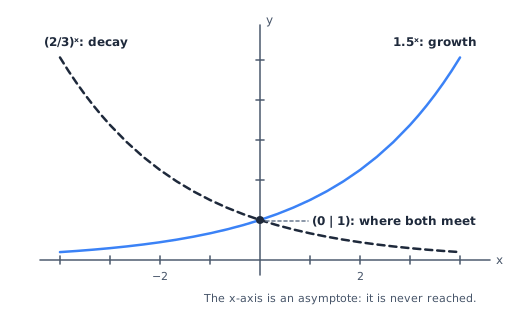
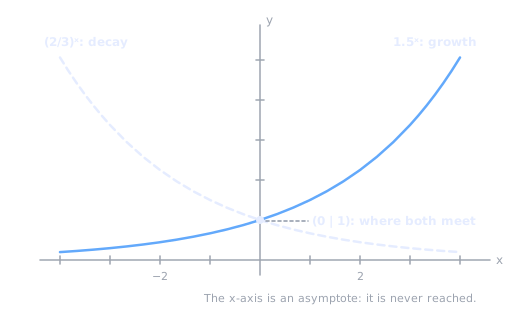
- Always positive. For every real , . That is why has no zero (Nullstelle), and a quantity with a positive starting value stays above zero for all time.
- The point . Because , the point lies on every such graph; there it meets the y-axis, the vertical axis (senkrechte Achse). For it is the point .
- The x-axis as asymptote. The x-axis is the horizontal axis (waagrechte Achse). For the graph comes arbitrarily close to it towards the left, for towards the right.
- Strictly monotonic (streng monoton). For the function increases, for it decreases. Every value is therefore taken at most once, and implies .
- Range (Wertebereich). takes exactly the positive numbers as values.
Two changes to the term look alike and do different things. lowers the graph by ; the asymptote becomes the line , and unlike this graph has a zero. shifts it to the right. Since , all function values are divided by in the process, and the asymptote stays the x-axis.
Your turn3 of 12
Which line is an asymptote of the graph of ?
Doubling time and half-life depend only on the factor
The doubling time is the span of time after which an exponentially growing quantity is twice as large as at the start of that span.
The half-life is the span of time after which half of an exponentially decreasing quantity is left.
We are looking for a span with . Inserting the formula gives on the left and on the right. Dividing both sides by leaves . Neither the starting value nor the moment appears in this condition; only decides it. The same holds for the half-life, with .
The starting value determines the height of the curve instead: is proportional to . A quantity with three times the starting value lies three times as high at any instant and takes exactly as long to double.
If the half-life is known, the decrease is most conveniently written like this:
As a check, insert multiples of : at the factor is , at it is . In general the same construction works for any factor :
An example: a radioactive sample has an activity of becquerels and a half-life of minutes.
| Time in minutes | |||||
|---|---|---|---|---|---|
| Activity in becquerels | |||||
| Decrease in the preceding 12 min |
Here the decrease per span halves along with the quantity as well. The formula also holds between the columns. After minutes, a third of the half-life, the factor is ; about becquerels are left, not the that an even decrease by a third of would give. Three such thirds together have to give the factor , and indeed .
Your turn4 of 12
A quantity halves every years. What share of the starting value is still there after years?
Ever more frequent compounding leads to the number e and the continuous growth rate
The nominal annual interest rate is the agreed rate that, with interest dates per year, is split into equal parts: each date earns .
The effective annual interest rate is the growth the capital actually experiences in one year. With interest dates the annual factor is , so the effective rate is .
For a nominal annual interest rate of 12%, that is , this gives:
| Compounding | Rate per date | Annual factor | Effective annual rate |
|---|---|---|---|
| annually, | 12% | 12% | |
| semi-annually, | 6% | 12.36% | |
| quarterly, | 3% | 12.55% | |
| monthly, | 1% | 12.68% | |
| continuously | 12.75% |
As soon as interest is credited more than once a year, the effective rate lies above the nominal one, and it rises with . It does not rise beyond every bound, though: the annual factors approach a fixed value. The same phenomenon defines the number .
The number is the value that approaches as grows. For the result is , for about , for about .
Continuous compounding (stetige Verzinsung) is this limiting case: interest is credited at every instant, and after years the capital equals . For every finite the annual factor stays below . The effective annual rate under continuous compounding is , so about 12.75% for .
Many models write the quantity with base , as . This is not a new type of growth but the same form in different notation, since . The number is called the continuous growth rate (stetige Wachstumsrate); the factor per unit of time is , and conversely , with the natural logarithm from the next section.
- Sign. means growth and decrease, because holds exactly for .
- The rate is not the percentage. For the factor per year is . The quantity therefore grows by about 10.52% per year, not by 10%.
- Rate and percentage are close only for small . is almost , but is far from .
Your turn5 of 12
For a quantity, , in years. By what percentage does it grow in one year?
The logarithm reverses raising to a power
For a base with and a number , is the exponent to which must be raised to give :
Thus , because , and , because .
is the logarithm to base , the natural logarithm. stands for the logarithm with base , the common one. We have and , and likewise and .
Two functions are inverses of each other if each undoes what the other does. For and this means:
The condition appears only with the second equation. exists only for positive , while has a value at every real number , and a positive one.
A function and its inverse swap the roles of and . Their graphs are therefore mirror images in the line , the bisector of the first quadrant (Winkelhalbierende, also called erste Mediane): the point on the graph of becomes the point on the graph of .
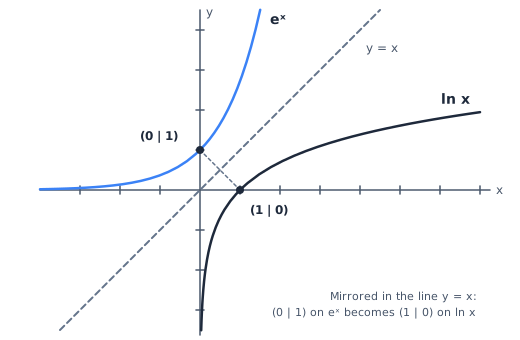
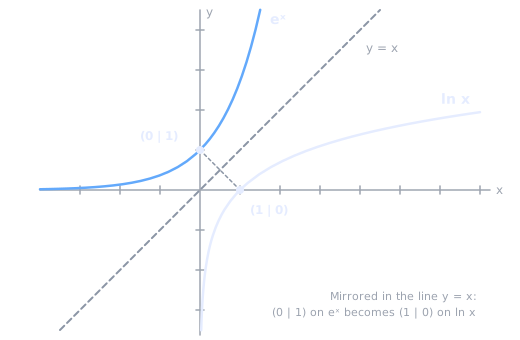
Almost everything asked about follows from this reflection.
- Domain (Definitionsbereich). Positive numbers only. The values of are exactly the positive numbers, and they form the domain of . and do not exist, because no power of is zero or negative.
- Zero and sign. holds exactly at . Between and , is negative, because a number below calls for a negative exponent, for instance . For , is positive.
- No upper limit, but very flat. is strictly increasing and takes every real value; the value , for instance, belongs to , about 22,000. The curve becomes very flat: .
- On both sides of the mirror line. The graph of lies entirely below the line , that of entirely above it: for .
- The y-axis as asymptote. For close to zero, falls below every bound.
The two derivatives on the formula sheet fit this picture. means: at every point the slope equals the function value. is positive for , confirming the increase, and gets smaller as grows, which is why the graph of keeps flattening.
Your turn6 of 12
Which statement about and is true?
Powers with the same base are combined through their exponents
The power rules hold for every positive base, not only for . Here they are written for and arbitrary real exponents and , with a check for and :
| Rule | Check with , |
|---|---|
Three common mistakes look like rules and are not:
| Common mistake | Counter-check |
|---|---|
| : left , right | |
| , : left , right | |
| : left , right |
A check with concrete numbers settles such a claim in seconds. Pick numbers for which the two sides do not agree by coincidence. With , for example, , and the second mistake would look right. A check that works out proves nothing; one that does not work out refutes.
For a sum there is no power rule; it stays as it is. And because is strictly increasing, always implies .
Your turn7 of 12
Which expression equals for every real number ?
Logarithms turn products into sums, and the change of base follows from that
Because the logarithm counts exponents, it translates the power rules: multiplying becomes adding, dividing becomes subtracting, raising to a power becomes multiplying. For positive numbers , and every real number :
The same rules hold for and for every logarithm . With and you get, for instance, , and . The quotient rule also gives : reciprocals have opposite logarithms.
| Common mistake | Check with , | What holds instead |
|---|---|---|
| left , right | there is no rule for | |
| left , right | is the sum | |
| left , right | the exponent becomes a factor: |
A logarithm to another base is computed via . If , then . Taking logarithms of both sides gives , and this yields the change of base (Basiswechsel):
An example: . That fits, because .
Your turn8 of 12
Which equation holds for all positive numbers and ?
Exponential equations are solved by taking logarithms and checked by bracketing
When the unknown sits in the exponent, two routes lead to the solution.
- Make the bases equal. If the right-hand side can be written as a power of the same base, compare the exponents. becomes and hence . This is allowed because an exponential function takes every value only once.
- Take logarithms. Otherwise apply to both sides and bring the exponent to the front with the power rule: becomes .
For with and this gives .
- Bracketing. Since and increases, the solution lies between and . This check needs no logarithms and is often enough for the decision.
- Solvable or not. has exactly one real solution for every and none for , because is always positive.
- Multiplying the right-hand side. Replacing by shifts the solution by , that is by a constant. For , for example, the factor shifts the solution by , the factor by .
- Logarithmic equations are solved the other way round, by raising the base to both sides. From it follows that , from that .
Doubling time and half-life come out the same way. becomes ; becomes , which is positive because for a decrease. comes out in the unit of time that belongs to: if is the factor of a quarter, counts quarters, and only is in years. For a quantity growing by 50% per year, , and with this gives years. Bracketing confirms it, . If the question is in which year the doubling falls, count: the first year runs from to , so the moment lies in the second year.
Your turn9 of 12
Between which two whole numbers does the solution of lie?
Your turn10 of 12
The equation with has the solution . What is the solution of ?
The higher growth factor catches up with any lead
Firm A sells units today and raises its sales by 20% per year; firm B sells units and raises them by 4% per year. Today A adds units and B adds units: at the moment B grows more in absolute terms, although its percentage is smaller. The two are level when
So A overtakes B in the fourteenth year, and after that the gap keeps widening, because the ratio grows without bound.
An exponential function with a base above eventually overtakes every power function , even if the latter stays ahead for a long time. On the way the graphs can intersect more than once. For and a table of values shows where:
Between and the order changes for the first time, between and for the second time; more precisely the intersections lie at about and . After that stays ahead for good. When moves on by , doubles, while grows by the factor , and that factor is below from on.
Your turn11 of 12
Firm A sells units today and raises its sales by 10% per year; firm B sells units and raises them by 2% per year. In which year does A overtake B? Use , and .
How to check a claim about growth and logarithms
- Insert . This gives the starting value and shows whether you have read the formula correctly.
- Factor or amount? In an exponential process the amount added or lost per span changes; only the factor stays the same.
- What depends on the starting value? Doubling time, half-life and percentage do not; every single value and every absolute increase do, and proportionally so.
- Whole-number points. Powers with whole exponents are easy to compute and bracket every solution. This checks a solution, the year of an event and the location of intersections.
- Check rules with a number. An arithmetic rule that fails for a single unluckily chosen number is false. Use numbers whose logarithms or powers you know, such as , , .
Your turn12 of 12
Someone checks the claim “ for all ” with and gets on both sides. What follows?
Common mistakes
- Adding percentages. Several changes are multiplied as factors: three times minus 10% is minus 27.1%, and 3% per quarter is more than 12% per year.
- Taking a fraction of the factor. A quarter of a unit of time goes with , not with .
- Taking the continuous rate for the percentage. For the factor per unit of time is , and is close to only when is small.
- Splitting a logarithm that cannot be split. There is no rule for , and is not .
- Bringing the exponent down without a logarithm. is not . Bracketing between two whole-number powers exposes the mistake at once.
- Letting an exponential quantity fall to zero. stays positive when the starting value is positive; the time axis is an asymptote, not a zero.
- Confusing a shift in the exponent with a shift up or down. shifts horizontally, lowers the graph and its asymptote with it.
Key takeaways
- Exponential means the same factor per unit of time. , growth for , decrease for . From step to step the increase changes, the factor does not.
- Doubling time and half-life depend only on : and respectively, measured in the unit of time of . A different starting value scales the values, not the times.
- The graph of is positive, passes through and has the x-axis as asymptote.
- The number is the limit of ; has the factor per unit of time.
- Logarithm means exponent: is defined only for positive numbers and undoes .
- Equations with the unknown in the exponent are solved by taking logarithms and checked by bracketing between whole-number powers.
Now practise it
Exponential and Logarithmic Functions (Exponential- und Logarithmusfunktionen)
PractiseWas this article helpful?